

The UK property market in 2026 presents an unprecedented challenge for chartered surveyors: how do you defend a valuation in court when Scotland and Northern Ireland are experiencing robust growth while London and the South East languish in decline? This widening regional price divergence is creating complex legal disputes where expert witness valuations must stand up to intense scrutiny.
As regional markets move in opposite directions, expert witnesses face increasing pressure to justify valuations that may seem contradictory when viewed through a national lens. The stakes are higher than ever, with courts demanding rigorous adherence to professional standards and comprehensive evidence to support regional assessments. Understanding Expert Witness Valuations in the North-South Price Divide: RICS Standards for Defending Divergent Regional Assessments has become essential for surveyors navigating this complex landscape.
Key Takeaways
- 📊 Regional divergence is widening in 2026, with Scotland and Northern Ireland showing strong growth while London and the South East experience market stagnation, creating complex valuation challenges for expert witnesses
- ⚖️ RICS launched updated expert witness standards in 2025, reinforcing that the primary duty is to the tribunal, not the client, with enhanced guidance on fees, conflicts of interest, and modern practices including AI use
- 🎯 Defending divergent regional assessments requires comprehensive market evidence, including local comparables, economic indicators, and clear documentation of regional factors affecting property values
- 🛡️ Professional compliance protects expert witnesses from legal challenges, with courts in 2026 expecting strict adherence to RICS valuation standards and practice statements
- 📚 RICS Accredited Expert Witness status provides industry-recognized credibility through specialized training and certification programs
Understanding the 2026 North-South Property Price Divide

The UK property market has always exhibited regional variations, but 2026 has brought a particularly stark North-South price divide that challenges traditional valuation approaches. While historical patterns showed London and the South East commanding premium prices with consistent growth, the current landscape tells a dramatically different story.
Current Regional Market Dynamics
Scotland and Northern Ireland are experiencing robust property price growth driven by several converging factors:
- 🏘️ Affordable housing stock attracting first-time buyers and investors
- 💼 Growing employment opportunities in tech and renewable energy sectors
- 🌍 International investment seeking value outside overheated Southern markets
- 🏗️ Infrastructure development improving connectivity and desirability
Conversely, London and the South East face significant headwinds:
- 📉 Price stagnation or modest declines in many submarkets
- 💰 Affordability crisis limiting buyer pools
- 🏢 Hybrid working reducing demand for proximity to central business districts
- 📊 Oversupply in certain property segments
This divergence creates substantial challenges for expert witnesses who must defend valuations that reflect these dramatically different regional realities. A surveyor providing professional valuation services must now demonstrate deep understanding of local market dynamics rather than relying on national trends.
Historical Context and Market Evolution
Understanding what house prices are doing requires examining the evolution from 2023 through 2026. The post-pandemic reshuffling of priorities, combined with economic pressures including interest rate fluctuations and cost-of-living challenges, has fundamentally altered regional market dynamics.
Regional Price Performance Comparison (2023-2026)
| Region | Average Growth | Key Drivers | Market Outlook |
|---|---|---|---|
| Scotland | +8.2% | Affordability, infrastructure investment | Strong |
| Northern Ireland | +7.5% | Economic growth, housing demand | Positive |
| North England | +4.3% | Regeneration, improved connectivity | Stable |
| Midlands | +2.1% | Mixed economic signals | Cautious |
| South East (excl. London) | +0.8% | Affordability constraints | Flat |
| London | -1.2% | Oversupply, affordability crisis | Challenging |
These divergent trends mean that expert witnesses must build cases using region-specific evidence rather than national benchmarks. Courts in 2026 expect expert witnesses to demonstrate strict adherence to RICS valuation standards while acknowledging legitimate regional variations[1].
RICS Standards for Expert Witness Valuations in Regional Disputes
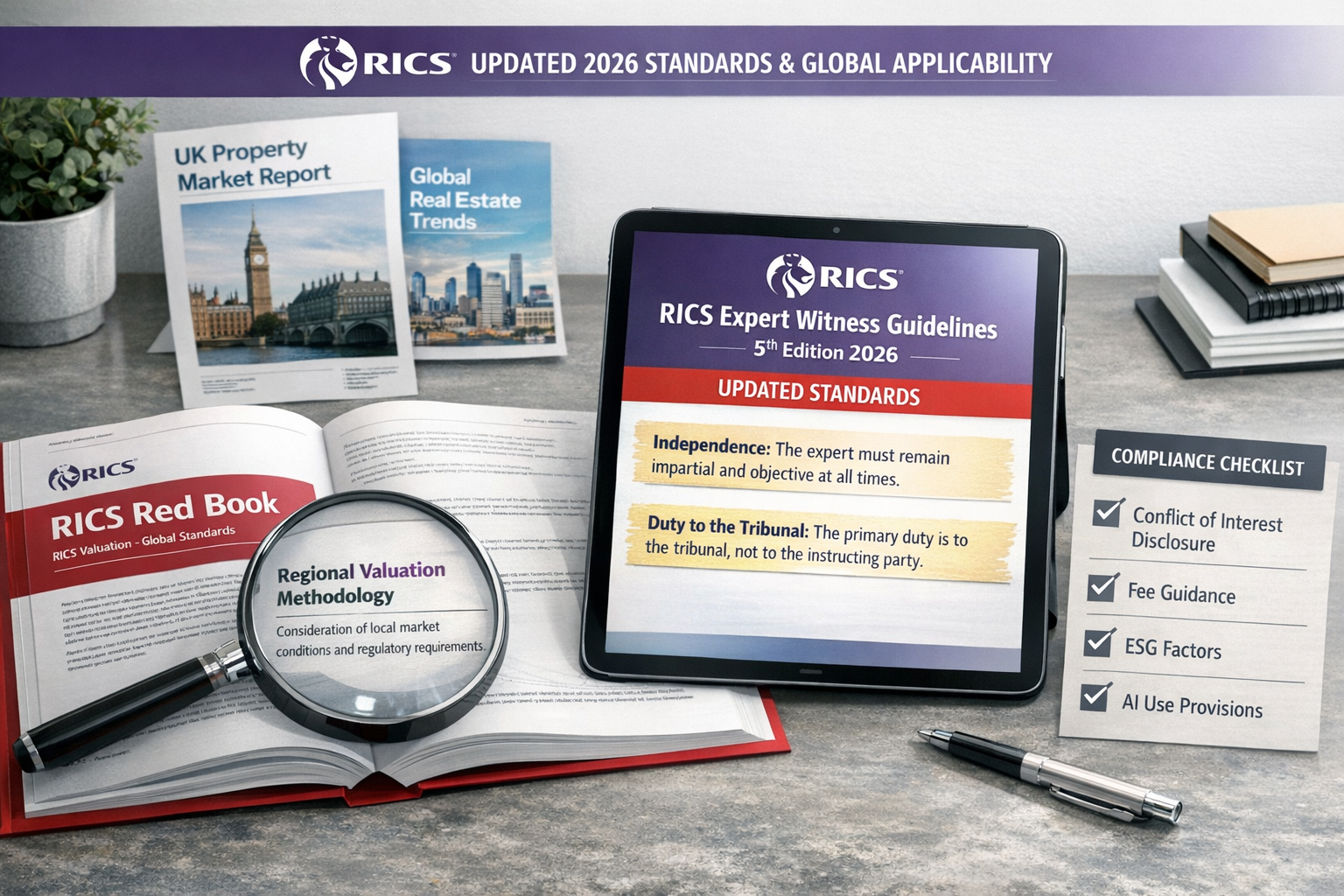
The Royal Institution of Chartered Surveyors (RICS) launched a global consultation on August 26, 2025, for the 5th edition of its "Surveyors acting as expert witnesses" professional standard, marking the first major update since 2014[2]. This updated framework provides crucial guidance for navigating Expert Witness Valuations in the North-South Price Divide.
Primary Duty to the Tribunal
The cornerstone principle reinforced in the updated standard is unequivocal: the expert witness's primary duty is to the tribunal, not the client[2]. This principle becomes particularly critical when defending divergent regional assessments that may not align with client expectations or national trends.
"All reports and evidence must be independent, unbiased, and within the surveyor's true expertise, regardless of regional market conditions or client preferences."
This independence requirement means that when valuing a property in a declining Southern market, the expert witness cannot inflate values to match historical norms or client expectations. Conversely, when assessing Northern properties experiencing rapid appreciation, the surveyor must provide robust evidence supporting higher valuations even if they seem anomalous compared to national averages.
Global Applicability with Local Flexibility
The 5th edition applies worldwide while recognizing local legal differences and various legal systems[2]. This framework is particularly relevant for regional UK valuations, as it acknowledges that:
- 📍 Local market conditions legitimately drive valuation differences
- ⚖️ Regional legal frameworks may vary (particularly in Scotland)
- 🌐 International investment patterns affect different regions differently
- 📊 Economic indicators must be assessed at appropriate geographic scales
Expert witnesses can confidently defend regional assessments by demonstrating how local factors align with RICS principles while producing different numerical outcomes.
Enhanced Fee Guidance and Conflict of Interest Disclosure
The updated standard provides clear guidance on conditional and deferred fees to protect professional independence[2]. This is crucial when handling regional valuation disputes, as clients may pressure experts to deliver valuations supporting specific outcomes.
Key provisions include:
- 💼 Fee independence: Compensation cannot be contingent on valuation outcomes
- 🔍 Conflict disclosure: Clear requirements for identifying and disclosing conflicts of interest
- 📋 Transparent engagement: Written terms clarifying the expert's duty to the tribunal
- 🛡️ Professional protection: Safeguards against client pressure to modify independent assessments
When defending a lower-than-expected London valuation or a higher-than-anticipated Scottish assessment, these fee and conflict provisions protect the expert's ability to maintain professional independence.
Modern Practice Provisions
The updated RICS standard covers AI use, digital evidence, and new legal procedures with emphasis on quality and relevance of expert evidence[2]. For regional valuations in 2026, this includes:
- 🤖 Using AI-powered valuation tools while maintaining professional judgment
- 📱 Presenting digital evidence including market analytics and comparable sales data
- 📊 Leveraging regional property databases and market intelligence platforms
- 🖥️ Conducting virtual inspections where appropriate (with proper disclosure)
These modern provisions enable expert witnesses to build comprehensive cases using contemporary tools while maintaining the rigor expected by courts and tribunals.
Environmental, Social, and Governance (ESG) Factors
The new edition includes a clear, practical framework for how ESG factors should be reflected in valuation advice worldwide[2]. Regional variations in ESG considerations can significantly impact valuations:
- 🌱 Northern regions with renewable energy infrastructure may command premiums
- 🏢 London properties with poor energy efficiency face increasing market resistance
- 🌍 Regional sustainability initiatives affect long-term value prospects
- 📈 ESG-conscious investors increasingly favor certain geographic markets
Expert witnesses must incorporate these factors into regional assessments, demonstrating how ESG considerations legitimately contribute to the North-South price divide.
Defending Divergent Regional Assessments: Building Bulletproof Cases
Successfully defending Expert Witness Valuations in the North-South Price Divide requires meticulous preparation, comprehensive evidence gathering, and clear communication of regional market realities. The following framework helps expert witnesses build cases that withstand scrutiny.
Comprehensive Market Evidence Collection
The foundation of any defensible regional valuation is robust market evidence specific to the property's location. This goes far beyond simple comparable sales analysis.
Essential Evidence Categories:
-
Local Comparable Sales
- Recent transactions within appropriate geographic radius
- Properties with similar characteristics and condition
- Adjustment documentation for differences
- Time-adjusted comparables accounting for market movement
-
Regional Economic Indicators
- Employment trends and major employer activity
- Population growth or decline patterns
- Infrastructure investment and development plans
- Average income levels and affordability metrics
-
Supply and Demand Analysis
- Current inventory levels and absorption rates
- New construction activity and planning permissions
- Rental market dynamics and yields
- Buyer and seller sentiment indicators
-
Regulatory and Policy Factors
- Regional housing policies and incentives
- Planning restrictions affecting supply
- Tax implications specific to the region
- Environmental regulations impacting development
When providing commercial valuations or residential assessments, this comprehensive evidence base demonstrates professional rigor and supports divergent regional conclusions.
Methodology Documentation and Transparency
Courts in 2026 expect complete transparency in valuation methodology[1]. Expert witnesses must clearly document:
- 📝 Valuation approach selection: Why specific methods (comparative, income, cost) were chosen for the regional context
- 🔢 Adjustment calculations: Detailed explanation of how comparable properties were adjusted
- 📊 Weighting rationale: How different evidence sources were weighted in reaching conclusions
- ⚠️ Limitations and assumptions: Clear disclosure of data limitations and necessary assumptions
This documentation should explicitly address regional factors, explaining how local market conditions influenced methodology choices and valuation conclusions.
Addressing Challenges to Regional Assessments
Expert witnesses must anticipate and prepare for common challenges to divergent regional valuations:
"Why is this property valued lower than similar properties were three years ago?"
Response framework:
- Present clear market trend data showing regional price movements
- Provide comparable sales demonstrating current market reality
- Explain economic and demographic factors driving regional decline
- Reference authoritative market reports supporting regional assessment
"How can properties in the North be worth more when London has always commanded premiums?"
Response framework:
- Document historical price trends showing changing regional dynamics
- Present evidence of Northern market drivers (employment, infrastructure, affordability)
- Explain investor behavior shifts and demand migration
- Provide comparable evidence from both regions demonstrating current reality
"Your valuation seems inconsistent with national averages."
Response framework:
- Demonstrate why national averages are inappropriate for local assessment
- Present regional market data showing local conditions
- Explain statistical concepts (mean vs. median, regional variation)
- Reference RICS guidance on appropriate geographic scope for comparables
Understanding average price reductions after survey can also inform realistic valuation adjustments based on property condition within regional contexts.
Professional Report Structure
A well-structured expert witness report following RICS standards should include:
1. Executive Summary
- Property details and inspection date
- Valuation conclusion with clear regional context
- Summary of key factors supporting assessment
2. Instructions and Scope
- Clear statement of instructions received
- Confirmation of independence and tribunal duty
- Scope of investigation and limitations
3. Property Description
- Detailed property characteristics
- Location analysis and regional context
- Condition assessment findings
4. Market Analysis
- Regional market overview and trends
- Comparable evidence presentation
- Supply and demand dynamics
- Economic and demographic factors
5. Valuation Methodology
- Approach selection and justification
- Detailed calculations and adjustments
- Sensitivity analysis for key assumptions
- Regional factors integration
6. Conclusions
- Final valuation figure with confidence range
- Summary of supporting evidence
- Regional context restatement
- Limitations and caveats
7. Appendices
- Comparable sales details
- Market data sources
- Professional qualifications
- Conflict of interest declaration
This structure ensures comprehensive coverage while maintaining clarity for tribunal members who may not have specialist property knowledge.
Leveraging RICS Accredited Expert Witness Status
RICS offers a 12-week Expert Witness Certificate course leading to RICS Accredited Expert Witness status, an industry-recognized benchmark of quality[5]. This accreditation provides:
- ✅ Enhanced credibility in court proceedings
- 📚 Comprehensive training in legal procedures and evidence presentation
- 🎓 Ongoing professional development requirements
- 🏆 Recognition of specialist expertise in expert witness work
For surveyors regularly involved in regional valuation disputes, this accreditation demonstrates commitment to professional excellence and can strengthen the weight given to testimony.
Regional Valuation Challenges: Practical Case Studies
Examining practical scenarios helps illustrate how Expert Witness Valuations in the North-South Price Divide: RICS Standards for Defending Divergent Regional Assessments apply in real-world situations.
Case Study 1: London Property Dispute – Declining Market Valuation
Scenario: A divorce settlement requires valuation of a London property purchased in 2022 for £1.2 million. The expert witness values it at £1.15 million in 2026, reflecting market decline. The selling party challenges this, arguing the property should have appreciated.
Expert Witness Approach:
-
Market Evidence Presentation
- Compiled 15 comparable sales showing 2-5% declines in the specific London submarket
- Presented regional price indices demonstrating market softening
- Documented increased inventory and longer selling times
-
Economic Context
- Explained hybrid working impact on London residential demand
- Detailed affordability constraints limiting buyer pool
- Referenced interest rate environment affecting purchasing power
-
Methodology Transparency
- Used comparative approach with detailed adjustment schedule
- Applied time adjustments reflecting market decline
- Conducted sensitivity analysis showing valuation range
-
RICS Compliance
- Clearly stated primary duty to tribunal
- Disclosed all assumptions and limitations
- Maintained independence despite client pressure for higher valuation
Outcome: The tribunal accepted the valuation, recognizing the expert's comprehensive regional evidence and adherence to RICS standards. The case demonstrated that declining valuations are defensible when supported by robust local market data.
Case Study 2: Scottish Property Development – Rising Market Assessment
Scenario: A property development dispute in Edinburgh requires valuation of development land. The expert witness values it 25% higher than a valuation conducted 18 months earlier, reflecting rapid regional appreciation.
Expert Witness Approach:
-
Development Market Analysis
- Documented recent land sales showing substantial price increases
- Presented planning permission approval rates and timelines
- Analyzed residential development demand in the area
-
Regional Growth Drivers
- Detailed Edinburgh's tech sector expansion
- Documented infrastructure improvements enhancing site accessibility
- Explained housing shortage driving development demand
-
Valuation Methodology
- Applied residual method appropriate for development land
- Used current sales values for completed units (showing appreciation)
- Adjusted construction costs for current market conditions
- Applied appropriate developer's profit margin
-
Challenge Response
- Anticipated challenge regarding rapid appreciation
- Prepared comparative analysis with other Scottish markets
- Referenced national statistics showing regional divergence
- Maintained professional independence throughout
Outcome: The higher valuation was accepted based on comprehensive regional evidence and clear methodology. The case illustrated how RICS standards support divergent assessments when properly evidenced.
Case Study 3: Cross-Regional Portfolio Valuation
Scenario: A pension fund requires valuation of a mixed portfolio including properties in Manchester, Birmingham, and London for SIPP pension valuations.
Expert Witness Approach:
-
Regional Segmentation
- Treated each region as distinct market with separate analysis
- Avoided averaging or blending regional trends
- Presented clear regional performance comparison
-
Portfolio-Level Insights
- Demonstrated how regional diversification affected overall value
- Explained risk-return profiles of different regional holdings
- Provided strategic context for regional performance differences
-
Consistent Methodology Application
- Applied same valuation principles across all regions
- Adjusted methodology where regional market characteristics required
- Documented regional differences in approach
-
Professional Standards Adherence
- Maintained independence for each property assessment
- Disclosed regional market limitations and data quality variations
- Provided confidence ranges reflecting regional market liquidity differences
Outcome: The portfolio valuation was accepted, with the tribunal appreciating the nuanced regional approach that recognized market differences while maintaining methodological consistency.
Professional Risk Management and Compliance
Navigating Expert Witness Valuations in the North-South Price Divide requires careful attention to professional risk management and regulatory compliance.
Understanding Legal Consequences
The updated RICS standard strengthens protections including risk mitigation for high-volume cases, template usage guidance, and clearer legal consequences for non-compliance[2]. Expert witnesses face potential consequences for:
- ⚠️ Failing to maintain independence: Disciplinary action and loss of professional standing
- 📋 Inadequate evidence: Rejection of testimony and potential cost awards
- 🚫 Conflicts of interest: Disqualification from proceedings and reputational damage
- ❌ Methodology failures: Professional negligence claims and insurance implications
Understanding these risks encourages rigorous adherence to RICS standards and comprehensive case preparation.
Housing-Specific Compliance Considerations
RICS members acting as expert witnesses in housing disrepair claims should note Awaab's Law (effective October 2025) and the Housing Health and Safety Rating System (HHSRS) to ensure reports meet current legal standards[2].
These regulations particularly affect:
- 🏘️ Social housing valuations and condition assessments
- 🔍 Disrepair claims requiring expert evidence
- 📊 Rental property valuations considering regulatory compliance
- ⚖️ Landlord-tenant disputes involving property standards
Expert witnesses must stay current with evolving housing regulations that may affect regional valuations differently based on local housing stock characteristics.
Template Usage and Quality Control
While templates can improve efficiency, the RICS standard provides guidance on template usage to ensure quality[2]. For regional valuations:
- ✏️ Templates must allow sufficient customization for regional factors
- 🔍 Standard sections should prompt consideration of local market conditions
- 📝 Boilerplate language must not override specific regional analysis
- ✅ Quality control processes should verify regional evidence adequacy
Templates should facilitate rather than constrain the comprehensive regional analysis required for defensible valuations.
Continuing Professional Development
Maintaining expertise in regional markets requires ongoing professional development:
- 📚 Regular review of regional market reports and data
- 🎓 Training on updated RICS standards and legal requirements
- 🗣️ Participation in regional property market forums
- 📊 Analysis of regional economic and demographic trends
- ⚖️ Understanding of evolving legal precedents in valuation disputes
The RICS Expert Witness Certificate provides structured CPD specifically focused on expert witness practice[5].
Technology and Innovation in Regional Valuation Evidence
Modern expert witnesses leverage technology to build stronger cases for divergent regional assessments while maintaining RICS compliance.
Data Analytics and Market Intelligence
Advanced data platforms enable:
- 📊 Regional market trend analysis: Real-time tracking of price movements, inventory levels, and transaction volumes
- 🗺️ Geographic visualization: Heat maps and spatial analysis showing regional variations
- 📈 Predictive analytics: Forecasting tools helping explain regional trajectories
- 🔍 Comparable search efficiency: Automated identification of relevant comparable evidence
These tools must be used judiciously, with the expert witness maintaining professional judgment and clearly disclosing methodology.
AI and Automated Valuation Models (AVMs)
The updated RICS standard addresses AI use in expert witness work[2]. For regional valuations:
- 🤖 AVMs can provide supporting evidence but cannot replace professional judgment
- 📊 Regional AVM accuracy varies significantly and must be validated
- 🔍 AI-generated comparables require expert review and adjustment
- ⚖️ Courts expect disclosure of AI tool usage and limitations
Expert witnesses should view AI as a tool enhancing efficiency rather than replacing the comprehensive regional analysis required for court proceedings.
Digital Evidence Presentation
Modern court proceedings increasingly involve digital evidence presentation:
- 💻 Interactive regional market data visualizations
- 📱 Virtual property tours and condition documentation
- 📊 Dynamic comparable sales analysis presentations
- 🗺️ Geographic information system (GIS) mapping of regional factors
These presentation methods can effectively communicate complex regional market dynamics to tribunal members, but must be balanced with clear written documentation.
Remote Inspections and Virtual Assessments
While physical inspection remains the gold standard, circumstances sometimes require remote assessment:
- 📹 Video inspection protocols with clear disclosure
- 📸 Photographic evidence with appropriate verification
- 🏠 Virtual tour technologies for preliminary assessment
- ⚠️ Clear limitation statements when remote inspection is used
Expert witnesses must clearly disclose when remote methods are employed and explain any impact on valuation confidence.
Future Trends and Emerging Challenges

The landscape of Expert Witness Valuations in the North-South Price Divide continues to evolve, with several emerging trends requiring attention.
Climate Change and Regional Resilience
Climate considerations increasingly affect regional valuations:
- 🌊 Flood risk variations across regions
- 🌡️ Energy efficiency requirements and retrofit costs
- 🌱 Regional renewable energy infrastructure
- 📉 Climate-related insurance availability and costs
Northern regions with lower climate risks may see relative value appreciation, while coastal Southern areas face increasing challenges.
Demographic Shifts and Migration Patterns
Population movements continue reshaping regional markets:
- 👥 Urban-to-rural migration affecting regional demand
- 🎓 Graduate retention rates in regional cities
- 👴 Aging population distributions and housing needs
- 🌍 International migration patterns and regional preferences
Expert witnesses must incorporate demographic analysis into regional valuations, explaining how population trends drive divergent market performance.
Infrastructure Investment and Connectivity
Major infrastructure projects create regional valuation impacts:
- 🚄 High-speed rail connections enhancing Northern accessibility
- 🛣️ Road network improvements affecting commutability
- 📡 Digital infrastructure and remote working enablement
- ✈️ Airport expansion and international connectivity
These factors contribute to the narrowing of the historical North-South divide and must be reflected in forward-looking valuations.
Regulatory Divergence
Post-Brexit regulatory evolution may increase regional variation:
- 🏴 Scottish housing policy divergence
- 🏴 Welsh sustainability requirements
- 🇬🇧 English planning reform impacts
- 🏴 Northern Ireland unique market dynamics
Expert witnesses must understand jurisdiction-specific regulations affecting regional valuations.
Professional Resources and Support
Surveyors engaged in expert witness work have access to comprehensive resources supporting regional valuation excellence.
RICS Guidance and Standards
Key resources include:
- 📘 RICS Valuation – Global Standards (Red Book): The foundational framework for all valuations[6]
- ⚖️ Surveyors acting as expert witnesses: The updated 5th edition professional standard[4]
- 📊 Sector-specific guidance: Tailored standards for different property types
- 🌍 Regional market reports: RICS-published market intelligence
These resources provide authoritative guidance for defending regional assessments.
Professional Development Opportunities
- 🎓 Expert Witness Certificate: 12-week comprehensive training program[5]
- 📚 Regional market seminars: Focused on specific geographic markets
- 🗣️ Peer discussion forums: Sharing experiences and best practices
- 📖 Case law reviews: Understanding legal precedents in valuation disputes
Ongoing engagement with these resources maintains professional competence.
Professional Indemnity Insurance
Adequate insurance coverage is essential:
- 🛡️ Coverage appropriate for expert witness work value and complexity
- 📋 Clear understanding of policy terms and exclusions
- ⚠️ Disclosure requirements for high-value or complex cases
- 💼 Run-off cover considerations for retiring practitioners
Insurance providers often offer risk management guidance supporting professional practice.
Peer Review and Quality Assurance
Many practices implement peer review processes:
- 👥 Internal review of expert reports before submission
- 🔍 External peer review for particularly complex or high-value cases
- ✅ Quality assurance checklists ensuring RICS compliance
- 📊 Post-case reviews identifying improvement opportunities
These processes strengthen report quality and reduce professional risk.
Conclusion
The widening North-South price divide in 2026 presents both challenges and opportunities for expert witnesses providing property valuations. Successfully navigating this landscape requires comprehensive understanding of regional market dynamics, rigorous adherence to RICS standards, and the ability to build bulletproof cases supporting divergent assessments.
The updated RICS expert witness standards provide a robust framework for maintaining professional independence while acknowledging legitimate regional variations. By focusing on comprehensive market evidence, transparent methodology, and clear communication, expert witnesses can confidently defend valuations that reflect regional realities rather than outdated national norms.
Actionable Next Steps
For surveyors engaged in expert witness work:
-
Review the updated RICS standards: Familiarize yourself with the 5th edition requirements and incorporate them into your practice[2][4]
-
Develop regional market expertise: Build comprehensive knowledge of the specific regions where you practice, including economic drivers, demographic trends, and market dynamics
-
Enhance evidence collection processes: Implement systematic approaches to gathering and documenting regional market evidence supporting your valuations
-
Consider RICS Accredited Expert Witness status: Pursue the Expert Witness Certificate to enhance credibility and expertise[5]
-
Invest in technology and data resources: Leverage modern tools for market analysis while maintaining professional judgment and RICS compliance
-
Establish peer review processes: Implement quality assurance measures ensuring reports meet professional standards before submission
-
Maintain continuing professional development: Stay current with regional market developments, regulatory changes, and evolving best practices
For those seeking expert valuation services, ensure your surveyor demonstrates:
- ✅ RICS membership and appropriate qualifications
- 📊 Deep understanding of relevant regional markets
- ⚖️ Clear commitment to tribunal duty and professional independence
- 📚 Familiarity with current RICS standards and legal requirements
- 🏆 Track record of successful expert witness work
The divergent regional markets of 2026 require expert witnesses who can navigate complexity with professional rigor and unwavering commitment to RICS standards. By building comprehensive regional evidence, maintaining methodological transparency, and focusing on tribunal duty above all else, surveyors can successfully defend divergent regional assessments while upholding the highest professional standards.
Whether you're valuing properties for capital gains purposes, right to buy assessments, or complex litigation matters, the principles outlined in this guide provide a foundation for professional excellence in an era of unprecedented regional market divergence.
References
[1] Expert Witness Roles In 2026 Northern Property Disputes Building Cases Amid Regional Price Divergence – nottinghillsurveyors.com
[2] Rics Launches Global Consultation On Updated Expert Witness Standard – rics.org
[3] Valuation Standards – isurv.com
[4] Surveyors Acting As Expert Witnesses – rics.org
[5] Expert Witness Certificate – rics.org
[6] Valuation Standards – rics.org