

The UK property market stands on the brink of its most significant transformation in generations. As the government unveils what it describes as "the biggest shake-up to the home buying system in this country's history," chartered surveyors face both unprecedented challenges and remarkable opportunities.[1] The RICS Homebuying Reforms 2026: How Mandatory Upfront Surveys Will Reshape Chartered Surveyor Workflows represents a fundamental shift that will require the profession to adapt rapidly, scale capacity, and reimagine service delivery models to meet surging demand for upfront property assessments.
For decades, the UK homebuying process has been plagued by inefficiency, uncertainty, and heartbreaking failures. Nearly one in three agreed sales collapse before completion, creating deep frustration, financial setbacks, and emotional strain for buyers and sellers alike.[2] These failures cost the economy a staggering £1.5 billion annually—a figure the reforms aim to halve through systematic improvements.[1] At the heart of this transformation lies a simple but powerful principle: provide comprehensive, professional property information upfront, before buyers commit emotionally and financially to a purchase.
The implications for chartered surveyors are profound. The RICS Homebuying Reforms 2026: How Mandatory Upfront Surveys Will Reshape Chartered Surveyor Workflows will fundamentally alter when surveys occur, who commissions them, how they're delivered, and what standards they must meet. This article explores the practical realities facing surveying practices as they prepare for this seismic shift, offering actionable guidance on workforce planning, operational transformation, and strategic positioning.
Key Takeaways
✅ Massive volume increase expected: Mandatory upfront surveys will dramatically increase demand for property assessments, requiring significant capacity expansion across the surveying profession.
✅ 24-month preparation window critical: RICS emphasizes that successful implementation requires a minimum two-year lead-in period for recruitment, training, and infrastructure investment.[3]
✅ Quality standards paramount: The reforms' success depends on high-quality, professional upfront information delivered by competent, regulated professionals working to consistent standards.[3]
✅ SME practices face unique challenges: Small and medium-sized surveying practices must carefully navigate capacity constraints while avoiding market disruption that could reduce consumer choice.[3]
✅ Workflow transformation required: Surveyors must adapt operational models to accommodate earlier-stage assessments, vendor-commissioned work, and integration with digital property logbooks.
Understanding the Government's Homebuying Reform Proposals
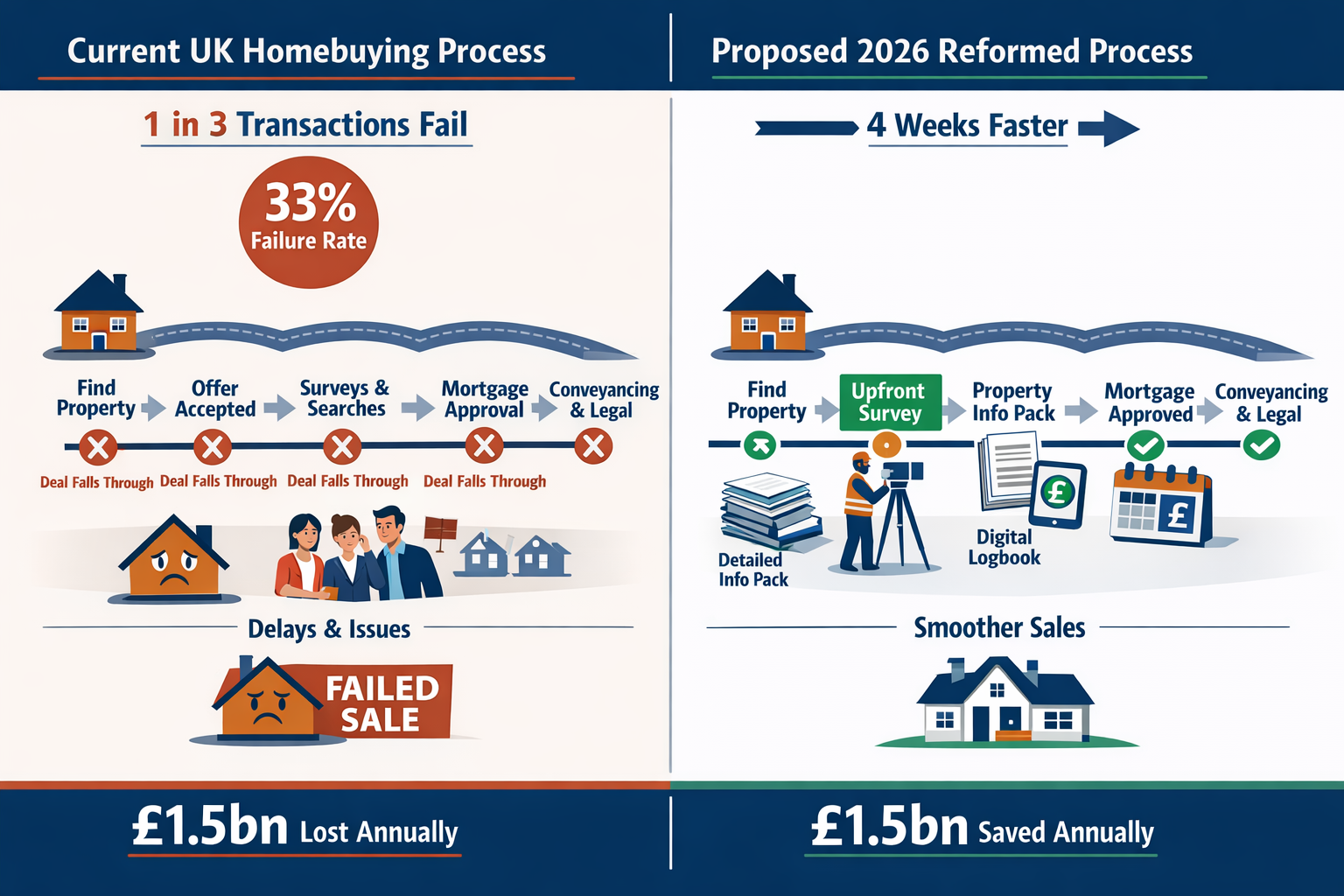
The Broken System: Why Reform Is Necessary
The current UK homebuying process has earned a reputation as one of the most frustrating, unpredictable, and costly in the developed world. Housing Secretary Steve Reed has been unequivocal in his assessment, describing the system as "broken" and a barrier preventing hardworking people from achieving homeownership.[1]
The statistics paint a damning picture:
- 32% of agreed sales fail to reach completion[2]
- £1.5 billion lost annually due to aborted transactions[1]
- Months of uncertainty for buyers and sellers throughout the process
- Emotional and financial trauma when sales collapse after significant investment
These failures don't occur randomly. They typically happen when critical information about a property's condition, legal status, or financial obligations emerges late in the transaction process—often after buyers have already invested thousands of pounds in surveys, legal fees, and mortgage arrangements. By the time a building defects survey reveals significant issues, buyers have already formed emotional attachments and financial commitments that make walking away devastating.
Core Elements of the 2026 Reform Package
The government's reform proposals represent a comprehensive overhaul of the entire homebuying ecosystem. The RICS Homebuying Reforms 2026: How Mandatory Upfront Surveys Will Reshape Chartered Surveyor Workflows sits within a broader package of interconnected changes designed to create transparency, accountability, and efficiency.[1]
Mandatory Upfront Information Packs 📋
Sellers will be required to provide detailed material information before properties are actively marketed, including:
- Complete title information and legal documentation
- Leasehold costs, ground rents, and service charges
- Property condition assessments from qualified surveyors
- Flood risk and environmental hazard data
- Chain status and transaction readiness indicators
- Results from local authority searches
This information must be published and made available to potential buyers before property listings appear online—a radical departure from current practice where such details emerge gradually throughout the transaction process.
Professional Regulation and Standards ⚖️
The reforms introduce multiple regulatory mechanisms to raise professional standards:
- Mandatory qualifications for estate agents
- Code of practice governing property marketing
- Public register of conveyancers and estate agents
- Performance benchmarks and transparency requirements
- Enhanced oversight of professional conduct
RICS has strongly supported these regulatory interventions, noting that "estate and letting agents play a central role in the consumer journey yet remain largely unregulated."[3]
Transaction Process Improvements ⚡
Several structural changes aim to accelerate transactions and reduce failure rates:
- Legally binding conditional contracts at earlier stages
- Digital property logbooks containing comprehensive property histories
- Identity verification requirements to prevent fraud
- Standardized information formats for easier comparison
- Four-week acceleration in average transaction times[1]
The Dual Consultation Structure
The government launched two separate but related consultations to gather industry feedback. The primary consultation on general reforms closed on 21 December 2025, while a second consultation specifically addressing material information requirements for property listings opened on 6 October 2025.[1]
This dual approach reflects the complexity of implementing such sweeping changes across multiple professional sectors, regulatory frameworks, and technology platforms. It also provides opportunities for stakeholders—including chartered surveyors—to shape implementation details that will directly affect their daily operations.
RICS Response and Professional Guidance on the Reforms
RICS Position: Cautious Support with Critical Conditions
In their February 2026 formal response to the government consultation, RICS articulated a position of cautious support for the reform principles while emphasizing critical conditions for successful implementation.[3] This nuanced stance reflects both the profession's recognition that change is necessary and legitimate concerns about rushed implementation that could create more problems than it solves.
RICS welcomed the government's ambition to fix a demonstrably broken system. The organization has long advocated for greater transparency, professionalism, and consumer protection in property transactions. However, RICS made clear that the reforms' success depends entirely on quality of execution, not merely speed of implementation.[3]
The Non-Negotiable 24-Month Implementation Timeline
Perhaps the most significant element of RICS's response was the identification of a minimum 24-month lead-in period as essential for successful implementation.[3] This isn't a negotiating position or a preference—RICS characterized it as a fundamental requirement to avoid market disruption and ensure quality outcomes.
Why does the profession need two full years? The answer lies in the scale of transformation required:
Workforce Capacity 👥
The surveying profession must recruit, train, and qualify thousands of additional professionals to handle the surge in upfront survey demand. This cannot happen overnight. Recruitment pipelines, training programs, professional qualifications, and practical experience requirements all take time to develop and deliver at scale.
Infrastructure Investment 💻
Practices must invest in new technology platforms, digital reporting systems, quality assurance frameworks, and administrative infrastructure. These investments require careful planning, vendor selection, system integration, and staff training—processes that cannot be rushed without compromising quality.
Standards Development 📊
RICS and other professional bodies must finalize updated standards, guidance documents, best practice frameworks, and quality benchmarks. The Home Survey Standard 2nd Edition is currently under development, with consultation processes that ensure robust, practical standards emerge.[4][6]
Market Preparation 🏘️
Consumers, estate agents, conveyancers, mortgage lenders, and other stakeholders must understand the new processes, adjust their expectations, and adapt their own workflows. This ecosystem-wide education and coordination requires sustained effort over an extended period.
Protecting SMEs and Market Diversity
RICS emphasized that "the impact on SMEs and sole practitioners must be carefully considered to avoid reducing choice or resilience in the sector."[3] This concern reflects a genuine risk that poorly implemented reforms could inadvertently consolidate the market, pushing smaller practices out of business and reducing consumer choice.
Small and medium-sized surveying practices face unique challenges in scaling capacity:
- Limited financial reserves for major infrastructure investments
- Constrained recruitment capacity in competitive labor markets
- Difficulty achieving economies of scale in technology adoption
- Cash flow pressures from changing payment timing and structures
- Greater vulnerability to market disruptions during transition periods
The RICS Homebuying Reforms 2026: How Mandatory Upfront Surveys Will Reshape Chartered Surveyor Workflows must be implemented in ways that support, rather than undermine, the diverse ecology of practices that currently serve the market. This includes chartered surveyors in Hertfordshire, Essex, and across all regions who provide essential local expertise and personalized service.
Quality Over Speed: The Professional Standards Imperative
RICS's response repeatedly emphasized that reform success depends on "high-quality, professional upfront information" delivered by "competent, regulated professionals working to consistent standards."[3] This isn't bureaucratic box-ticking—it reflects hard-won lessons about what happens when quality is sacrificed for speed.
Consider what happens if upfront surveys are rushed, superficial, or inconsistent:
❌ Consumer confidence erodes when surveys miss significant defects
❌ Transaction failures continue despite upfront information
❌ Professional liability claims surge from inadequate assessments
❌ Reform objectives fail to materialize
❌ Public trust in the profession declines
The antidote is systematic investment in professional standards, quality assurance, competency frameworks, and regulatory oversight. RICS has committed to developing and enforcing these standards, but implementation requires time, resources, and sector-wide cooperation.
How Mandatory Upfront Surveys Will Transform Surveyor Workflows
Fundamental Shift in Survey Timing and Commissioning
The most obvious impact of the RICS Homebuying Reforms 2026: How Mandatory Upfront Surveys Will Reshape Chartered Surveyor Workflows is the shift in when surveys occur and who commissions them. Currently, buyers typically commission surveys after agreeing on a purchase price, often weeks into the transaction process. Under the reforms, surveys must be completed before properties are actively marketed.
This timing shift creates several cascading effects:
Vendor Commissioning Model 🏠
Sellers, rather than buyers, will increasingly commission upfront surveys to prepare comprehensive information packs. This reverses the traditional client relationship and creates new dynamics:
- Sellers want surveys that present properties favorably while remaining honest
- Buyers may question whether vendor-commissioned surveys are truly independent
- Surveyors must navigate potential conflicts of interest carefully
- Professional standards and regulatory oversight become even more critical
Earlier-Stage Property Assessments 🔍
Conducting surveys before properties are market-ready means surveyors may encounter:
- Properties still occupied by current owners with all furnishings in place
- Limited access to certain areas during initial assessments
- Incomplete or ongoing maintenance and repair work
- Less urgency from vendors who haven't yet committed to selling
These conditions require adapted survey methodologies and clear communication about scope and limitations. Surveyors must balance thoroughness with practicality when assessing properties at earlier stages of the sales process.
Integration with Digital Property Logbooks
The reforms envision digital property logbooks that maintain comprehensive property histories throughout their lifecycle.[1] These logbooks will contain:
- Original construction specifications and materials
- All subsequent alterations, extensions, and renovations
- Maintenance records and service histories
- Previous survey reports and condition assessments
- Energy performance certificates and environmental data
- Planning permissions and building control approvals
Surveyors will need to integrate their reports into these digital systems, which creates both opportunities and obligations:
Opportunities ✅
- Access to comprehensive property histories informs more accurate assessments
- Longitudinal data reveals patterns of deterioration or improvement
- Reduced duplication of effort when properties change hands
- Enhanced professional value through contribution to permanent property records
Obligations ⚠️
- Reports must meet standardized digital formats and data structures
- Information must be clear, accurate, and suitable for long-term reference
- Professional liability extends beyond immediate transaction to future users
- Technology systems must be mastered and integrated into workflows
Volume Surge and Capacity Planning
Perhaps the most significant operational impact is the sheer volume increase in survey demand. When upfront surveys become mandatory for all marketed properties, rather than optional for motivated buyers, the total number of surveys required will increase dramatically.
Consider the mathematics:
| Current State | Reformed State |
|---|---|
| ~1.2 million residential transactions annually | ~1.2 million residential transactions annually |
| ~60-70% of buyers commission surveys | ~100% of marketed properties require surveys |
| ~700,000-840,000 surveys conducted | ~1.5-2 million surveys required (accounting for properties marketed but not sold) |
This represents a potential doubling or more of survey volume across the industry. Even accounting for efficiencies and streamlined processes, this surge requires massive capacity expansion.
Workflow Standardization and Quality Assurance
The RICS Homebuying Reforms 2026: How Mandatory Upfront Surveys Will Reshape Chartered Surveyor Workflows will necessitate greater standardization in survey methodologies, reporting formats, and quality benchmarks. RICS is developing the Home Survey Standard 2nd Edition specifically to support this standardization.[4][6]
Standardized Reporting Templates 📝
Upfront surveys must be easily comparable across properties, allowing buyers to make informed decisions. This requires:
- Consistent condition rating scales and terminology
- Standardized section structures and information categories
- Clear visual presentation of key findings
- Accessible language suitable for non-technical audiences
- Digital formats compatible with property logbook systems
Enhanced Quality Assurance Processes ✓
With surveys occurring earlier and serving as foundational transaction documents, quality assurance becomes paramount:
- Peer review processes for complex or high-value properties
- Regular calibration exercises to ensure consistency across surveyors
- Continuing professional development focused on emerging building pathologies
- Technology-assisted quality checks for completeness and accuracy
- Client feedback mechanisms to identify improvement opportunities
Practices that invest in robust quality assurance frameworks will differentiate themselves in an increasingly competitive market. Those offering Level 3 Full Building Surveys must ensure their methodologies align with evolving standards while maintaining the thoroughness clients expect.
Practical Guidance for Surveyors: Preparing for the Transformation
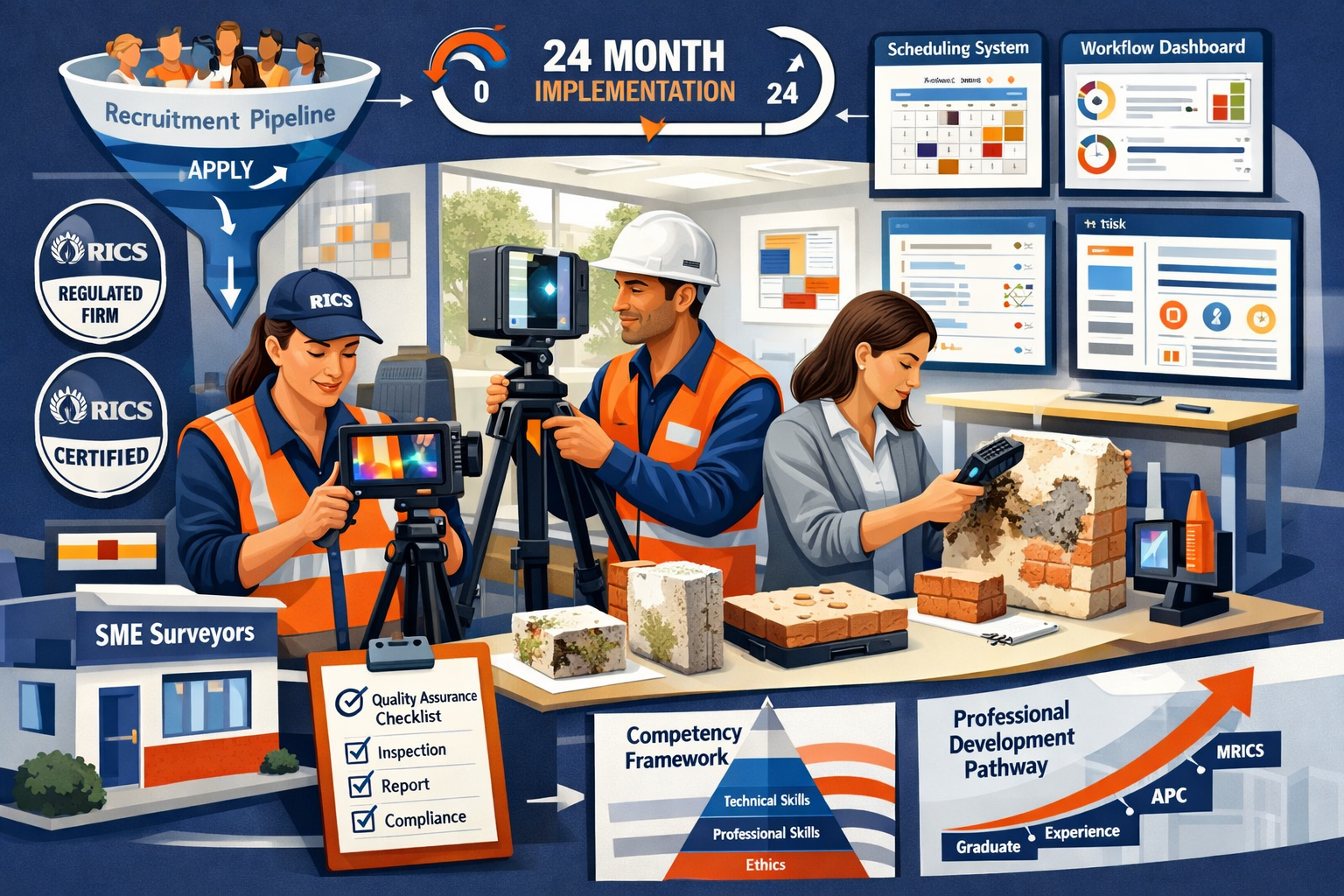
Strategic Workforce Planning and Talent Acquisition
The 24-month implementation window RICS identified isn't generous—it's the minimum time required for effective preparation.[3] Surveying practices must begin strategic workforce planning immediately to position themselves for success.
Recruitment Pipeline Development 👔
Attracting new talent into the surveying profession requires sustained effort across multiple channels:
University Partnerships: Strengthen relationships with universities offering surveying and built environment programs. Offer placement opportunities, sponsor student projects, and participate in careers events to build awareness of the profession's opportunities.
Apprenticeship Programs: Develop structured apprenticeship pathways that combine practical experience with formal qualifications. These programs can attract career-changers and school leavers who might not pursue traditional university routes.
Cross-Sector Recruitment: Look beyond traditional surveying backgrounds to identify transferable skills. Construction managers, building inspectors, architectural technologists, and facilities managers may possess relevant knowledge that can be developed into surveying competency.
Diversity and Inclusion: Actively recruit from underrepresented groups to broaden the profession's talent pool and better reflect the communities served. This isn't just ethical—it's practical given the scale of recruitment required.
Retention Strategies 🎯
Recruiting talent is only half the challenge; retaining qualified professionals in a competitive market requires deliberate strategies:
- Competitive compensation packages that reflect market realities
- Clear career progression pathways with defined milestones and advancement opportunities
- Investment in continuing professional development and specialization
- Flexible working arrangements that accommodate modern lifestyle expectations
- Positive workplace culture that values expertise and professional judgment
Practices that create attractive working environments will have significant advantages in talent markets where demand exceeds supply.
Training and Professional Development
The RICS Homebuying Reforms 2026: How Mandatory Upfront Surveys Will Reshape Chartered Surveyor Workflows requires not just more surveyors, but surveyors with specific competencies aligned to reformed processes.
Core Competency Development 📚
Training programs must address:
Upfront Assessment Methodologies: Techniques for conducting thorough assessments of occupied properties with limited preparation time and potentially restricted access.
Vendor Communication Skills: Navigating the different dynamics of vendor-commissioned work while maintaining professional independence and objectivity.
Digital Literacy: Mastering property logbook systems, digital reporting platforms, and technology-assisted survey tools.
Risk Assessment and Communication: Clearly articulating property risks in standardized formats that support informed buyer decision-making.
Building Pathology Knowledge: Understanding emerging construction methods, materials, and defect patterns, particularly in modern and recently constructed properties. Surveyors should be familiar with building pathology principles to identify and assess defects accurately.
Specialized Training Pathways 🎓
Different property types and transaction contexts require specialized knowledge:
- Heritage and period properties: Understanding traditional construction methods and appropriate conservation approaches
- Modern methods of construction: Assessing timber frame, SIPs panels, modular construction, and other contemporary building systems
- Leasehold properties: Evaluating service charge reasonableness, lease terms, and management quality
- Energy efficiency and sustainability: Integrating EPC and MEES considerations into condition assessments
- Urgent and dangerous issues: Identifying and communicating urgent or dangerous building issues that require immediate attention
Technology Investment and Digital Transformation
Successful adaptation to reformed workflows requires significant technology investment across multiple domains.
Survey Technology and Equipment 🔧
Modern survey practice increasingly relies on advanced diagnostic tools:
- Thermal imaging cameras for identifying insulation defects, moisture ingress, and heat loss
- Moisture meters for detecting dampness and water penetration
- Laser measuring devices for accurate dimensional surveys
- Drones for roof and chimney inspections on tall or complex buildings
- Borescopes for investigating concealed spaces and cavities
These tools enhance survey quality and efficiency, but require capital investment and training in proper use and interpretation.
Digital Reporting Platforms 💻
Standardized, digital-first reporting is essential for integration with property logbooks:
- Cloud-based survey software that enables field data capture on tablets and smartphones
- Template systems that ensure consistency while allowing customization for property-specific issues
- Photo annotation tools for clear visual communication of defects
- Automated quality checks that flag missing information or inconsistencies
- Client portals for secure report delivery and ongoing access
Practice Management Systems 📊
Handling increased volume requires robust operational infrastructure:
- Scheduling and resource allocation tools that optimize surveyor utilization
- Customer relationship management systems for tracking inquiries, quotes, and follow-up
- Financial management platforms for invoicing, payment tracking, and financial reporting
- Quality assurance workflows for peer review and standards compliance
- Performance analytics to identify bottlenecks and improvement opportunities
Business Model Adaptation and Service Diversification
The RICS Homebuying Reforms 2026: How Mandatory Upfront Surveys Will Reshape Chartered Surveyor Workflows creates opportunities for innovative service models and revenue diversification.
Vendor-Focused Service Packages 📦
Develop comprehensive packages specifically designed for sellers preparing properties for market:
- Pre-marketing condition assessments with actionable maintenance recommendations
- Defect remediation guidance connecting vendors with trusted contractors
- Energy efficiency improvement advice to enhance property marketability
- Property logbook preparation services ensuring comprehensive documentation
- Ongoing monitoring for properties that remain on market for extended periods
Estate Agent Partnerships 🤝
Build strategic relationships with estate agents who will play central roles in coordinating upfront information packs:
- Preferred provider arrangements for their vendor clients
- Streamlined referral processes with clear service level agreements
- Joint marketing initiatives highlighting the value of quality upfront surveys
- Training and education helping agents understand and communicate survey findings
- Technology integration enabling seamless information flow between systems
Subscription and Retainer Models 🔄
For property investors, landlords, and portfolio owners, consider ongoing relationship models:
- Annual condition monitoring for investment properties
- Portfolio assessment services for multi-property owners
- Maintenance planning support based on condition data
- Regulatory compliance monitoring for statutory considerations
- Priority access during peak demand periods
Managing the Transition Period
The journey from current practice to fully reformed workflows won't happen overnight. Successful practices will manage this transition deliberately and strategically.
Phased Implementation Approach 📅
Rather than waiting for mandatory implementation, consider voluntary adoption of reformed practices:
Phase 1 (Months 1-6): Internal preparation
- Assess current capacity and identify gaps
- Begin recruitment and training initiatives
- Evaluate and select technology platforms
- Develop standardized templates and processes
Phase 2 (Months 7-12): Pilot programs
- Offer upfront survey services to willing vendors
- Test workflows and identify refinements
- Build case studies and success stories
- Gather feedback and iterate
Phase 3 (Months 13-18): Market positioning
- Launch marketing campaigns highlighting readiness
- Formalize partnership agreements
- Scale successful pilot initiatives
- Expand capacity based on demand signals
Phase 4 (Months 19-24): Full readiness
- Achieve target capacity levels
- Finalize quality assurance frameworks
- Complete technology integration
- Position for mandatory implementation
Risk Management and Contingency Planning ⚠️
Prepare for potential challenges and disruptions:
- Demand volatility: Build flexible capacity that can scale up or down based on market conditions
- Regulatory changes: Stay engaged with RICS consultations and policy developments to anticipate adjustments
- Technology failures: Maintain backup systems and manual processes for business continuity
- Quality incidents: Develop clear protocols for addressing errors, complaints, and professional liability claims
- Competitive pressures: Monitor market positioning and adjust pricing and service offerings accordingly
Regional Considerations and Market Variations
Geographic Distribution of Surveying Capacity
The impact of the RICS Homebuying Reforms 2026: How Mandatory Upfront Surveys Will Reshape Chartered Surveyor Workflows will vary significantly across different regions and property markets. Understanding these variations is essential for effective strategic planning.
Metropolitan vs. Regional Markets 🏙️
Urban centers like Central London, Chelsea, and Fulham have relatively high concentrations of chartered surveyors and established professional infrastructure. These markets may adapt more quickly to reformed workflows.
Regional markets in areas like Berkshire, Watford, and Hemel Hempstead may face greater challenges in scaling capacity, particularly if talent gravitates toward metropolitan opportunities. Strategic recruitment and retention efforts become even more critical in these markets.
Property Type Variations 🏘️
Different property types present distinct survey challenges and capacity requirements:
Period Properties: Areas with significant heritage housing stock require surveyors with specialized knowledge of traditional construction methods, conservation principles, and period-specific defects.
New Build Developments: Modern construction methods, warranty arrangements, and developer relationships create different assessment contexts requiring specific expertise.
Leasehold Flats: Complex service charge arrangements, building management issues, and shared infrastructure require additional investigation beyond basic condition assessment.
Rural Properties: Septic systems, private water supplies, agricultural buildings, and land boundaries introduce complexities not present in urban settings.
Addressing Geographic Gaps in Service Provision
The reforms must not create or exacerbate geographic inequalities in access to quality surveying services. Several strategies can address potential gaps:
Regional Collaboration Networks 🌐
Practices in neighboring areas can form collaborative networks to:
- Share capacity during peak demand periods
- Provide mutual coverage for specialized property types
- Pool resources for technology investments
- Coordinate training and professional development
Mobile and Flexible Deployment 🚗
Technology enables more flexible service delivery models:
- Surveyors can efficiently cover wider geographic territories
- Remote report preparation reduces time spent in local offices
- Digital communication maintains client relationships across distances
- Flexible working arrangements attract talent to regional practices
Investment in Regional Capacity Building 💪
Professional bodies, government, and industry stakeholders should prioritize:
- Training programs in underserved regions
- Financial support for SME practices in capacity expansion
- Technology grants to reduce barriers to digital transformation
- Marketing campaigns promoting surveying careers in regional markets
The Broader Ecosystem: Coordination with Other Professionals
Estate Agents and Property Marketers
The RICS Homebuying Reforms 2026: How Mandatory Upfront Surveys Will Reshape Chartered Surveyor Workflows cannot succeed in isolation. Estate agents will play pivotal roles in coordinating upfront information packs and managing vendor expectations.
Surveyors must develop effective working relationships with agents based on:
Mutual Understanding 🤝
- Agents need to understand survey processes, timelines, and limitations
- Surveyors need to appreciate agents' marketing objectives and client management challenges
- Both professions benefit from clear communication protocols and realistic expectations
Aligned Incentives 💡
- Quality upfront surveys reduce transaction failures, benefiting agents through higher completion rates
- Agents who consistently recommend quality surveyors enhance their own professional reputations
- Joint success metrics focus on completed transactions, not just agreed sales
Streamlined Processes ⚡
- Standardized referral and commissioning procedures
- Clear service level agreements for turnaround times
- Integrated technology platforms for information sharing
- Coordinated communication with vendors and buyers
Conveyancers and Legal Professionals
Legal professionals will interact with survey reports in new ways under reformed processes:
Earlier Legal Engagement ⚖️
Conveyancers will need to review survey findings earlier in transactions to:
- Identify potential legal implications of physical defects
- Advise on contractual protections and indemnities
- Coordinate with surveyors on construction law advice where appropriate
- Ensure upfront information packs meet legal requirements
Enhanced Professional Coordination 📞
Surveyors and conveyancers should establish:
- Clear referral pathways for properties with complex legal-physical interactions
- Joint client communication protocols for issues affecting both condition and title
- Shared understanding of professional boundaries and expertise areas
- Collaborative approaches to resolving transaction obstacles
Mortgage Lenders and Valuers
Lenders will adapt their processes to leverage upfront survey information:
Valuation Integration 💷
Mortgage valuations may increasingly reference upfront condition surveys, creating opportunities for:
- Reduced duplication between survey and valuation processes
- Enhanced risk assessment based on comprehensive condition data
- Streamlined approval processes when quality information exists upfront
- Potential cost savings for buyers through integrated services
Lending Criteria Adjustments 📋
Lenders may develop new criteria and processes based on upfront survey availability:
- Conditional offers based on satisfactory upfront surveys
- Risk-based pricing reflecting property condition transparency
- Expedited processing for properties with comprehensive information packs
- Enhanced fraud prevention through verified property data
Measuring Success: Key Performance Indicators for Reformed Workflows
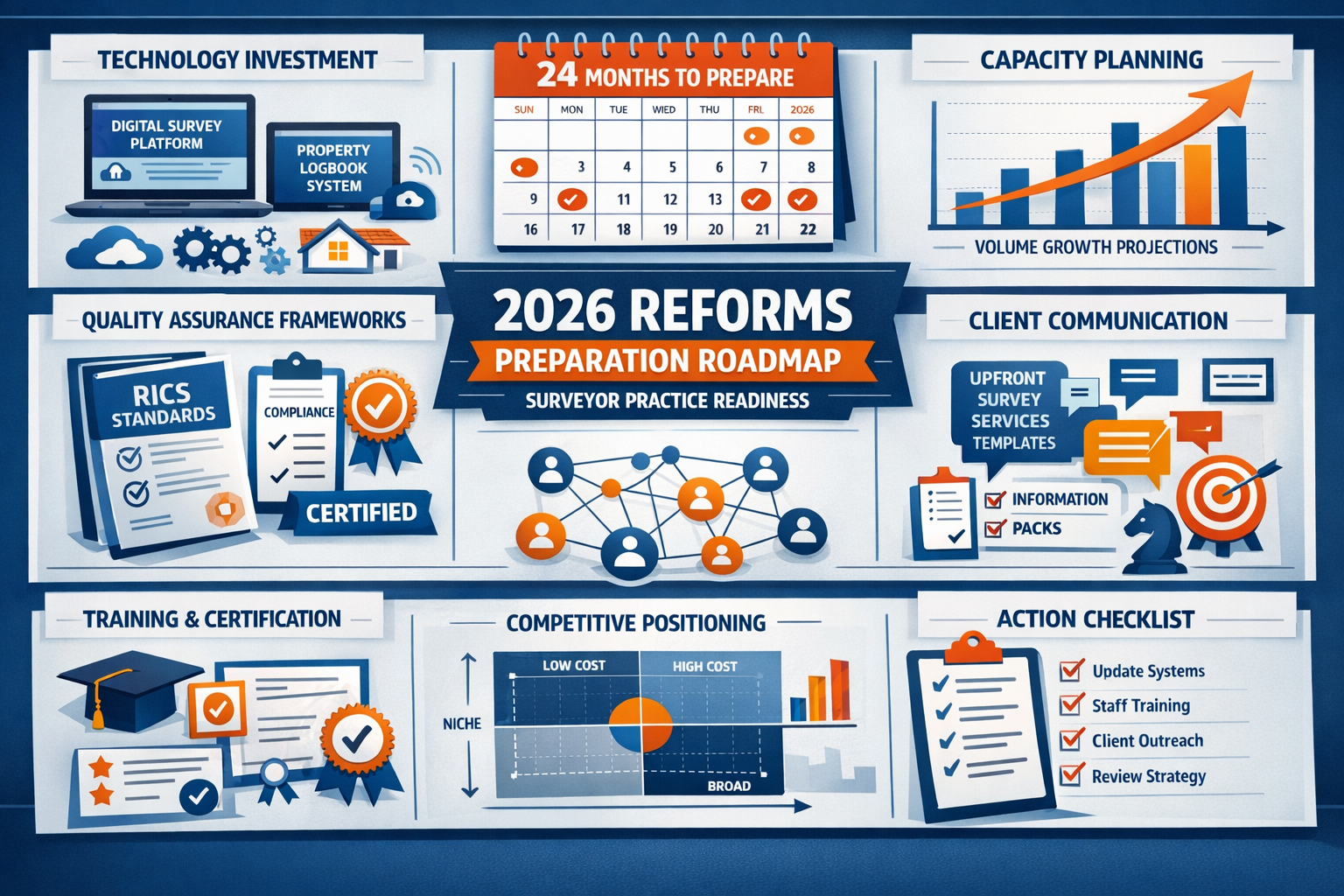
Transaction-Level Metrics
The ultimate test of the RICS Homebuying Reforms 2026: How Mandatory Upfront Surveys Will Reshape Chartered Surveyor Workflows is whether it achieves the government's objectives of reducing failures and accelerating transactions.
Fall-Through Rate Reduction 📉
Current baseline: 32% of agreed sales fail to complete[2]
Target improvement: Halving the economic cost suggests reducing failures to approximately 16-20%
Surveyor contribution: Quality upfront surveys that accurately identify and communicate property issues before buyers commit emotionally and financially.
Transaction Timeline Acceleration ⏱️
Current baseline: Average 12-16 weeks from offer acceptance to completion
Target improvement: Four-week acceleration to 8-12 weeks[1]
Surveyor contribution: Completing thorough assessments before marketing eliminates buyer-side survey delays and reduces renegotiation cycles.
Practice-Level Performance Indicators
Individual practices should track metrics that indicate successful adaptation:
Capacity Utilization 📊
- Survey volume handled relative to available surveyor time
- Percentage of capacity allocated to upfront vs. traditional buyer-commissioned surveys
- Seasonal variation and demand management effectiveness
Quality Metrics ✓
- Peer review outcomes and quality assurance scores
- Client satisfaction ratings and feedback
- Complaint and professional liability claim rates
- Accuracy of condition assessments compared to subsequent findings
Financial Performance 💰
- Revenue per surveyor and practice profitability
- Average fee levels and pricing effectiveness
- Payment collection rates and debtor days
- Return on technology and infrastructure investments
Workforce Metrics 👥
- Recruitment success rates and time-to-hire
- Staff retention and turnover rates
- Training completion and competency development
- Employee satisfaction and engagement scores
Industry-Wide Success Indicators
Broader indicators will reveal whether the reforms achieve systemic improvements:
Consumer Confidence 😊
- Public perception of homebuying process reliability
- Willingness to engage in property transactions
- Trust in professional advice and information
- Overall satisfaction with homeownership journey
Market Efficiency 🏘️
- Total properties marketed vs. properties sold
- Time on market for typical properties
- Price discovery effectiveness and negotiation patterns
- Overall transaction costs for buyers and sellers
Professional Standards 🎓
- Consistency of survey quality across providers
- Compliance with RICS standards and guidance
- Professional development participation rates
- Regulatory enforcement actions and outcomes
Future Outlook: Beyond 2026 Implementation
Continuous Evolution of Standards and Practices
The RICS Homebuying Reforms 2026: How Mandatory Upfront Surveys Will Reshape Chartered Surveyor Workflows represents a beginning, not an ending. Professional standards, technology capabilities, and market expectations will continue evolving beyond initial implementation.
Emerging Technologies 🚀
Future developments may include:
Artificial Intelligence: AI-assisted defect identification from photographs and thermal images, pattern recognition across large property datasets, and predictive modeling of deterioration trajectories.
Building Information Modeling: Integration of survey data with BIM systems for comprehensive digital property twins, enabling sophisticated analysis and maintenance planning.
Remote Sensing: Drone-based thermal imaging, LiDAR scanning for precise dimensional surveys, and satellite data for environmental risk assessment.
Blockchain: Immutable property logbooks with cryptographically verified survey records, smart contracts automating information disclosure, and enhanced fraud prevention.
Expanding Scope of Surveyor Value Proposition
As upfront surveys become standard, surveyors can expand their value proposition beyond basic condition assessment:
Lifecycle Advisory Services 🔄
- Long-term maintenance planning based on condition data
- Renovation and improvement prioritization guidance
- Energy efficiency upgrade roadmaps
- Sustainability and climate resilience assessments
Market Intelligence 📈
- Comparative property analysis based on condition data
- Neighborhood-level building quality trends
- Investment decision support for buyers
- Portfolio optimization for multi-property owners
Risk Management 🛡️
- Comprehensive hazard identification and mitigation planning
- Insurance claim support and documentation
- Dispute resolution and expert witness services
- Regulatory compliance monitoring and advice
Policy Evolution and Regulatory Refinement
Initial implementation will inevitably reveal areas requiring adjustment and refinement:
Standards Updates 📝
RICS will continue developing and updating professional standards based on:
- Practical experience with reformed workflows
- Emerging building technologies and construction methods
- Consumer feedback and expectations
- Regulatory requirements and legal developments
Market Monitoring 👀
Government and industry bodies will track reform outcomes to:
- Assess whether objectives are being achieved
- Identify unintended consequences requiring correction
- Evaluate impact on different market segments and regions
- Determine whether additional interventions are needed
International Learning 🌍
The UK can learn from homebuying systems in other jurisdictions:
- Vendor disclosure requirements in various countries
- Professional liability and insurance frameworks
- Technology adoption and digital transformation approaches
- Consumer protection mechanisms and dispute resolution
Conclusion: Embracing Transformation as Opportunity
The RICS Homebuying Reforms 2026: How Mandatory Upfront Surveys Will Reshape Chartered Surveyor Workflows represents the most significant transformation in UK property transactions in generations. For chartered surveyors, this change brings both substantial challenges and remarkable opportunities.
The challenges are real and significant: massive capacity expansion, workforce recruitment and training, technology investment, workflow transformation, and business model adaptation. These cannot be achieved overnight, which is why RICS's emphasis on a 24-month implementation timeline is so critical.[3]
Yet the opportunities are equally compelling. Mandatory upfront surveys will:
✅ Elevate the profession's role from optional due diligence to essential transaction infrastructure
✅ Increase demand for surveying services across all property types and price points
✅ Enhance professional value through integration with digital property logbooks
✅ Improve consumer outcomes by reducing transaction failures and financial losses
✅ Create new service opportunities in vendor advisory, lifecycle planning, and market intelligence
Success requires deliberate, strategic action across multiple dimensions:
Actionable Next Steps for Surveying Practices
Immediate Actions (Next 3 Months) 🎯
- Assess current capacity and identify gaps in workforce, technology, and processes
- Engage with RICS consultations and policy developments to stay informed and contribute input
- Begin recruitment planning to build talent pipelines for anticipated demand
- Evaluate technology platforms for digital reporting and property logbook integration
- Develop estate agent relationships to position for vendor-commissioned work
Medium-Term Initiatives (3-12 Months) 📅
- Implement training programs focused on upfront assessment methodologies and reformed workflows
- Invest in survey technology including thermal imaging, moisture detection, and digital reporting tools
- Pilot upfront survey services with willing vendors to test processes and gather feedback
- Standardize reporting templates aligned with emerging RICS guidance and digital formats
- Build quality assurance frameworks to ensure consistency and professional standards compliance
Long-Term Strategic Positioning (12-24 Months) 🚀
- Scale capacity to target levels based on market projections and regional demand
- Formalize partnership agreements with estate agents, conveyancers, and other ecosystem participants
- Launch marketing campaigns highlighting readiness and expertise for reformed processes
- Diversify service offerings to capture opportunities beyond basic condition assessment
- Establish performance monitoring to track success metrics and identify continuous improvement opportunities
The Professional Imperative
The RICS Homebuying Reforms 2026: How Mandatory Upfront Surveys Will Reshape Chartered Surveyor Workflows ultimately succeeds or fails based on the quality and professionalism of survey delivery. As RICS emphasized, reforms depend on "high-quality, professional upfront information" delivered by "competent, regulated professionals working to consistent standards."[3]
This places a profound responsibility on the surveying profession. Rushed, superficial, or inconsistent surveys will undermine reform objectives and erode public trust. Conversely, thorough, accurate, and professionally delivered assessments will demonstrate the profession's value and justify the central role surveyors play in property transactions.
The coming months and years will test the profession's capacity to rise to this challenge. Those practices that invest wisely in people, technology, and processes will thrive in the reformed market. Those that delay or underinvest risk being left behind as the market transforms around them.
The opportunity is clear. The timeline is defined. The action required is substantial but achievable. The future of homebuying in the UK—and the surveying profession's role within it—depends on the choices made today.
For surveyors seeking to understand how these reforms will affect their practice, or homebuyers and sellers wanting to learn more about the changing landscape, exploring resources on building survey services and understanding what to look out for when buying an old house provides valuable context for navigating this transformation.
The RICS Homebuying Reforms 2026 aren't just changing how properties are bought and sold—they're redefining what it means to be a chartered surveyor in the modern property market. Embracing this transformation with professionalism, quality, and strategic vision will ensure the profession emerges stronger, more valued, and better positioned to serve consumers in the decades ahead.
References
[1] Government Announces Biggest Shake Home Buying Process Countrys History – todaysconveyancer.co.uk
[2] Rics Responds To Major Changes In Home Buying And Selling – rics.org
[3] Rics Response To The Home Buying And Selling Reform Consultation – rics.org
[4] Home Survey Standard 2nd Edition A Progress Update – rics.org
[5] Home Buying And Selling Reform Hub – rics.org
[6] Rics Launches Consultation Updated Home Survey Standard – rics.org
[7] Home Buying And Selling Reform – gov.uk
[8] Rics Publishes Update On Current Developments In Home Buying Selling Reform – lexisnexis.co.uk