

As urban centers across the United Kingdom experience unprecedented densification in 2026, party wall surveyors face increasingly complex challenges. The convergence of residential apartments, commercial offices, and retail spaces within single development projects has transformed traditional party wall procedures into intricate coordination exercises involving multiple stakeholders, diverse regulatory requirements, and competing property interests. Understanding how to navigate Party Wall Surveys in Mixed-Use Development: Navigating 2026's Urban Intensification Projects has become essential for property professionals managing today's urban transformation.
The construction landscape of 2026 presents a unique environment where market recovery meets labor shortages and regulatory evolution. With 57% of construction professionals citing insufficient worker supply as a critical constraint [1], and specific sectors like data centers showing 57% net positive demand readings [1], the pressure on party wall surveyors to deliver efficient, compliant services has never been greater. Mixed-use developments—combining retail, residential, and commercial elements—require surveyors to balance the interests of diverse occupants while ensuring legal compliance and minimizing construction disruption.
Key Takeaways
- Mixed-use developments require coordinated party wall strategies that address multiple stakeholder groups including residential leaseholders, commercial tenants, retail operators, and building owners simultaneously
- 2026's urban intensification projects demand enhanced documentation practices incorporating digital workflows, building information modeling (BIM), and AI-driven precision tools to manage complex party wall interfaces [3]
- Regulatory compliance extends beyond the Party Wall Act 1996 to encompass building regulations, planning conditions, fire safety requirements, and sector-specific standards for commercial and residential uses
- Stakeholder communication protocols must be tailored to different occupant types, with residential owners requiring different engagement approaches than commercial lease holders or retail operators
- Professional surveyors must navigate labor constraints and material supply challenges while maintaining party wall survey timelines and quality standards in 2026's competitive construction market [1]
Understanding Mixed-Use Development Party Wall Complexity 🏗️
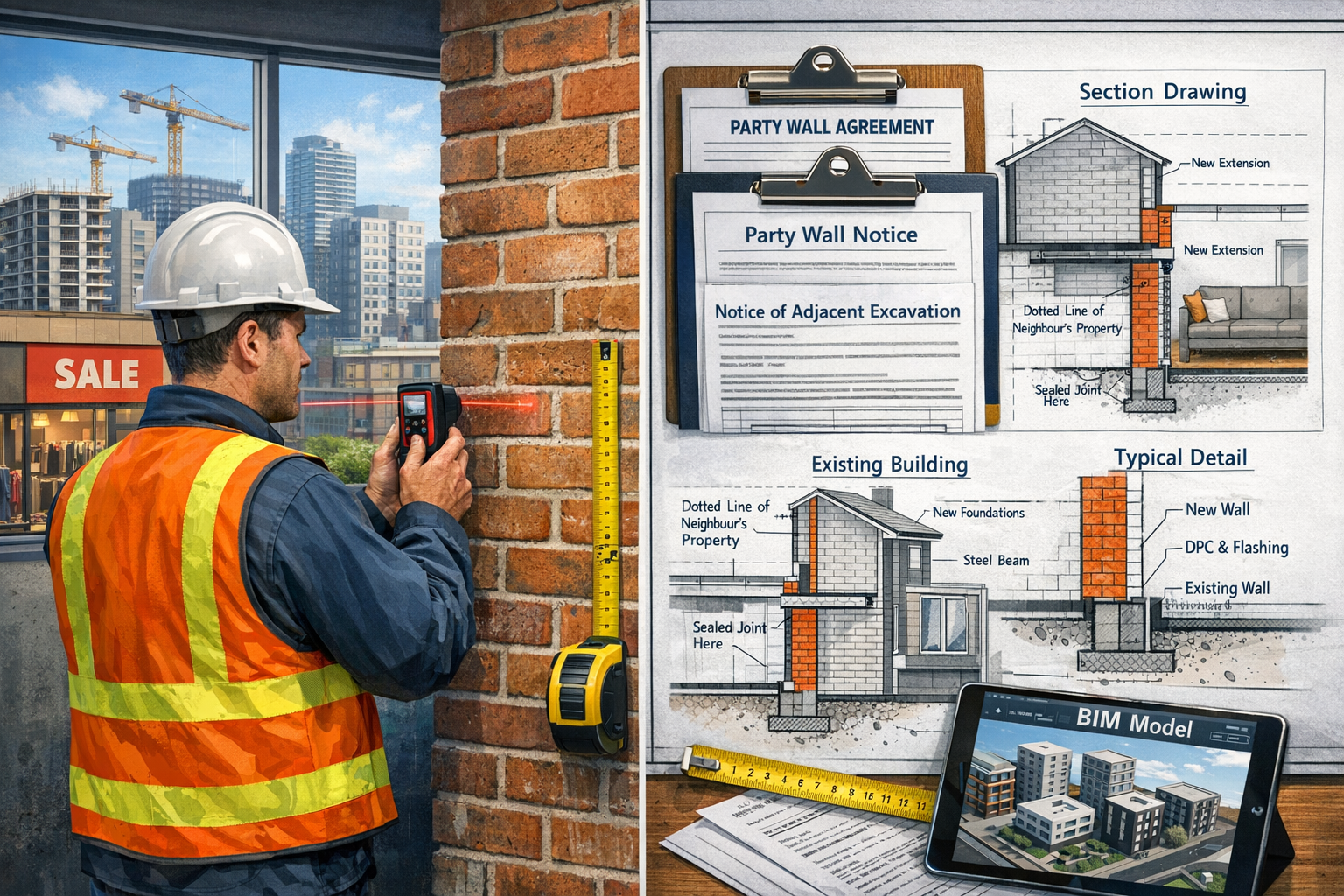
Mixed-use developments fundamentally differ from single-use buildings in their party wall requirements. A traditional residential terrace involves straightforward owner-to-owner relationships, but a mixed-use building might feature ground-floor retail units, mid-level commercial offices, and upper-floor residential apartments—each with different ownership structures, lease terms, and operational requirements.
The Multi-Stakeholder Challenge
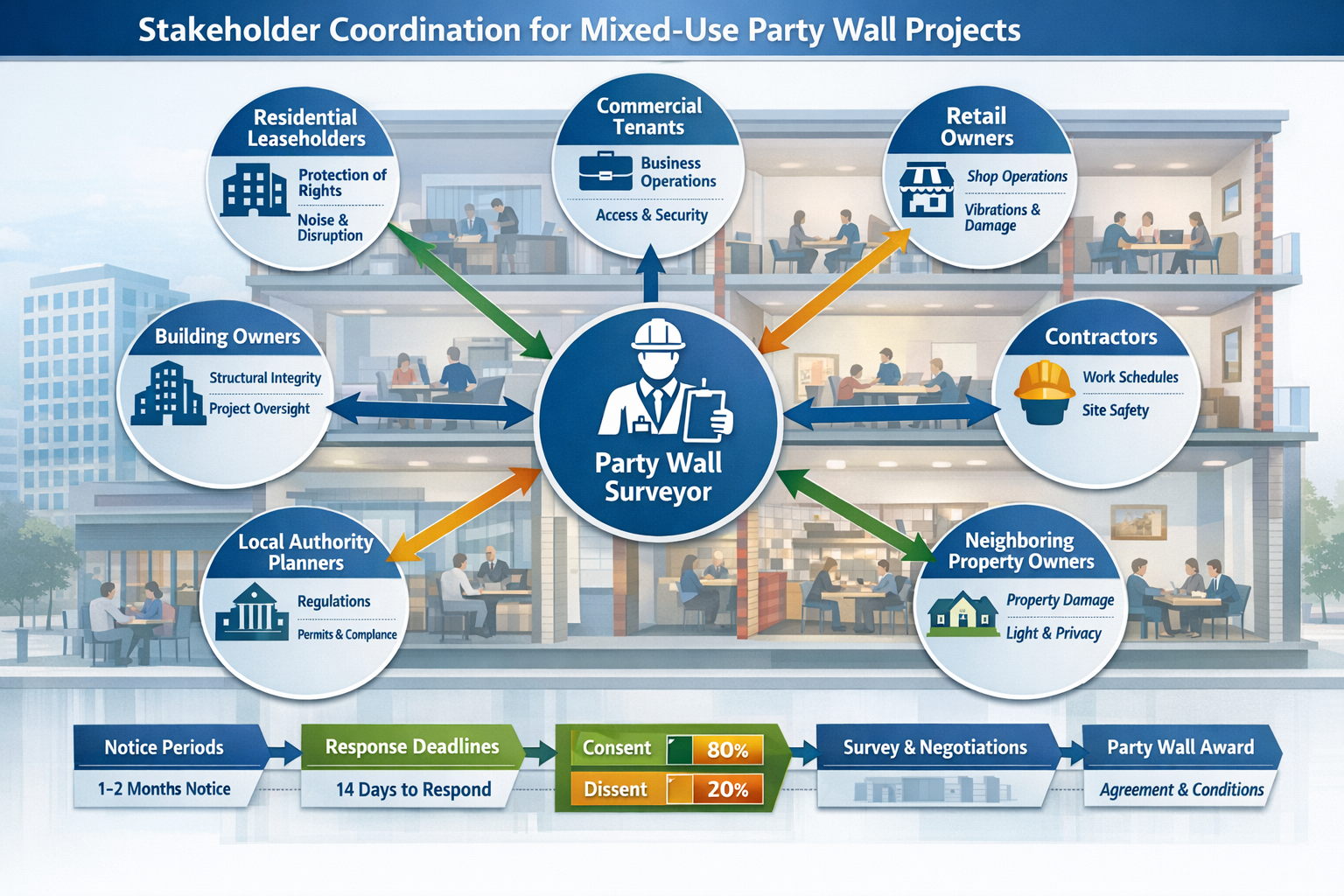
Party wall surveyors working on urban intensification projects in 2026 must coordinate with an expanded range of stakeholders:
- Residential leaseholders concerned about noise, vibration, and disruption to daily living
- Commercial tenants focused on business continuity and minimal operational interruption
- Retail operators requiring uninterrupted trading access and customer flow
- Building owners managing investment returns and property values
- Freeholders with long-term asset management perspectives
- Managing agents coordinating building-wide services
- Local authorities enforcing planning conditions and building regulations
Each stakeholder group brings distinct priorities and concerns to party wall procedures. Residential occupants typically prioritize evening and weekend quiet enjoyment, while commercial tenants may accept daytime disruption but require absolute certainty about project timelines. Retail operators often cannot tolerate any disruption during peak trading periods, requiring construction scheduling that accommodates seasonal variations.
Types of Party Wall Works in Mixed-Use Contexts
The Party Wall Act 1996 applies to several categories of work, each presenting unique challenges in mixed-use settings:
| Work Type | Section | Mixed-Use Considerations |
|---|---|---|
| New wall on boundary | Section 1 | Must consider different floor uses and structural loads |
| Work to existing party wall | Section 2 | Requires coordination across multiple occupancy types |
| Excavation near neighboring building | Section 6 | Complex foundation interactions with varied building uses |
| Cutting into party wall | Section 2(2)(a) | Different penetration requirements for services serving varied uses |
When party wall disputes arise in mixed-use developments, resolution becomes more complex due to the number of affected parties and the diversity of their interests. A single excavation project might trigger Section 6 notices to dozens of residential leaseholders, multiple commercial tenants, and several retail operators—each requiring individual notice service and potentially appointing separate surveyors.
Ownership and Lease Structures
Understanding ownership structures is crucial for proper party wall notice service in 2026's mixed-use developments:
Freehold ownership of entire mixed-use buildings is relatively rare in urban centers. More commonly, surveyors encounter:
- Long leasehold residential units (99-999 years) with individual owners
- Commercial leases (10-25 years) with tenant occupation
- Retail leases (5-15 years) with frequent turnover
- Intermediate leases creating additional layers of interest
- Freehold retention by institutional investors or developers
This complexity means that determining who must receive party wall notices—and who has authority to appoint surveyors—requires careful title investigation. The building owner undertaking works must serve notices on all affected owners, but in mixed-use developments, this might involve serving notices to:
- Individual residential leaseholders (who are "owners" under the Act)
- Commercial tenants (if their leases grant sufficient interest)
- Head lessees with intermediate interests
- The freeholder (if affected by the works)
Failure to properly identify and serve all required parties can invalidate the party wall process, exposing building owners to legal challenges and potential injunctions halting construction. Professional surveyors must conduct thorough due diligence to identify all relevant parties before commencing notice procedures.
Party Wall Surveys in Mixed-Use Development: Documentation and Technical Requirements
The technical documentation requirements for Party Wall Surveys in Mixed-Use Development: Navigating 2026's Urban Intensification Projects extend well beyond traditional residential party wall procedures. Mixed-use buildings demand comprehensive technical assessments that account for varied structural systems, diverse building services, and complex occupancy patterns.
Pre-Construction Condition Surveys
Condition surveys form the foundation of party wall protection in mixed-use developments. These surveys must document:
Structural elements across different use zones:
- Load-bearing walls and columns serving commercial spaces
- Residential floor structures and ceiling finishes
- Retail frontages and display windows
- Common areas and circulation spaces
- Building services penetrations through party walls
- Fire compartmentation and protection systems
The surveyor's photographic record must capture existing conditions in sufficient detail to resolve future disputes about construction damage. In 2026, advanced technologies enhance this process:
- High-resolution digital photography with GPS tagging and timestamps
- 3D laser scanning creating point cloud models of existing conditions
- Thermal imaging detecting hidden defects or moisture issues
- Drone surveys for external elevations and roof conditions available through specialized services
These technologies provide objective evidence of pre-construction conditions, reducing disputes about whether observed damage resulted from party wall works or pre-existed the construction project [3].
Technical Drawings and Specifications
Party wall drawings for mixed-use developments require exceptional precision and clarity. Standard drawing packages should include:
Site location plans showing:
- Property boundaries and party wall locations
- Adjacent buildings and their uses
- Excavation zones relative to neighboring structures
- Access routes for construction vehicles and materials
Detailed section drawings illustrating:
- Proposed works in relation to party walls
- Foundation depths and proximity to adjacent buildings
- Structural connections to existing party structures
- Building services routes through party walls
- Fire stopping and compartmentation details
Method statements specifying:
- Construction sequencing to minimize disruption
- Temporary support measures for party walls
- Noise and vibration control procedures
- Hours of working appropriate to mixed-use context
- Dust suppression and site management protocols
The complexity of mixed-use buildings often necessitates Building Information Modeling (BIM) integration, allowing surveyors to visualize three-dimensional relationships between proposed works and existing structures. BIM models can demonstrate how basement excavations affect ground-floor retail units differently than upper-floor residential apartments, enabling targeted communication with affected stakeholders.
Schedule of Condition
The Schedule of Condition represents a critical protective document, particularly in mixed-use contexts where different areas have vastly different values and finishes. A luxury residential apartment with marble bathrooms and hardwood floors requires more detailed condition documentation than a shell-and-core commercial office space.
Effective schedules organize documentation by:
Building zone:
- Retail areas (including customer-facing finishes)
- Commercial spaces (structural and service elements)
- Residential units (detailed finish documentation)
- Common areas (lobbies, corridors, amenity spaces)
Element type:
- External walls and facades
- Internal partitions and finishes
- Floor and ceiling structures
- Building services (mechanical, electrical, plumbing)
- Fixtures and fittings
- Decorative finishes
Condition rating system:
- Excellent (new or recently renovated)
- Good (well-maintained, minor wear)
- Fair (functional with visible wear)
- Poor (requiring repair or replacement)
- Defective (not functioning as intended)
Photographic documentation should include reference markers allowing precise location identification, with each photograph cross-referenced to floor plans showing camera position and direction. This level of detail proves essential when disputes arise about alleged construction damage to specific elements.
Regulatory Compliance Documentation
Beyond party wall-specific requirements, mixed-use developments in 2026 must satisfy multiple regulatory frameworks:
Building Regulations approval for:
- Structural alterations affecting party walls
- Fire safety measures in mixed-use buildings
- Sound insulation between different uses
- Ventilation and building services installations
Planning conditions often requiring:
- Construction management plans
- Delivery and servicing strategies
- Noise and vibration monitoring
- Community liaison procedures
Sector-specific requirements such as:
- Food safety standards for retail food premises
- Workplace regulations for commercial offices
- Housing standards for residential units
- Accessibility requirements across all uses
Professional surveyors must ensure party wall documentation aligns with these broader regulatory requirements. For example, proposed structural works to a party wall might require both party wall awards and building control approval for structural calculations, with both processes running concurrently but requiring separate documentation.
The consequences of ignoring these requirements can be severe, including enforcement action, project delays, and financial penalties. In 2026's constrained construction market, where labor shortages already challenge project delivery [1], regulatory non-compliance represents an unacceptable risk.
Stakeholder Coordination Strategies for Urban Intensification Projects
Successfully navigating Party Wall Surveys in Mixed-Use Development: Navigating 2026's Urban Intensification Projects requires sophisticated stakeholder coordination strategies. The traditional two-party negotiation model proves inadequate when dozens of affected parties have competing interests and varying levels of property knowledge.
Tailored Communication Approaches
Different stakeholder groups require customized communication strategies:
Residential leaseholders typically:
- Have limited property development experience
- Require plain-language explanations of party wall rights
- Appreciate evening and weekend consultation availability
- Value reassurance about property protection
- Respond well to visual presentations and site visits
Commercial tenants generally:
- Understand business disruption implications
- Focus on operational continuity and timeline certainty
- Prefer concise, business-focused communications
- May have in-house property teams or advisors
- Require detailed scheduling information for business planning
Retail operators specifically need:
- Absolute clarity on trading impact
- Advance notice for seasonal planning (Christmas, sales periods)
- Guarantees about customer access maintenance
- Compensation frameworks for lost trading opportunities
- Rapid response protocols for urgent issues
Effective surveyors develop communication matrices identifying each stakeholder, their primary concerns, preferred communication channels, and key decision-makers. This systematic approach ensures no affected party is overlooked and all receive appropriate engagement.
Notice Service Procedures
Serving party wall notices in mixed-use developments demands meticulous attention to legal requirements. The Party Wall Act 1996 specifies strict notice formats and service methods, with serious consequences for non-compliance.
Notice types include:
Line of Junction Notice (Section 1):
- Two months' minimum notice period
- Describes proposed new wall on boundary
- Specifies whether building owner requires neighbor's contribution
Party Structure Notice (Section 2):
- Two months' minimum notice period
- Details proposed works to existing party wall
- Includes drawings showing extent of works
Notice of Adjacent Excavation (Section 6):
- One month's minimum notice period
- Describes excavation depth and proximity
- Includes plans showing excavation location
In mixed-use buildings, surveyors often serve multiple notice types simultaneously to the same building, as different works trigger different sections of the Act. For example, basement excavation (Section 6) combined with new structural connections to party walls (Section 2) requires separate notices for each work category.
Managing Consent and Dissent
When neighbors refuse party wall works or fail to respond to notices, the Act provides clear procedures:
Deemed dissent occurs when:
- Adjoining owner doesn't respond within 14 days
- Response doesn't constitute clear consent
- Conditional consent is offered (treated as dissent)
Surveyor appointment follows dissent:
- Building owner appoints their surveyor
- Adjoining owner appoints their surveyor (or building owner's surveyor appoints on their behalf after 10 days)
- The two surveyors may appoint a third surveyor
In mixed-use developments with dozens of affected parties, surveyors commonly encounter:
- Multiple consents from cooperative parties requiring no further action
- Several dissents requiring formal party wall awards
- Non-responses triggering deemed dissent procedures
- Partial responses requiring clarification and follow-up
Professional surveyors maintain detailed tracking systems recording:
| Party | Notice Date | Response Due | Response Received | Status | Surveyor Appointed |
|---|---|---|---|---|---|
| Flat 1A | 15/01/2026 | 29/01/2026 | 20/01/2026 | Consent | N/A |
| Flat 1B | 15/01/2026 | 29/01/2026 | None | Deemed dissent | Yes – 10/02/2026 |
| Shop 2 | 15/01/2026 | 29/01/2026 | 25/01/2026 | Dissent | Yes – 26/01/2026 |
This systematic approach ensures compliance with statutory timeframes and prevents procedural errors that could invalidate the party wall process.
The Party Wall Award
The Party Wall Award represents the legally binding document governing party wall works. In mixed-use developments, awards must address:
Scope of works:
- Detailed description of permitted activities
- Drawings and specifications incorporated by reference
- Limitations on working hours appropriate to mixed-use context
- Access requirements and routes
Conditions and protections:
- Structural protection measures for party walls
- Noise and vibration limits for different building zones
- Dust suppression and site management requirements
- Making good provisions for any damage
Rights and responsibilities:
- Building owner's right to execute described works
- Adjoining owner's right to inspect and monitor
- Surveyor's role in dispute resolution
- Compensation mechanisms for damage or loss
Specific considerations for mixed-use buildings:
- Different working hours for retail, commercial, and residential zones
- Phased access arrangements minimizing disruption
- Enhanced protection for high-value commercial fit-outs
- Business continuity provisions for trading occupiers
Awards typically include special conditions addressing mixed-use complexity, such as:
"Works affecting the ground floor retail unit shall not be undertaken during the period 15 November to 31 December without the prior written consent of the retail operator, such consent not to be unreasonably withheld."
Or:
"Noisy works audible within residential units shall be limited to Monday-Friday 08:00-18:00 and Saturday 09:00-13:00, with no works on Sundays or Bank Holidays."
These tailored conditions balance the building owner's right to develop their property against adjoining owners' rights to reasonable enjoyment of their premises.
Technology-Enabled Coordination
In 2026, technology significantly enhances stakeholder coordination for party wall surveys. AI-driven precision tools revolutionize workflows through [3]:
Digital notice serving platforms enabling:
- Electronic delivery with proof of service
- Automated response tracking and deadline monitoring
- Template libraries ensuring legal compliance
- Multi-party communication dashboards
Project management systems providing:
- Real-time construction progress updates
- Automated stakeholder notifications
- Document repositories accessible to all parties
- Issue logging and resolution tracking
Monitoring technologies offering:
- Vibration sensors with automated alerts
- Noise monitoring linked to award conditions
- Structural movement tracking
- Photographic progress documentation
These technologies address the coordination challenges inherent in mixed-use developments, where manual tracking of dozens of parties across multiple notice types and award conditions becomes impractical.
Navigating 2026's Construction Market Challenges
The broader construction market context of 2026 significantly impacts how surveyors approach Party Wall Surveys in Mixed-Use Development: Navigating 2026's Urban Intensification Projects. Understanding market dynamics helps professionals anticipate challenges and develop effective mitigation strategies.
Labor Shortages and Project Timelines
The construction industry in 2026 faces acute labor constraints, with 57% of professionals citing insufficient worker supply as a critical issue [1]. This shortage directly affects party wall survey timelines and procedures:
Extended construction periods mean:
- Longer disruption to adjoining owners
- Greater risk of relationship breakdown
- Increased monitoring requirements
- Higher costs for protective measures
Skilled labor scarcity particularly impacts:
- Specialist underpinning works
- Structural alterations to party walls
- Making good and remedial works
- Quality of construction execution
Professional surveyors must account for these constraints when drafting party wall awards, setting realistic timelines that acknowledge labor availability challenges while protecting adjoining owners' interests. Awards might include provisions such as:
"The Building Owner shall use reasonable endeavors to complete the works within 12 months of commencement, acknowledging that labor availability constraints may affect the construction program. Progress updates shall be provided to Adjoining Owners monthly."
Sector-Specific Market Dynamics
Different sectors within mixed-use developments show varying market strength in 2026, influencing party wall survey approaches:
Strong demand sectors [1]:
- Data centers (57% net positive demand) – driving technical infrastructure projects
- Healthcare facilities – maintaining robust construction activity
- Residential development – continuing in urban intensification projects
Declining sectors [1]:
- Office construction – experiencing lowest demand since COVID pandemic
- Traditional retail – facing ongoing structural challenges
These market dynamics affect stakeholder attitudes toward party wall works. Commercial office tenants in declining markets may resist disruption more strongly, knowing alternative premises are readily available. Conversely, residential leaseholders in strong markets may accept short-term disruption recognizing property value appreciation from development activity.
Material Supply and Tariff Impacts
Tariff concerns and material supply chain disruptions affect party wall procedures in 2026 [1]. Surveyors must consider:
Material availability influencing:
- Construction methodology selection
- Temporary works design
- Making good specifications
- Cost estimation for damage compensation
Price volatility affecting:
- Security for expenses provisions in awards
- Compensation calculations
- Cost-sharing arrangements
- Dispute resolution over financial matters
Awards increasingly include price adjustment mechanisms protecting both building and adjoining owners from material cost fluctuations:
"Costs for making good shall be calculated using the BCIS indices current at the date of execution of works, with adjustments for material price variations exceeding 10% from the date of this Award."
Regulatory Evolution and Professional Standards
The surveying profession in 2026 operates within an evolving regulatory framework. While specific party wall legislation remains stable, broader professional standards continue developing [2].
RICS guidance emphasizes:
- Professional competence and continuing development
- Client care and communication standards
- Conflict of interest management
- Complaints handling procedures
Professional indemnity insurance requirements have increased, reflecting:
- Higher property values in urban centers
- Greater complexity of mixed-use projects
- Increased litigation risk
- Regulatory enforcement activity
Surveyors must maintain robust professional practices including:
✅ Comprehensive engagement letters clearly defining scope, fees, and responsibilities
✅ Conflict checking procedures ensuring independence and impartiality
✅ File management systems maintaining complete documentation
✅ Continuing professional development maintaining technical competence
✅ Professional indemnity insurance providing adequate coverage
Emerging Opportunities in Urban Intensification
Despite challenges, 2026 presents significant opportunities for party wall surveyors specializing in mixed-use developments. Urban intensification projects—converting underutilized buildings, adding additional floors, or developing brownfield sites—drive demand for sophisticated party wall services [4].
Conversion projects transforming:
- Obsolete office buildings into residential or mixed-use
- Retail premises into residential above commercial
- Industrial sites into creative mixed-use quarters
- Car parks into residential developments
Densification projects involving:
- Rooftop additions to existing buildings
- Basement excavations for additional space
- Infill development on constrained urban sites
- Airspace development above existing structures
These projects invariably trigger party wall procedures, often with exceptional complexity due to:
- Multiple existing party walls requiring simultaneous works
- Varied existing conditions from different construction periods
- Complex ownership structures accumulated over decades
- Heritage considerations in conservation areas
- Planning constraints limiting construction methodology
Surveyors who develop expertise in these specialized scenarios position themselves advantageously in 2026's market, where specific opportunities in urban intensification outweigh broader market challenges [4].
Risk Management and Dispute Prevention
Effective risk management distinguishes successful party wall surveyors in mixed-use developments. The complexity of multiple stakeholders, diverse uses, and competing interests creates numerous potential conflict points requiring proactive management.
Pre-Emptive Risk Assessment
Before commencing party wall procedures, professional surveyors conduct comprehensive risk assessments identifying potential issues:
Structural risks:
- Existing building condition and stability
- Foundation interactions with adjacent structures
- Load transfer through party walls
- Temporary works requirements during construction
Stakeholder risks:
- Difficult or litigious adjoining owners
- Vulnerable occupants requiring special consideration
- Commercial tenants with strict lease obligations
- Multiple ownership layers complicating decision-making
Operational risks:
- Access constraints in dense urban environments
- Trading impacts on retail operations
- Noise-sensitive uses (recording studios, medical facilities)
- Security requirements for high-value premises
Regulatory risks:
- Planning condition compliance
- Building regulation approval dependencies
- Listed building or conservation area constraints
- Environmental health requirements
This risk assessment informs the party wall strategy, including:
- Enhanced condition survey detail for high-risk areas
- Additional protective measures in party wall awards
- Specialized monitoring programs
- Contingency planning for potential disputes
Protective Measures in Awards
Well-drafted party wall awards incorporate protective provisions minimizing dispute risk:
Monitoring programs specifying:
- Baseline condition surveys before commencement
- Regular inspections during construction phases
- Vibration and noise monitoring with defined thresholds
- Photographic documentation of critical stages
- Final completion inspections
Access arrangements detailing:
- Notice periods for surveyor inspections
- Rights of entry for monitoring
- Emergency access provisions
- Coordination with building security and management
Making good provisions establishing:
- Standards for reinstatement of damage
- Timeframes for completion of making good
- Dispute resolution for disagreements about standards
- Financial security for making good obligations
Compensation mechanisms addressing:
- Damage to property and contents
- Loss of amenity during construction
- Business interruption for commercial occupiers
- Diminution in property value (if proven)
These provisions create clear frameworks for managing construction impacts, reducing ambiguity that often leads to disputes.
Early Warning Systems
Implementing early warning systems helps identify emerging issues before they escalate into formal disputes:
Regular stakeholder updates providing:
- Construction progress reports
- Upcoming activities likely to cause disruption
- Monitoring results and trend analysis
- Opportunities for questions and concerns
Issue logging systems capturing:
- Complaints or concerns from adjoining owners
- Observed deviations from award conditions
- Monitoring threshold exceedances
- Damage reports requiring investigation
Response protocols ensuring:
- Rapid acknowledgment of issues raised
- Investigation and root cause analysis
- Corrective actions implemented promptly
- Communication of outcomes to affected parties
This proactive approach demonstrates the building owner's commitment to responsible development, building goodwill that proves invaluable when unexpected issues arise.
Dispute Resolution Procedures
Despite best efforts, disputes sometimes occur in complex mixed-use party wall projects. The Party Wall Act provides a dispute resolution framework:
Third surveyor determination:
- Either appointed surveyor may refer matters to the third surveyor
- Third surveyor makes binding determination on disputed matters
- Faster and less expensive than court proceedings
- Maintains professional relationships between parties
Court proceedings as last resort:
- Appeals against third surveyor determinations
- Enforcement of award provisions
- Injunctions to prevent or remedy breaches
- Damages claims for losses suffered
Professional surveyors aim to resolve disputes through negotiation and mediation before invoking formal procedures. In mixed-use contexts, this might involve:
- Facilitated meetings bringing stakeholders together
- Independent expert opinions on technical matters
- Revised working methods addressing specific concerns
- Enhanced compensation for particularly affected parties
The goal remains achieving practical solutions that allow construction to proceed while protecting adjoining owners' legitimate interests.
Future-Proofing Party Wall Practice
As urban intensification continues reshaping cities, party wall surveyors must adapt their practices to emerging trends and technologies shaping the built environment in 2026 and beyond.
Sustainability and Environmental Considerations
Modern mixed-use developments increasingly incorporate sustainability features affecting party wall procedures:
Retrofit projects adding:
- External wall insulation systems
- Rooftop solar installations
- Ground source heat pump systems
- Green roofs and living walls
These interventions often involve party wall works, requiring surveyors to understand:
- Thermal performance implications
- Structural loading from new systems
- Weatherproofing and water management
- Long-term maintenance access requirements
Awards must address the permanent nature of sustainability installations, ensuring adjoining owners understand ongoing implications for their properties. For example:
"The Building Owner shall maintain the external wall insulation system in good repair and shall provide access to the Adjoining Owner's surveyor for inspection at reasonable intervals."
Digital Transformation
The surveying profession's digital transformation continues accelerating in 2026 [3]. Party wall practitioners increasingly adopt:
AI-powered tools for:
- Automated notice generation and tracking
- Condition survey analysis and comparison
- Risk assessment and prediction
- Document management and retrieval
Remote inspection technologies:
- Video conferencing for stakeholder consultations
- Drone surveys for external condition assessment
- 360-degree photography for virtual property tours
- Remote monitoring sensors for real-time data
Blockchain applications potentially offering:
- Immutable records of notice service
- Smart contracts automating award conditions
- Transparent cost tracking and compensation
- Secure multi-party document sharing
These technologies enhance efficiency and accuracy while reducing costs, making professional party wall services more accessible for smaller projects within mixed-use developments.
Collaborative Working Models
The complexity of mixed-use party wall projects drives adoption of collaborative working models:
Integrated project teams including:
- Party wall surveyors
- Structural engineers
- Building control officers
- Project managers
- Contractor representatives
Early engagement with:
- Adjoining owners during design development
- Commercial tenants for program coordination
- Retail operators for trading impact mitigation
- Residents' associations for community liaison
This collaborative approach, aligned with modern construction delivery methods, produces better outcomes than traditional adversarial models. Building owners benefit from smoother project delivery, while adjoining owners gain meaningful input into construction management.
Professional Development and Specialization
The increasing complexity of Party Wall Surveys in Mixed-Use Development: Navigating 2026's Urban Intensification Projects drives professional specialization. Surveyors developing expertise in specific areas position themselves as sought-after specialists:
Technical specializations:
- Complex basement excavations
- Historic building party wall works
- High-rise and tall building projects
- Retail and commercial fit-out coordination
Sector specializations:
- Healthcare facility developments
- Educational institution projects
- Hotel and hospitality developments
- Data center and technical installations
Geographic specializations:
- Central London prime property
- Regional city center regeneration
- Suburban intensification projects
- Coastal and flood-risk developments
Maintaining professional competence through continuing professional development ensures surveyors remain current with evolving best practices, regulatory changes, and technological innovations shaping the profession.
Conclusion: Mastering Mixed-Use Party Wall Surveys in 2026
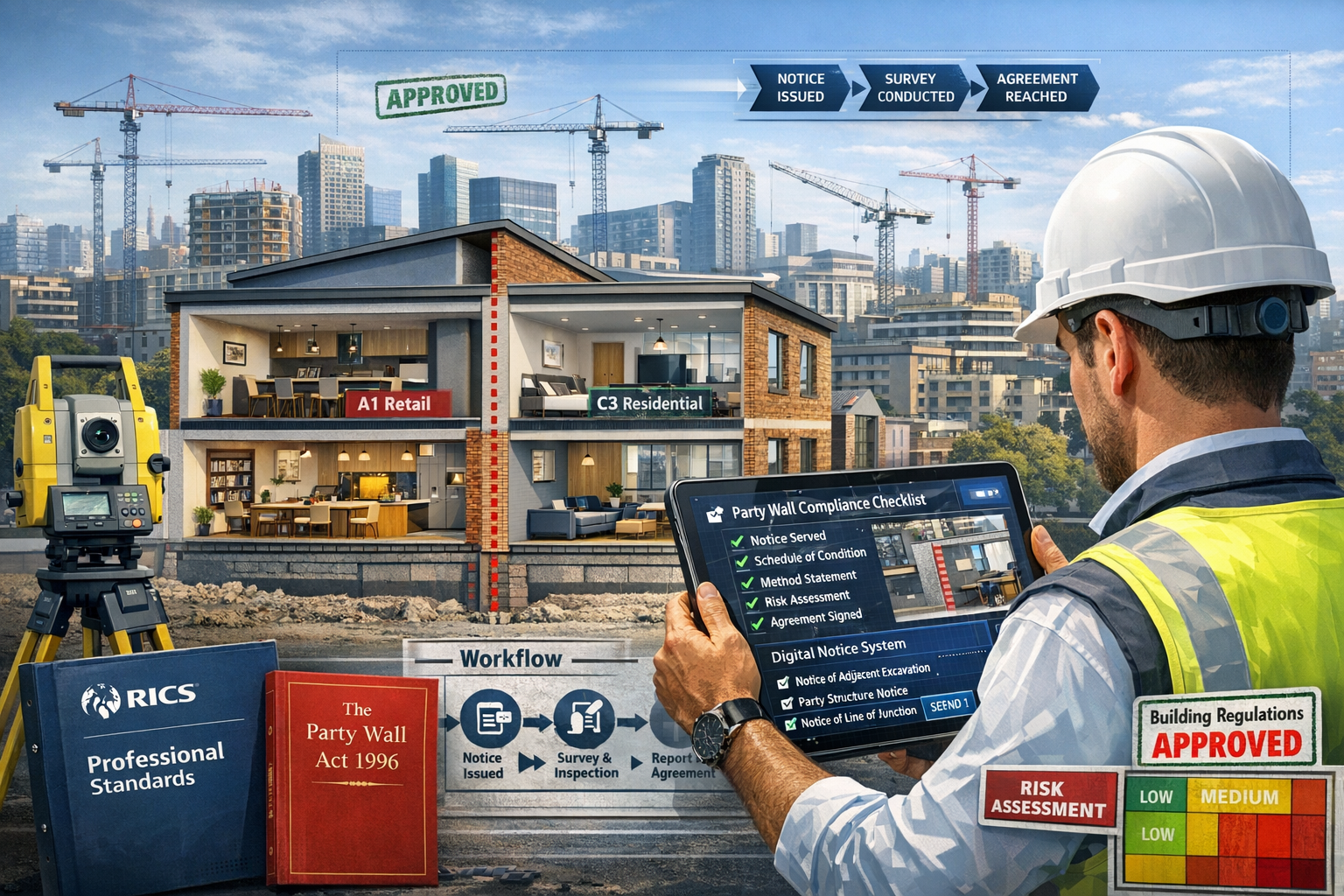
Successfully navigating Party Wall Surveys in Mixed-Use Development: Navigating 2026's Urban Intensification Projects requires a sophisticated blend of technical expertise, stakeholder management skills, regulatory knowledge, and practical problem-solving abilities. As urban centers continue densifying and mixed-use developments become the dominant form of new construction, party wall surveyors play an increasingly critical role in enabling responsible development while protecting property rights.
The key principles for success include:
🎯 Comprehensive stakeholder identification and engagement – Understanding the diverse interests within mixed-use buildings and tailoring communication approaches to each group's needs and concerns.
🎯 Meticulous technical documentation – Producing detailed condition surveys, drawings, and specifications that withstand scrutiny and provide clear evidence for dispute resolution.
🎯 Proactive risk management – Identifying potential issues early and implementing protective measures that prevent disputes rather than merely managing them after they arise.
🎯 Technology adoption – Leveraging digital tools, AI-driven precision, and remote monitoring capabilities to enhance efficiency and accuracy while reducing costs.
🎯 Market awareness – Understanding the broader construction market dynamics, labor constraints, and sector-specific trends that influence party wall procedures and stakeholder attitudes.
🎯 Professional standards maintenance – Adhering to RICS guidance, maintaining appropriate insurance, and investing in continuing professional development to ensure competence in this specialized field.
Actionable Next Steps
For building owners planning mixed-use development projects:
✅ Engage party wall surveyors early in the design process, ideally before submitting planning applications
✅ Conduct preliminary title investigations to identify all parties requiring notice service
✅ Budget adequately for party wall procedures, including surveyor fees, protective measures, and potential compensation
✅ Develop stakeholder engagement strategies appropriate to the mixed-use context
✅ Consider technology solutions for efficient notice service and construction monitoring
For adjoining owners receiving party wall notices:
✅ Seek professional advice promptly – the 14-day response deadline is strict
✅ Appoint an experienced party wall surveyor with mixed-use development expertise
✅ Document existing conditions thoroughly before works commence
✅ Maintain constructive communication with the building owner while protecting your rights
✅ Understand your rights to compensation for damage and loss of amenity
For property professionals developing party wall expertise:
✅ Invest in specialized training covering mixed-use development complexities
✅ Develop relationships with complementary professionals (structural engineers, building control officers)
✅ Build technology capabilities including BIM, digital surveying tools, and project management platforms
✅ Stay current with market trends, regulatory changes, and professional standards
✅ Consider professional membership organizations providing guidance and support
The urban intensification transforming cities in 2026 creates both challenges and opportunities for party wall professionals. Those who master the complexities of mixed-use developments, embrace technological innovation, and maintain unwavering professional standards will find themselves well-positioned to thrive in this dynamic market. By understanding the unique requirements of Party Wall Surveys in Mixed-Use Development: Navigating 2026's Urban Intensification Projects, surveyors contribute to sustainable urban growth that respects property rights while enabling the development cities need to accommodate growing populations and evolving economic activities.
For professional assistance with party wall surveys in mixed-use developments, consider consulting with experienced chartered surveyors who understand the unique challenges of urban intensification projects. Whether you're a building owner planning development or an adjoining owner protecting your interests, expert guidance ensures compliance with legal requirements while minimizing disruption and dispute risk.
References
[1] 2026 Construction Outlook Mixed Trends – https://dailyreporter.com/2026/01/14/2026-construction-outlook-mixed-trends/
[2] Post Alta Nsps 2026 Standards Implementation Challenges And Success Stories For Property Surveyors – https://nottinghillsurveyors.com/blog/post-alta-nsps-2026-standards-implementation-challenges-and-success-stories-for-property-surveyors
[3] Ai Driven Precision In Property Surveying How Artificial Intelligence Is Revolutionizing Workflows In 2026 – https://nottinghillsurveyors.com/blog/ai-driven-precision-in-property-surveying-how-artificial-intelligence-is-revolutionizing-workflows-in-2026
[4] Rics Monitor Why 2026 Is A Market Of Specific Opportunities – https://www.commercialsearch.com/news/rics-monitor-why-2026-is-a-market-of-specific-opportunities/
[5] Party Wall Faqs – https://jdmsurveyors.com/party-wall-faqs/