

The property market in 2026 stands at a critical crossroads. As mortgage rates gradually ease from their recent peaks and wage growth continues its upward trajectory, affordability dynamics are shifting unevenly across the United Kingdom. What appears as recovery in one region manifests as continued pressure in another, creating a complex landscape where traditional valuation methodologies face unprecedented challenges. For chartered surveyors tasked with delivering accurate property valuations, this environment demands nothing less than a fundamental recalibration of approach—one that balances technological innovation with professional judgment, regulatory compliance with market realities, and algorithmic precision with human expertise.
Valuation Accuracy in Uncertain Markets: How Chartered Surveyors Navigate Affordability Pressures in 2026 has emerged as the defining challenge for the profession. With asking prices adjusting to realistic levels in some markets while remaining stubbornly inflated in others, surveyors must navigate a minefield of competing pressures: lender requirements for conservative valuations, seller expectations shaped by outdated comparables, buyer affordability constraints, and regulatory demands for transparency and independence.
Key Takeaways
- Modern AI-driven valuation models have reduced median error rates to 3-5%, down from historical rates of 10-15%, while cutting valuation timeframes from weeks to minutes[1]
- New RICS standards on AI use in surveying practice take effect March 9, 2026, establishing clear frameworks for responsible automation while maintaining human oversight requirements[3]
- Affordability pressures vary significantly by region in 2026, requiring surveyors to develop localized methodologies that reflect actual market conditions rather than national trends[5]
- Enhanced governance requirements now mandate valuer independence, including rotation policies and audit committee oversight to eliminate conflicts of interest[2]
- The optimal approach combines algorithmic insights with professional judgment, particularly for unique properties or markets experiencing rapid change[1]
Understanding Valuation Accuracy in Uncertain Markets: How Chartered Surveyors Navigate Affordability Pressures in 2026
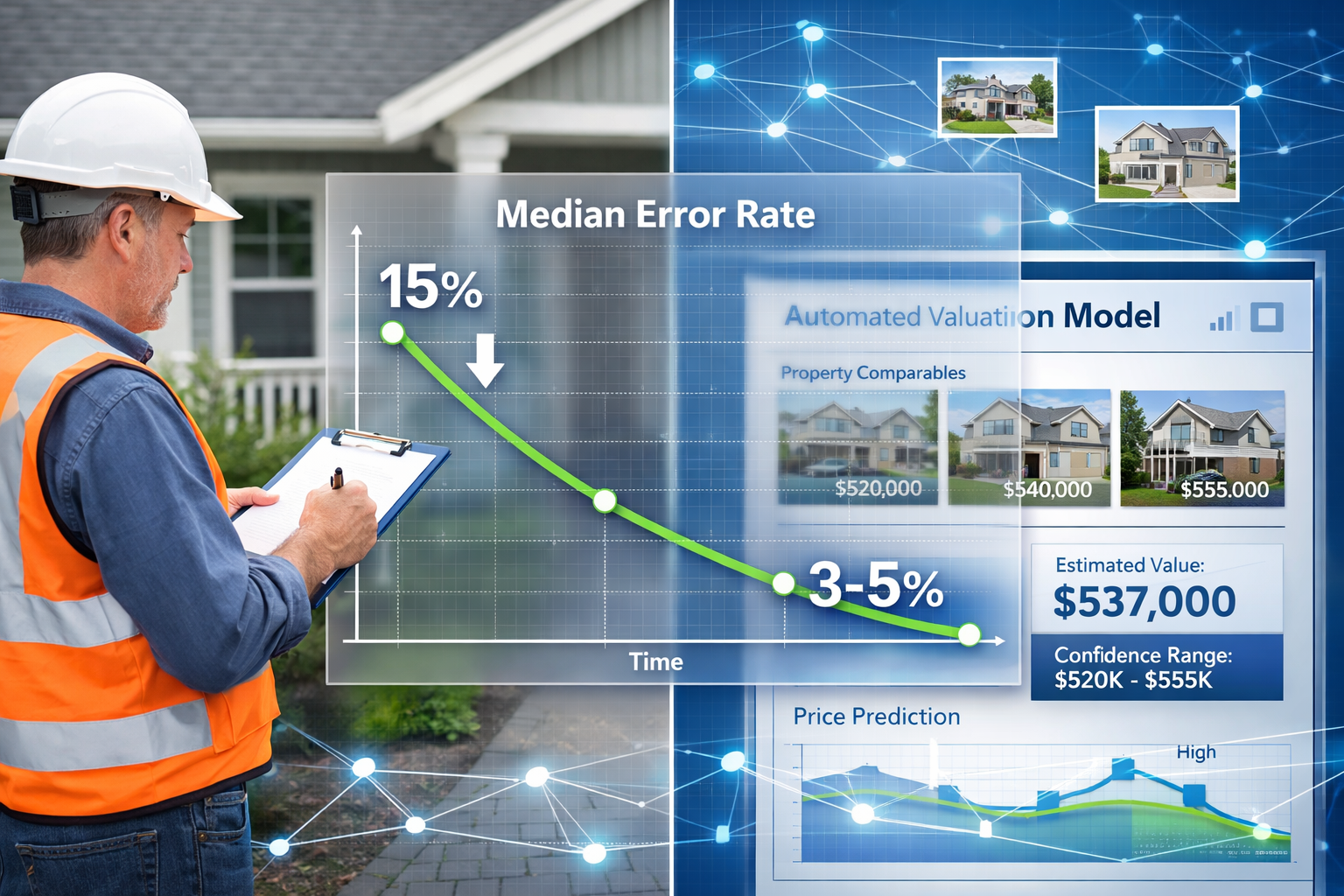
The concept of valuation accuracy has evolved dramatically over the past several years. Where once a variance of 10-15% from eventual sale price was considered acceptable, modern expectations—driven by both technological capabilities and regulatory scrutiny—now demand far greater precision. 📊
The New Accuracy Standards
Modern Automated Valuation Models (AVMs) now report median error rates of just 3-5%, representing a quantum leap in predictive capability[1]. This improvement stems from several technological advances:
- Machine learning algorithms that continuously refine their understanding of price determinants
- Vision and language processing that extracts value signals from property descriptions and photographs
- Real-time market data integration that captures sentiment shifts and emerging trends
- Adaptive modeling that adjusts weightings based on local market conditions
However, accuracy alone tells only part of the story. In uncertain markets characterized by affordability pressures, the type of accuracy matters enormously. A valuation that accurately reflects what a property should sell for under normal market conditions may prove wildly inaccurate when affordability constraints limit the buyer pool or when sellers refuse to adjust expectations to market realities.
The Affordability Context of 2026
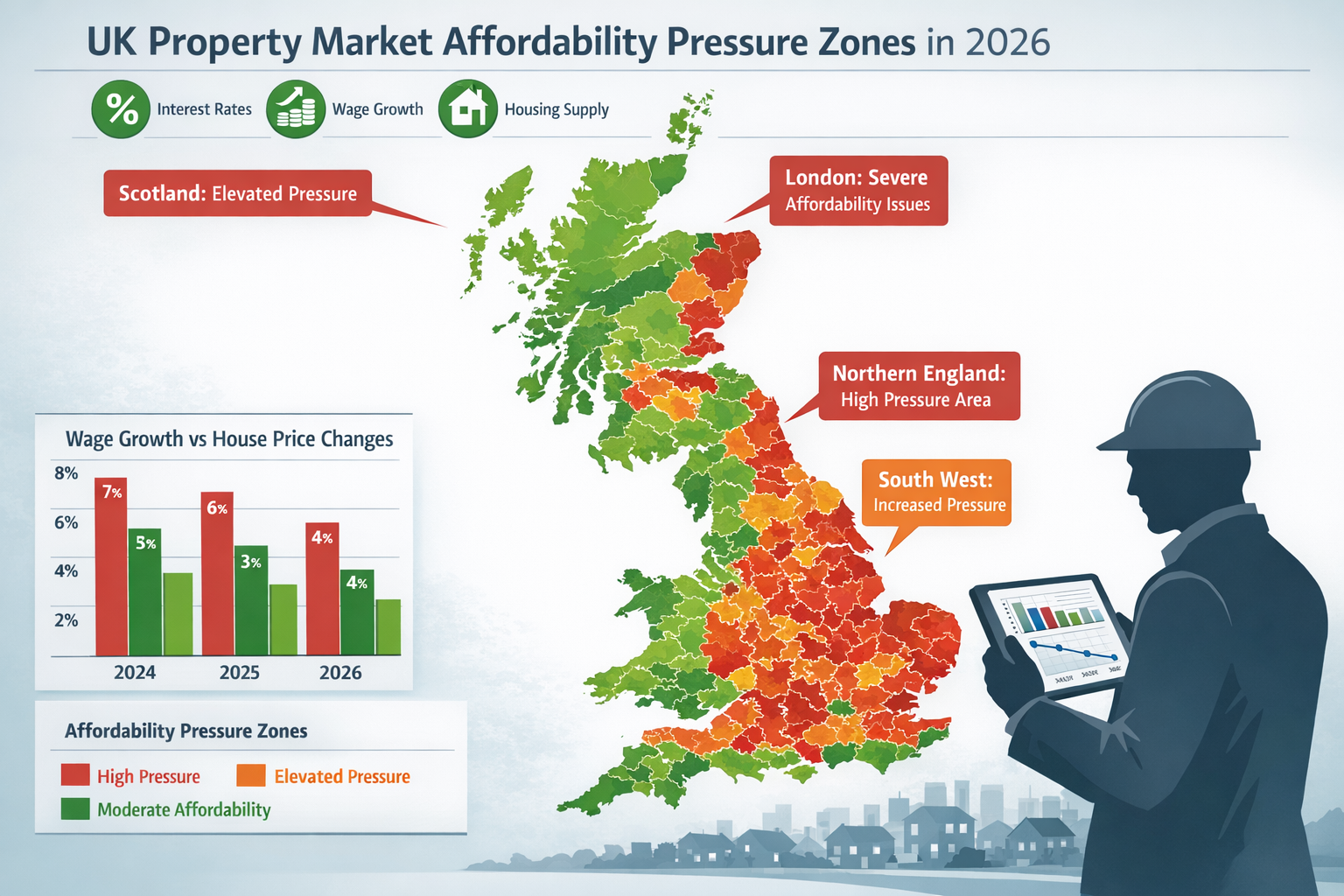
The affordability landscape in 2026 presents a complex picture. While mortgage rates have eased from their 2023-2024 peaks, they remain elevated compared to the ultra-low rates of the previous decade. Simultaneously, wage growth has continued, but unevenly across sectors and regions[5].
This creates several distinct market scenarios:
| Market Type | Characteristics | Valuation Challenge |
|---|---|---|
| Recovery Markets | Rates down, wages up, prices stabilizing | Identifying sustainable value vs. temporary corrections |
| Pressure Markets | High prices, limited wage growth | Distinguishing realistic from aspirational valuations |
| Transition Markets | Seller expectations adjusting downward | Timing the inflection point accurately |
| Stable Markets | Balanced supply/demand, steady affordability | Maintaining precision amid low transaction volumes |
Chartered surveyors operating across these varied conditions must develop market-specific methodologies rather than applying one-size-fits-all approaches. A capital gains valuation in Kingston might require fundamentally different assumptions than one in South East London, despite their geographic proximity.
The Technology Revolution: AI and Machine Learning in Property Valuation
The integration of artificial intelligence into property valuation represents perhaps the most significant methodological shift in the profession's history. Yet this revolution comes with important caveats and requirements that surveyors must navigate carefully.
How AI is Transforming Valuation Speed and Precision
The efficiency gains from AI adoption are staggering. Valuation processes that once consumed days or weeks now complete in seconds or minutes[1]. This acceleration stems from AI's ability to:
✅ Process vast comparable datasets instantaneously, identifying relevant transactions across multiple dimensions
✅ Analyze property imagery to extract condition, quality, and feature information without physical inspection
✅ Integrate textual descriptions to capture qualitative factors that influence buyer sentiment
✅ Model complex interactions between location, property characteristics, and market conditions
For routine valuations—particularly for annual tax purposes or insurance reinstatement cost assessments—these capabilities deliver unprecedented efficiency without sacrificing accuracy.
The RICS Framework for Responsible AI Use
Recognizing both the opportunities and risks inherent in AI adoption, the Royal Institution of Chartered Surveyors published comprehensive guidance that comes into practice on March 9, 2026[3]. This standard establishes clear boundaries for automation while preserving the essential role of professional judgment.
Key provisions include:
- Human accountability: Surveyors remain responsible for valuations even when AI tools generate initial estimates
- Transparency requirements: Disclosure of AI involvement in valuation processes
- Quality assurance protocols: Regular validation of algorithmic outputs against actual market outcomes
- Bias monitoring: Ongoing assessment to ensure AI models don't perpetuate or amplify market inequities
- Limitation recognition: Clear understanding of scenarios where AI reliability diminishes
The standard explicitly acknowledges that full automation of high-stakes professional opinion is unlikely to meet RICS standards without human involvement[3]. This reflects a pragmatic recognition that while AI excels at pattern recognition across large datasets, it struggles with:
- Unique or unusual properties with few true comparables
- Rapidly changing market conditions where historical patterns break down
- Properties with significant defects or renovation requirements
- Complex legal situations such as leasehold extension valuations
The Optimal Human-AI Partnership
The emerging best practice combines algorithmic power with professional expertise in a structured workflow:
- AI generates initial valuation range based on comprehensive comparable analysis
- System flags confidence level based on data quality and market stability
- Surveyor reviews algorithmic reasoning and identifies potential blind spots
- Professional judgment adjusts for factors AI cannot adequately capture
- Final valuation includes explanation of human override decisions when applicable
This combined human-AI approach is becoming the industry standard[1], particularly for high-value transactions or properties in markets experiencing affordability pressures. The surveyor's role evolves from data gatherer to quality controller and expert interpreter—a shift that demands new skills while preserving the irreplaceable value of professional judgment.
Regional Variations and Market-Specific Challenges in 2026
One of the most significant challenges facing chartered surveyors in 2026 is the dramatic variation in market conditions across regions and property segments. National statistics obscure local realities, making generalized valuation approaches increasingly unreliable.
Understanding Regional Affordability Dynamics
The affordability equation—the relationship between property prices, mortgage costs, and household incomes—varies enormously across the UK. In 2026, several distinct patterns have emerged:
London and the South East continue to experience the most acute affordability pressures. Despite some price adjustments from peak levels, the ratio of median house prices to median incomes remains at historically elevated levels. For chartered surveyors in Esher, Putney, and similar affluent areas, this creates particular challenges in distinguishing sustainable valuations from those dependent on continued access to high-income buyers or significant deposits.
Regional cities present a more mixed picture. Markets that experienced significant pandemic-era price growth are now adjusting, with asking prices coming down to meet buyer affordability. Surveyors must carefully assess whether observed transaction prices represent a new equilibrium or a temporary trough before further adjustment.
Former industrial areas experiencing regeneration face unique valuation challenges. Rapid neighborhood transformation can render historical comparables nearly useless, while future value depends heavily on infrastructure investment timelines and employment growth—factors with significant uncertainty.
Adjusting Methodologies for Local Realities
Effective valuation in this fragmented market requires localized methodological adjustments:
Comparable selection criteria must be tightened geographically while expanding temporally in slow-moving markets. A six-month lookback period might capture adequate data in active markets but prove insufficient in areas with limited transactions.
Adjustment factors for property differences must reflect local buyer priorities. Energy efficiency commands premium pricing in some markets while barely registering in others. Period features add significant value in heritage-conscious areas but may represent maintenance burdens elsewhere.
Market condition adjustments become critical when valuing properties in transitioning markets. A comparable sale from three months ago may require significant downward adjustment if asking prices have since declined to meet affordability constraints.
Buyer pool analysis helps surveyors understand realistic demand. A property priced beyond local affordability depends on attracting buyers from outside the immediate area—a significantly less certain proposition that should influence valuation confidence levels.
For surveyors working across multiple regions, developing and maintaining this localized expertise represents a significant investment. However, it's essential for delivering valuations that accurately reflect market realities rather than statistical averages that may not apply to any specific property.
Special Considerations for Unique Property Types
Certain property categories present heightened challenges in uncertain markets:
New build properties require careful assessment of the gap between developer pricing and resale values. Survey requirements for new builds differ from existing properties, but valuation challenges intensify when developer incentives mask true market values.
Leasehold properties with short remaining terms face particular uncertainty. Leasehold extension valuations must account for both current market conditions and likely future scenarios when the lease becomes unmortgageable.
Properties requiring significant renovation present dual challenges: estimating both current condition value and post-improvement value in markets where buyer appetite for projects fluctuates with economic confidence.
Rural and unique properties with limited comparables require greater reliance on professional judgment, making the human element of the human-AI partnership particularly critical.
Enhanced Governance and Independence Requirements
Parallel to technological transformation, the valuation profession has experienced significant regulatory evolution focused on independence, transparency, and accountability. These changes directly impact how chartered surveyors structure their practices and client relationships.
The Independent RICS Review Recommendations
An independent review established 13 key recommendations covering critical aspects of valuation practice[2]. These recommendations emerged from analysis of valuation failures and regulatory concerns, particularly in commercial property and financial reporting contexts, but have implications across all valuation work.
Core recommendations include:
🔍 Independence structures: Valuers should be commissioned by and report to an independent Chair of an Audit Committee rather than management with direct interest in asset values
🔍 Mandatory rotation: Maximum valuer tenure of 9 years for standard work, reduced to 5 years for high-risk valuations, with some European jurisdictions implementing 3-year cycles
🔍 Audit trails: Comprehensive recording of client-valuer meetings, discussions, and decision rationale
🔍 Quality assurance: Systematic review processes including file reviews, peer challenges, and outcome analysis
🔍 Methodology disclosure: Clear explanation of valuation approaches, assumptions, and limitations
🔍 Risk assessment: Formal evaluation of valuation complexity, market uncertainty, and potential conflicts
Practical Implementation for Chartered Surveyors
While these recommendations initially targeted large-scale commercial valuations, the principles cascade throughout the profession. Surveyors conducting residential valuations increasingly face similar expectations:
Documentation standards have risen substantially. Comprehensive file notes explaining comparable selection, adjustment rationale, and professional judgment override decisions are now essential. This documentation serves multiple purposes: supporting the valuation if challenged, enabling quality review, and providing audit trails for regulatory examination.
Client relationship management requires greater formality. Clear engagement letters specifying scope, limitations, and independence provisions protect both surveyor and client. When preparing properties for market, surveyors must maintain appropriate boundaries between advisory and valuation roles.
Conflict identification demands systematic processes. Surveyors must proactively identify potential conflicts—previous work for the client, relationships with transaction parties, or financial interests in outcomes—and implement appropriate safeguards or decline instructions.
Quality assurance programs should include regular file reviews, comparison of valuations against subsequent sale prices, and peer consultation on complex or unusual cases. These practices not only satisfy regulatory expectations but genuinely improve accuracy.
Balancing Independence with Client Service
The enhanced independence requirements create tension with traditional client relationship models. Long-standing client relationships built on trust and understanding can deliver better outcomes through deep knowledge of client portfolios and requirements. Yet these same relationships create potential independence concerns.
The solution lies in structural safeguards and transparency:
- Clear policies on rotation and tenure limits
- Documented procedures for managing conflicts
- Transparent disclosure of relationships in valuation reports
- Independent review of valuations where independence might be questioned
- Separation of advisory and valuation functions within practices
For smaller surveying practices, implementing these safeguards while maintaining client relationships requires thoughtful design. However, the investment pays dividends through enhanced credibility, reduced liability risk, and alignment with evolving professional standards.
Valuation Accuracy in Uncertain Markets: Practical Strategies for Chartered Surveyors
With the technological, regulatory, and market context established, what practical strategies should chartered surveyors employ to maintain valuation accuracy while navigating affordability pressures in 2026?
Strategy 1: Develop Robust Market Intelligence Systems
Accurate valuation depends fundamentally on current market knowledge. In uncertain markets, this knowledge must extend beyond transaction data to encompass:
Leading indicators such as mortgage application volumes, viewing-to-offer ratios, and time-on-market trends that signal shifting demand before transaction data reflects it
Affordability metrics including local wage data, mortgage availability at different price points, and buyer demographic shifts
Sentiment indicators from estate agents, mortgage brokers, and other market participants who observe buyer behavior in real-time
Policy developments affecting affordability such as Help to Buy scheme changes, stamp duty adjustments, or planning policy reforms
Surveyors in Kingston or South East London benefit from developing systematic intelligence-gathering processes that capture these diverse inputs and synthesize them into actionable market understanding.
Strategy 2: Implement Tiered Confidence Frameworks
Not all valuations carry equal certainty. Transparent communication of confidence levels serves both professional integrity and client needs:
High confidence valuations in active markets with abundant comparables and stable conditions warrant narrow valuation ranges and firm opinions
Moderate confidence valuations in transitioning markets or for properties with fewer comparables should acknowledge uncertainty through wider ranges or explicit caveats
Low confidence valuations for unique properties in uncertain markets require extensive qualification and may benefit from scenario-based approaches presenting multiple outcomes under different market assumptions
This tiered approach aligns with the RICS AI guidance[3] requiring disclosure of algorithmic confidence levels and extends the principle to overall professional opinion.
Strategy 3: Master the Art of Comparable Adjustment
In markets experiencing affordability pressures, the skill of comparable adjustment becomes paramount. Simple per-square-foot or percentage adjustments often prove inadequate when:
- Market conditions shift rapidly between comparable sale and valuation dates
- Affordability constraints affect different price segments differently
- Property features command varying premiums in changing markets
Advanced adjustment techniques include:
📐 Paired sales analysis comparing similar properties that differ in specific features to quantify adjustment factors empirically
📐 Time-trend analysis tracking how specific property types perform relative to market averages over time
📐 Segmented modeling developing separate adjustment frameworks for different price tiers or property types
📐 Buyer motivation analysis considering how affordability pressures affect the premium for specific features
These techniques demand greater analytical rigor but deliver materially improved accuracy in uncertain markets.
Strategy 4: Leverage Technology While Maintaining Professional Skepticism
The optimal use of AI and machine learning requires neither blind faith nor Luddite rejection. Instead, surveyors should:
Understand algorithmic logic: Know what data feeds the model, how it weights different factors, and where its blind spots lie
Validate outputs systematically: Compare AI-generated valuations against professional judgment and investigate significant discrepancies
Override when appropriate: Don't defer to algorithmic authority when professional knowledge suggests different conclusions
Document reasoning: Explain both agreement with and departures from AI recommendations
Monitor performance: Track how AI valuations perform against subsequent market outcomes and refine usage accordingly
This approach treats AI as a powerful tool that enhances but doesn't replace professional expertise—precisely the model the RICS framework envisions[3].
Strategy 5: Build Multidisciplinary Collaboration
Complex valuations in uncertain markets often benefit from multidisciplinary input:
Building surveyors provide essential insight into condition, defects, and renovation requirements that affect value. Understanding what to look for when buying an old house or recognizing common defects in older homes directly impacts valuation accuracy.
Planning specialists assess development potential and constraint risks that may not be apparent from standard searches
Market researchers provide demographic and economic analysis informing demand projections
Legal experts clarify complex tenure issues, particularly for leasehold extension valuations or properties with unusual restrictions
Mortgage brokers offer real-world perspective on lending appetite and buyer affordability at different price points
Building networks with these complementary professionals enhances valuation quality while creating referral opportunities and professional development.
Strategy 6: Invest in Continuous Professional Development
The rapid pace of change in valuation practice—technological, regulatory, and methodological—demands ongoing learning:
Technical skills in data analysis, statistical modeling, and AI literacy become increasingly important
Market knowledge requires continuous updating as affordability dynamics shift
Regulatory awareness ensures compliance with evolving standards like the March 2026 RICS AI guidance[3]
Soft skills in client communication, conflict management, and professional judgment articulation grow in importance as valuations become more complex
Surveyors who view professional development as investment rather than obligation position themselves for success in an evolving profession.
Case Studies: Valuation Challenges and Solutions in 2026
Examining specific scenarios illustrates how chartered surveyors apply these principles in practice:
Case Study 1: The Overpriced Suburban Semi
Scenario: A 1930s semi-detached property in a commuter town, listed at £525,000 based on a comparable sale six months prior. The surveyor's instruction is for mortgage valuation purposes.
Challenge: The market has shifted significantly in six months. Mortgage rates have declined slightly, improving affordability, but asking prices remain elevated. Recent listings show properties sitting unsold, with several price reductions.
Approach:
- AI valuation model suggests £510,000 based on historical comparables
- Surveyor identifies that recent comparables required 8-12 weeks to sell versus 4-6 weeks historically
- Analysis of withdrawn listings reveals several properties initially priced at £520,000+ failed to sell
- Recent sales at £485,000-£495,000 represent properties that adjusted to market reality
- Surveyor values at £490,000, explaining the market condition adjustment and noting limited buyer pool at higher price points
Outcome: The valuation proves accurate when the property eventually sells at £487,500 after the seller reduces the asking price. The lender avoids over-lending based on inflated comparables.
Case Study 2: The Unique Period Property
Scenario: A Grade II listed Georgian townhouse in a market town with few comparables and significant character features but also substantial maintenance requirements.
Challenge: AI models struggle with unique properties. The three most recent comparables span 18 months and vary significantly in condition and features. The property requires specialist heritage maintenance knowledge.
Approach:
- Surveyor recognizes AI confidence level is low due to limited comparables
- Engages building surveyor colleague to assess maintenance requirements and costs
- Researches buyer demographics for period properties in the area
- Identifies that the market for high-maintenance period properties has softened as affordability pressures make buyers more cost-conscious
- Develops scenario-based valuation: £675,000 assuming heritage-appreciative buyer, £625,000 for mainstream market
- Recommends £640,000 as realistic market value with detailed explanation of uncertainty
Outcome: The property takes four months to sell at £638,000 to a buyer specifically seeking a period property, validating the surveyor's nuanced approach.
Case Study 3: The New Build Premium Puzzle
Scenario: A new build apartment in a development offering significant incentives including stamp duty payment, furniture packages, and Help to Buy.
Challenge: Developer pricing at £385,000 doesn't reflect true market value once incentives are removed. Comparable resales of similar units in the development sold at £340,000-£350,000.
Approach:
- Surveyor quantifies incentive value at approximately £25,000
- Reviews resale comparables showing 10-12% discount to new build pricing
- Assesses whether the development has reached sales velocity justifying pricing or if incentives mask weak demand
- Values at £355,000, explicitly noting the new build premium and incentive adjustments
- Flags to lender that resale value may differ from purchase price
Outcome: The valuation protects the lender from over-exposure while providing clear rationale for the valuation approach. Understanding survey requirements for new builds proves essential to accurate assessment.
The Future of Valuation Practice: Trends Beyond 2026

While this article focuses on 2026 challenges, understanding emerging trends helps surveyors prepare for continued evolution:
Increasing Data Granularity
Property data continues to become more granular and accessible. Future valuation models may incorporate:
- Energy performance data linked to actual consumption and cost, not just EPC ratings
- Neighborhood amenity scores based on walkability, school quality, and transport access
- Environmental risk metrics including flood, subsidence, and climate change exposure
- Smart home technology valuations as connected homes become standard
Blockchain and Property Records
Distributed ledger technology promises to revolutionize property records, potentially enabling:
- Instant verification of ownership, charges, and transaction history
- Transparent comparable data with complete transaction details
- Automated compliance with regulatory requirements through smart contracts
- Reduced fraud risk through immutable record-keeping
Sustainability Integration
Environmental considerations increasingly influence value:
- Carbon pricing may create explicit value differentials based on property efficiency
- Retrofit requirements could impose costs on inefficient properties affecting value
- Climate resilience becomes a valuation factor as extreme weather increases
- Green premium quantification becomes more sophisticated and evidence-based
Regulatory Evolution
Professional standards will continue adapting:
- Enhanced transparency requirements for valuation methodology and assumptions
- Standardized reporting formats enabling better comparable analysis and quality review
- Continuing competence requirements ensuring surveyors maintain current knowledge
- Technology governance frameworks evolving as AI capabilities advance
Chartered surveyors who anticipate and prepare for these trends position themselves as leaders rather than followers in professional evolution.
Conclusion: Excellence in Uncertain Times
Valuation Accuracy in Uncertain Markets: How Chartered Surveyors Navigate Affordability Pressures in 2026 represents both challenge and opportunity for the profession. The convergence of technological transformation, regulatory evolution, and market uncertainty creates complexity unprecedented in modern practice.
Yet this complexity also elevates the value of professional expertise. As AI handles routine analysis, the surveyor's role as expert interpreter, quality controller, and professional judgment provider becomes more rather than less critical. The properties and markets most affected by affordability pressures—those experiencing rapid change, those with unique characteristics, those in transition—are precisely the ones where human expertise proves irreplaceable.
Success in this environment requires:
✅ Embracing technology while maintaining appropriate skepticism and human oversight
✅ Developing deep market knowledge that extends beyond transaction data to encompass affordability dynamics, buyer behavior, and leading indicators
✅ Implementing robust governance that ensures independence, transparency, and accountability
✅ Investing in continuous learning to maintain technical competence and regulatory compliance
✅ Building collaborative networks that bring multidisciplinary expertise to complex valuations
✅ Communicating uncertainty transparently rather than projecting false precision
✅ Maintaining professional integrity even when client pressures encourage optimistic valuations
The chartered surveyors who thrive in 2026 and beyond will be those who view these challenges not as burdens but as opportunities to demonstrate professional value. By combining cutting-edge analytical tools with timeless professional judgment, by balancing efficiency with thoroughness, and by maintaining unwavering commitment to accuracy and independence, the profession can navigate uncertain markets while serving clients, lenders, and the broader public interest.
Actionable Next Steps
For chartered surveyors seeking to enhance their practice:
-
Review and update technology infrastructure to incorporate appropriate AI tools while implementing quality assurance protocols aligned with RICS guidance effective March 9, 2026[3]
-
Develop systematic market intelligence processes capturing affordability metrics, sentiment indicators, and leading signals beyond transaction data
-
Implement enhanced documentation standards creating comprehensive audit trails for comparable selection, adjustments, and professional judgment decisions
-
Establish independence safeguards including conflict identification procedures, rotation policies where appropriate, and transparent client relationship disclosures
-
Invest in professional development focusing on data analytics, market analysis, regulatory compliance, and emerging technologies
-
Build collaborative networks with building surveyors, planning specialists, and other professionals who enhance valuation quality
-
Engage with professional bodies to stay current on evolving standards, share best practices, and contribute to professional development
The path forward requires both humility—recognizing the genuine uncertainty in current markets—and confidence in the enduring value of professional expertise. By combining these qualities with technological competence and unwavering ethical standards, chartered surveyors can deliver the valuation accuracy that uncertain markets demand.
References
[1] How Ai And Machine Learning Are Reshaping Property Valuations In 2026 – thepaintedhinge.com
[2] Independent Review Of Real Estate Valuations By Rics – altusgroup.com
[3] What Surveyors Think Ai – ww3.rics.org
[4] Post Alta Nsps 2026 Standards Implementation Challenges And Success Stories For Property Surveyors – nottinghillsurveyors.com
[5] Forecasting The Future What To Expect From House Prices In 2026 – surveyingcorp.com
[6] Navigating The 2026 Land Survey Equipment Boom Total Stations Gps And Laser Scanners Reviewed – nottinghillsurveyors.com