

Dilapidation Survey: The Complete Guide to Protecting Your Property in 2026
Imagine watching helplessly as cracks appear in your walls while construction roars next door—but having no proof that your property was pristine before the work began. This nightmare scenario unfolds more often than most property owners realize, resulting in costly disputes, lengthy legal battles, and uncompensated damage. A dilapidation survey serves as your insurance policy against such scenarios, providing irrefutable evidence of your property’s condition before nearby construction, demolition, or infrastructure work begins.
Whether you’re a homeowner facing nearby excavation, a commercial property owner adjacent to major development, or a contractor seeking to protect your interests, understanding dilapidation surveys can save thousands of pounds and countless headaches. This comprehensive guide explores everything you need to know about these critical property assessments in 2026.
Key Takeaways
- A dilapidation survey creates a detailed baseline record of property conditions before construction work begins, documenting existing damage and structural integrity through photographs, measurements, and written descriptions
- These surveys protect all parties by providing independent evidence that prevents disputes, supports insurance claims, and establishes clear accountability for any new damage
- Multiple inspection types exist including pre-construction condition surveys, Schedule of Dilapidations for commercial leases, and post-construction follow-up assessments
- Advanced technology enhances accuracy with drones, 360° cameras, laser measuring equipment, and thermal imaging capturing comprehensive property documentation
- Legal requirements vary by location and project type, with mandatory surveys often required for excavation, demolition, and large-scale construction projects
What Is a Dilapidation Survey?
A dilapidation survey is a detailed inspection and documentation of a property’s current condition, typically conducted before construction, demolition, or significant infrastructure work takes place nearby. This comprehensive assessment creates an irrefutable baseline record that captures the property’s structural integrity, existing defects, and overall state at a specific point in time.[1]
The survey serves as a protective measure for both property owners and contractors. For owners, it provides evidence of pre-existing conditions should damage occur during nearby works. For contractors and developers, it offers protection against false claims for damage that existed before their project commenced.[1]
Core Components of a Dilapidation Report
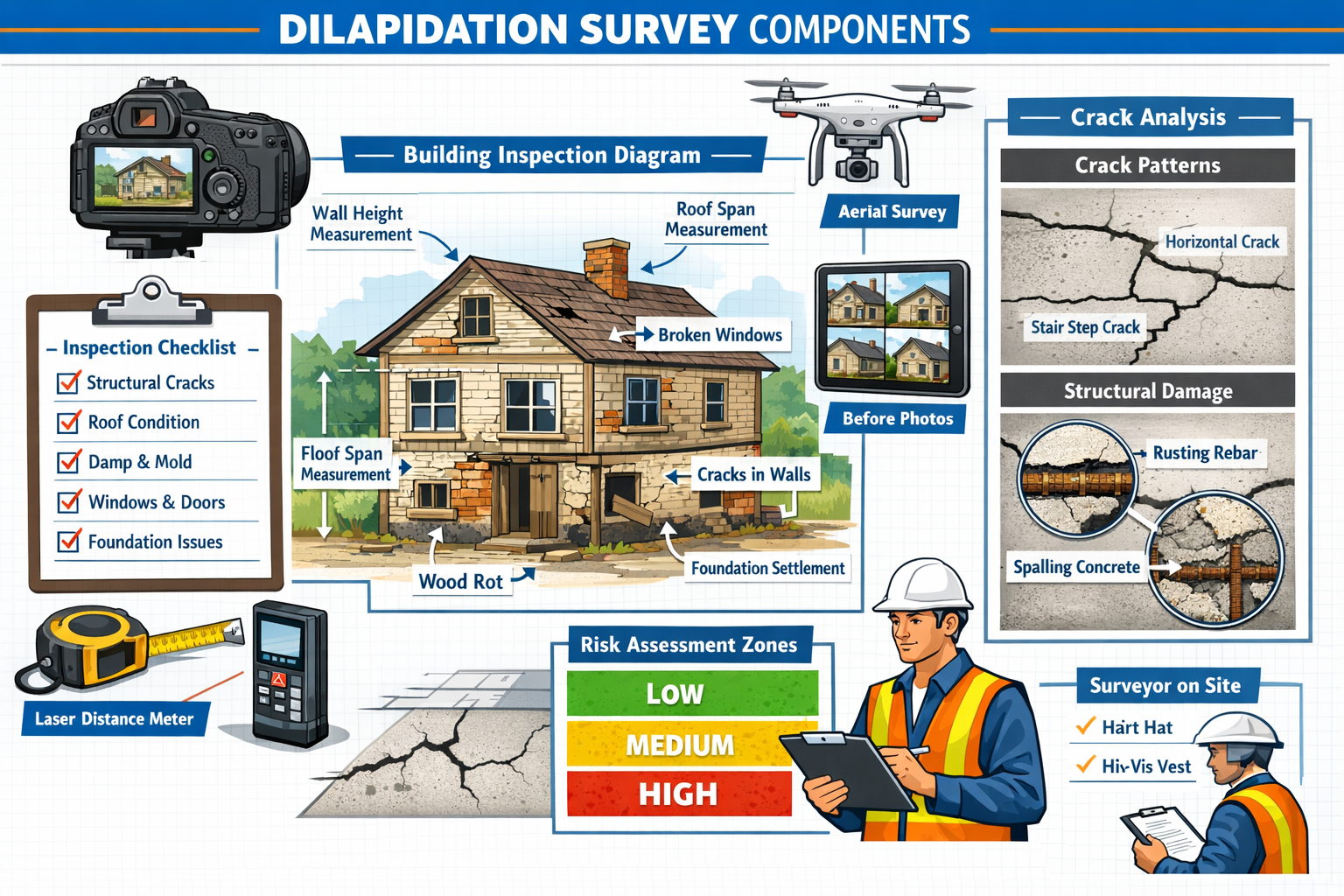
A thorough dilapidation survey includes several essential elements that work together to create a complete picture of property conditions:[1]
📸 Photographic Evidence: High-resolution images of all property areas, including:
- External walls and facades
- Internal walls, ceilings, and floors
- Structural elements like beams and columns
- Existing cracks, stains, or defects
- Driveways, paths, and boundary features
📝 Written Descriptions: Detailed narrative accounts describing:
- The condition of each room or area
- Existing damage with severity assessments
- Materials and construction methods observed
- Notable features or concerns
📏 Measurements and Diagrams: Technical documentation including:
- Annotated floor plans
- Crack width measurements
- Level readings for floors and foundations
- Distance measurements for reference points
🔍 Inspection Notes: Professional observations regarding:
- Structural soundness
- Signs of movement or settlement
- Water damage or dampness
- Material deterioration
⚠️ Risk Assessments: Evaluation of potential vulnerabilities to construction impacts
💡 Recommendations: Suggested protective measures or monitoring requirements
Understanding what questions should be asked during a building survey can help property owners prepare for the dilapidation inspection process.
Types of Dilapidation Surveys and When They’re Needed
Different situations call for different types of dilapidation assessments. Understanding which survey you need ensures appropriate protection for your specific circumstances.
Pre-Construction Condition Surveys
These surveys document property conditions before nearby construction begins. They’re essential when:[1]
- Residential construction is planned adjacent to your property
- Commercial building projects will involve heavy machinery or excavation
- Excavation work extends below your foundation level
- Demolition activities could cause vibration or debris impact
- Major landscaping involves earth movement or tree removal
- Infrastructure projects like road widening or utility installation affect your area
Pre-construction surveys typically occur 1-2 weeks before work commences, allowing time for report preparation while ensuring conditions haven’t changed significantly.
Schedule of Dilapidations (Commercial Leases)
For commercial tenants, a Schedule of Dilapidations represents a different but related concept. This document outlines repair obligations under a lease agreement, identifying:[7]
- Breaches of repair covenants
- Required remedial works
- Estimated costs for compliance
- Decorative condition standards
Commercial tenants should understand dilapidation protocols to avoid unexpected end-of-lease costs.
Post-Construction Follow-Up Inspections
Follow-up surveys compare current conditions against the baseline report to identify any new damage. These inspections are recommended:[1]
✅ After construction completion
✅ During significant project delays
✅ When construction plans change substantially
✅ When additional works are introduced
✅ When disputes arise about responsibility
Specialist Dilapidation Assessments
Certain projects require specialized survey approaches:
Infrastructure Projects: Government and council works often mandate dilapidation surveys for affected properties, with requirements varying by jurisdiction.[1]
Strata and Multi-Unit Buildings: Body corporates may commission surveys to protect common property when adjacent development occurs.[1]
Heritage Properties: Listed buildings require particularly detailed documentation given their historical significance and vulnerability to construction impacts.
For properties requiring comprehensive structural assessment, a Level 3 full building survey provides the most detailed evaluation available.
The Dilapidation Survey Process: Step-by-Step
Understanding what happens during a dilapidation survey helps property owners prepare effectively and ensures nothing is overlooked.
Step 1: Initial Consultation and Scope Definition
The process begins with discussing:
- The nature of planned construction work
- Property type, age, and construction
- Specific concerns or vulnerable areas
- Timeline requirements
- Access arrangements
Step 2: Pre-Inspection Preparation
Property owners should:
🔑 Ensure full access to all areas including basements, lofts, and outbuildings
🧹 Clear obstructions that might prevent inspection of walls, floors, or structural elements
📋 Gather relevant documentation like previous surveys, planning permissions, or repair records
🗓️ Schedule the inspection when lighting conditions are optimal
Step 3: On-Site Inspection
Professional surveyors conduct systematic examinations using:[2]
Advanced Technology:
- Drones for roof and high-level inspections
- 360° cameras mounted on vehicles for comprehensive exterior documentation
- Laser measuring equipment for precise dimensional recording
- Thermal imaging to detect hidden moisture or insulation issues
- Underground pipe detection equipment when excavation is planned
Traditional Methods:
- Visual inspection of all accessible areas
- Crack width measurement using gauges
- Level checks for floors and thresholds
- Material condition assessment
- Photographic documentation from multiple angles
The inspection typically takes 2-4 hours for residential properties and longer for commercial buildings, depending on size and complexity.
Step 4: Report Compilation
Surveyors prepare comprehensive reports containing:[1]
📊 Executive Summary: Overview of property condition and key findings
🏠 Property Description: Address, type, age, construction details
📸 Photographic Schedule: Numbered images corresponding to written descriptions
📝 Room-by-Room Assessment: Detailed condition notes for each area
📐 Annotated Plans: Diagrams showing defect locations
⚠️ Defect Schedule: Table listing existing damage with severity ratings
💼 Conclusions and Recommendations: Professional opinions on vulnerabilities and protective measures
Step 5: Report Delivery and Review
Reports are typically delivered within 5-10 working days. Property owners should:
- Review the report thoroughly
- Raise questions about unclear findings
- Share copies with relevant parties (contractors, insurers, legal advisors)
- Store the report securely for future reference
Understanding building pathology principles helps interpret survey findings and their implications.
Step 6: Ongoing Monitoring (If Required)
For extended construction projects, periodic monitoring visits may be recommended to:
- Track any progressive changes
- Document construction impacts as they occur
- Provide early warning of developing issues
- Update the condition record
Who Benefits from a Dilapidation Survey?
Dilapidation surveys serve multiple stakeholders, each gaining specific protections and advantages.[1]
Property Owners and Occupiers
Benefits:
- 🛡️ Protection against unwarranted damage claims: Clear evidence of pre-existing conditions
- 💰 Insurance claim support: Documentation assists with claims if damage occurs
- ⚖️ Legal evidence: Court-admissible records for dispute resolution
- 🔍 Peace of mind: Knowing your property’s baseline condition is recorded
When particularly valuable:
- Older properties more vulnerable to vibration damage
- Properties with existing minor defects that could be blamed on construction
- High-value properties where damage costs would be substantial
- Properties with previous settlement or structural issues
Builders and Contractors
Benefits:
- 📋 Protection against false claims: Evidence that damage existed before work began
- 🤝 Improved client relationships: Demonstrates professionalism and transparency
- ⏱️ Reduced dispute resolution time: Clear baseline eliminates speculation
- 💼 Insurance premium benefits: Some insurers offer reduced rates for contractors using dilapidation surveys
Developers and Project Managers
Benefits:
- 📊 Risk management: Identifies vulnerable neighboring properties requiring special precautions
- 📅 Project planning: Informs construction methodology to minimize impact
- 💬 Stakeholder communication: Provides objective basis for discussions with affected parties
- 🏗️ Compliance: Meets council and regulatory requirements in many jurisdictions
Councils and Local Authorities
Benefits:
- 🏛️ Public infrastructure protection: Documents conditions before roadworks or utility projects
- 📜 Regulatory compliance: Fulfills duty of care to affected property owners
- 💵 Budget management: Establishes clear liability boundaries for damage claims
- 📑 Record keeping: Creates permanent records for future reference
For projects in specific areas, working with chartered surveyors in London ensures local expertise and regulatory knowledge.
Legal Requirements and Regulatory Framework
The legal landscape surrounding dilapidation surveys varies significantly by jurisdiction, project type, and property classification.
UK Regulatory Context
In the United Kingdom, dilapidation surveys aren’t universally mandated by law, but several situations create practical or contractual requirements:
Party Wall Act 1996: While not explicitly requiring dilapidation surveys, the Act’s provisions for protecting neighboring properties make surveys highly advisable when:[4]
- Building on or at a boundary wall
- Excavating within 3-6 meters of a neighboring structure
- Undertaking works affecting shared structures
Commercial Lease Obligations: Most commercial leases include repair covenants requiring tenants to maintain properties and return them in good condition. Dilapidation surveys at lease commencement and termination establish baseline and final conditions.[7]
Planning Conditions: Local planning authorities may impose conditions requiring condition surveys of neighboring properties for:[4]
- Basement excavations
- Demolition projects
- Major structural alterations
- Works affecting conservation areas
Construction Design and Management (CDM) Regulations 2015: These regulations require risk assessment and management, which often necessitates understanding neighboring property conditions.
Professional Standards
The Royal Institution of Chartered Surveyors (RICS) provides guidance on dilapidation assessments through various publications and professional standards.[5][6] RICS-qualified surveyors follow established protocols ensuring:
- Consistent methodology
- Professional indemnity insurance coverage
- Ethical conduct
- Competent technical assessment
When selecting a surveyor, verify their RICS membership and relevant experience with similar property types.
Insurance Considerations
Many construction insurance policies require or strongly recommend pre-construction condition surveys. Benefits include:
- Faster claim processing: Pre-existing documentation speeds assessment
- Reduced premium disputes: Clear baseline prevents arguments about damage causation
- Coverage eligibility: Some policies mandate surveys for certain work types
Property owners should review their insurance policies and consult insurers before nearby construction begins.
Common Issues Identified in Dilapidation Surveys
Understanding typical findings helps property owners recognize what surveyors look for and why certain defects matter.
Structural Concerns
Cracking: The most common finding, with significance varying by:[1]
| Crack Width | Severity | Typical Cause | Concern Level |
|---|---|---|---|
| <0.1mm | Hairline | Plaster shrinkage, minor settlement | Low |
| 0.1-1mm | Fine | Thermal movement, minor settlement | Low-Moderate |
| 1-5mm | Moderate | Ongoing settlement, structural movement | Moderate |
| 5-15mm | Severe | Significant structural issues | High |
| >15mm | Very Severe | Major structural failure | Critical |
Settlement and Movement: Signs include:
- Sloping floors
- Doors or windows binding
- Gaps between walls and ceilings
- Diagonal cracks from corners
- Bulging or leaning walls
Foundation Issues: Indicators such as:
- Step cracking in brickwork
- Horizontal cracks in foundations
- Differential settlement patterns
- Subsidence-related damage
For properties showing urgent or dangerous building issues, immediate professional assessment is essential.
Moisture and Dampness
Rising Damp: Ground moisture traveling up walls, evidenced by:
- Tide marks on walls typically 0.5-1.5m high
- Salt deposits and staining
- Deteriorating plaster
- Musty odors
Penetrating Damp: Water ingress through walls or roofs showing as:
- Isolated damp patches
- Staining after rainfall
- Mold growth
- Deteriorating internal finishes
Condensation: Moisture from internal activities causing:
- Widespread mold on cold surfaces
- Window condensation
- Musty smells in poorly ventilated areas
External Defects
Roof Issues:
- Missing, slipped, or damaged tiles/slates
- Deteriorating flashings
- Gutter and downpipe defects
- Chimney stack deterioration
Understanding pitched roof types and common defects helps contextualize roof-related findings.
Drainage Problems:
- Cracked or collapsed drains
- Poor surface water management
- Blocked gullies or soakaways
- Inadequate falls on paving
Boundary Features:
- Leaning or damaged fences
- Cracked retaining walls
- Subsiding garden walls
- Deteriorating gates
Internal Conditions
Decorative Condition:
- Peeling paint or wallpaper
- Stained ceilings
- Damaged floor coverings
- Worn fixtures and fittings
Services:
- Outdated electrical installations
- Aging plumbing systems
- Inefficient heating
- Ventilation deficiencies
Cost Considerations and Value Proposition
Understanding the investment required for a dilapidation survey helps property owners budget appropriately and recognize the value provided.
Typical Survey Costs in 2026
Dilapidation survey fees vary based on several factors:
Property Size and Complexity:
- Small residential property (1-2 bedrooms): £300-£600
- Medium residential property (3-4 bedrooms): £600-£1,000
- Large residential property (5+ bedrooms): £1,000-£2,000
- Commercial properties: £1,500-£5,000+
Geographic Location:
- London and Southeast: Premium rates typically 20-40% higher
- Regional areas: More competitive pricing
- Remote locations: Additional travel costs may apply
Survey Scope:
- Basic photographic record: Lower end of range
- Comprehensive structural assessment: Higher end of range
- Multiple follow-up visits: Additional fees per visit
- Rush service: Premium charges (typically 25-50% extra)
Technology Requirements:
- Drone surveys: Additional £200-£500
- Thermal imaging: Additional £150-£400
- 3D scanning: Additional £500-£2,000
For specialized assessments involving building materials assessments, costs may increase due to laboratory testing requirements.
Return on Investment
The cost of a dilapidation survey represents exceptional value when considering potential savings:
Dispute Prevention: A single unresolved damage claim can cost:
- Legal fees: £5,000-£50,000+
- Expert witness fees: £2,000-£10,000
- Court costs: £5,000-£25,000
- Repair costs (if liability unclear): £10,000-£100,000+
Insurance Benefits:
- Faster claim processing saves time and stress
- Clear evidence prevents claim denial
- Reduced excess payments in some cases
Peace of Mind: The intangible value of knowing your interests are protected throughout construction projects cannot be overstated.
“A dilapidation survey costing £800 prevented a £45,000 dispute when construction vibration was initially blamed for pre-existing settlement cracks. The survey’s photographic evidence immediately resolved the matter.” – Property Owner Testimonial
Choosing the Right Dilapidation Surveyor
Selecting a qualified, experienced surveyor ensures your dilapidation survey provides the protection you need.
Essential Qualifications and Credentials
Professional Memberships:
- ✅ RICS (Royal Institution of Chartered Surveyors) membership
- ✅ Relevant specialist designations (AssocRICS, MRICS, FRICS)
- ✅ Professional indemnity insurance (minimum £1 million coverage)
Experience and Expertise:
- Demonstrated experience with similar property types
- Knowledge of local construction practices and geology
- Understanding of relevant legal frameworks
- Track record of court-admissible reports (if litigation potential exists)
Technical Capabilities:
- Access to modern survey equipment
- Proficiency with relevant software and documentation tools
- Ability to produce clear, comprehensive reports
- Photographic and diagrammatic skills
Questions to Ask Potential Surveyors
Before engaging a surveyor, ask:
- What is your experience with dilapidation surveys specifically?
- Are you RICS-qualified and what level of membership do you hold?
- What does your survey include and what is excluded?
- What technology and equipment will you use?
- How long will the inspection take and when will I receive the report?
- What format will the report take and is it suitable for legal proceedings if needed?
- Do you offer follow-up inspections and at what cost?
- Can you provide references from similar projects?
- What is your professional indemnity insurance coverage?
- Will you personally conduct the inspection or delegate to others?
Red Flags to Avoid
⚠️ Warning signs indicating you should look elsewhere:
- Unwillingness to provide proof of qualifications
- Significantly cheaper quotes than competitors (often indicates rushed work)
- Vague scope descriptions
- No professional indemnity insurance
- Poor communication or responsiveness
- Inability to provide references
- Pressure tactics or rushed decisions
Working with established firms like chartered surveyors in areas such as Fulham or Hammersmith provides access to experienced professionals with local knowledge.
Maximizing the Value of Your Dilapidation Survey

Once you’ve commissioned a survey, several steps ensure you extract maximum benefit from the investment.
Before the Survey
Document Everything Yourself:
- Take your own photographs with dated timestamps
- Note any concerns or vulnerable areas
- Gather previous survey reports or repair records
- Create a list of specific areas requiring attention
Prepare the Property:
- Ensure all areas are accessible
- Remove obstructions blocking walls or structural elements
- Arrange for utility access if needed
- Inform tenants or occupiers about the inspection
Communicate with the Surveyor:
- Share your specific concerns
- Provide context about planned construction
- Discuss timeline requirements
- Clarify report format and delivery method
During the Survey
Be Available:
- Accompany the surveyor if possible
- Point out areas of concern
- Ask questions about findings
- Take notes on observations and recommendations
Don’t Interfere:
- Allow the surveyor to work systematically
- Avoid rushing the inspection
- Trust their professional judgment on methodology
After the Survey
Review Thoroughly:
- Read the entire report carefully
- Check that all areas are covered
- Verify photographs are clear and comprehensive
- Ensure descriptions match your understanding
Seek Clarification:
- Contact the surveyor about unclear findings
- Request additional explanation of technical terms
- Discuss any apparent omissions
Share Appropriately:
- Provide copies to contractors before work begins
- Share with insurance companies
- Give to legal advisors if disputes are anticipated
- Store securely for future reference
Implement Recommendations:
- Consider suggested protective measures
- Arrange monitoring if recommended
- Address urgent defects identified
- Plan for follow-up surveys as advised
Understanding building survey timeframes helps coordinate dilapidation assessments with construction schedules.
Dilapidation Surveys vs. Other Property Assessments
Understanding how dilapidation surveys differ from other property inspections helps ensure you commission the right assessment for your needs.
Dilapidation Survey vs. Building Survey
Building Survey (Level 3 Survey):
- Purpose: Comprehensive assessment for property purchase decisions
- Timing: Before buying a property
- Scope: Detailed analysis of all accessible areas with advice on repairs, maintenance, and defects
- Output: Extensive report with repair cost estimates and urgency ratings
- Focus: Informing purchase decisions and negotiation
Dilapidation Survey:
- Purpose: Baseline condition record before construction impacts
- Timing: Before nearby construction begins
- Scope: Factual documentation of current conditions without extensive analysis
- Output: Photographic and written record of existing state
- Focus: Evidence for comparison and dispute prevention
For guidance on choosing between survey types for property purchases, see our article on Level 2 vs Level 3 surveys.
Dilapidation Survey vs. Condition Survey
Condition Survey:
- Purpose: Assessment of current state for various purposes (asset management, maintenance planning, lease events)
- Timing: Periodic or event-driven
- Scope: Evaluation of condition with grading and categorization
- Output: Report with condition ratings and recommendations
- Focus: Understanding current state and planning future actions
Dilapidation Survey:
- Purpose: Specific baseline before construction
- Timing: Pre-construction only
- Scope: Factual record without extensive evaluation
- Output: Evidence-focused documentation
- Focus: Protection and comparison capability
Dilapidation Survey vs. Structural Survey
Structural Survey:
- Purpose: Detailed assessment of structural integrity, often following concerns
- Timing: When structural issues are suspected or confirmed
- Scope: In-depth analysis of structural elements, potentially including invasive investigation
- Output: Technical report with structural engineering analysis
- Focus: Understanding and addressing structural problems
Dilapidation Survey:
- Purpose: Baseline record before external impacts
- Timing: Pre-construction
- Scope: Surface-level documentation of visible conditions
- Output: Factual record of current state
- Focus: Evidence creation for future comparison
Technology and Innovation in Dilapidation Surveys
The surveying profession has embraced technological advances that enhance accuracy, efficiency, and comprehensiveness of dilapidation assessments.
Drone Technology
Applications:[2]
- Roof inspections without scaffolding or access equipment
- High-level facade examination
- Overall property context and surroundings
- Inaccessible area documentation
Benefits:
- Safer than traditional access methods
- Faster inspection of large or complex roofs
- High-resolution imagery from multiple angles
- Cost-effective compared to scaffolding
Limitations:
- Weather-dependent operation
- Regulatory restrictions in some areas
- Cannot access internal spaces
- Limited detail on complex architectural features
360° Camera Systems
Applications:[2]
- Comprehensive street-level documentation
- Internal room capture
- Virtual walkthrough creation
- Complete coverage verification
Benefits:
- Immersive documentation
- Reviewable after inspection
- Shareable with stakeholders
- Comprehensive coverage assurance
Laser Scanning and Measurement
Applications:
- Precise dimensional recording
- 3D model creation
- Deformation measurement
- Accurate floor level assessment
Benefits:
- Millimeter-level accuracy
- Permanent dimensional record
- Quantifiable change detection
- Integration with CAD systems
Thermal Imaging
Applications:
- Hidden moisture detection
- Insulation deficiency identification
- Air leakage location
- Heating system assessment
Benefits:
- Non-invasive investigation
- Hidden defect revelation
- Comprehensive moisture mapping
- Energy efficiency insights
Digital Reporting Platforms
Features:
- Cloud-based report access
- Interactive floor plans
- Searchable photograph libraries
- Comparison tools for follow-up surveys
Benefits:
- Easy sharing and distribution
- Permanent accessible records
- Efficient follow-up comparisons
- Enhanced presentation quality
Common Dilapidation Survey Scenarios and Case Studies
Real-world examples illustrate how dilapidation surveys protect property interests across various situations.
Scenario 1: Basement Excavation Adjacent to Terraced Property
Situation: Victorian terraced house owner concerned about neighbor’s basement excavation extending 4 meters below ground level.
Survey Action:
- Comprehensive pre-construction dilapidation survey documented existing minor settlement cracks and floor level variations
- Photographic schedule captured all crack widths with precise measurements
- Monitoring regime established with crack gauges installed
Outcome: During construction, new cracks appeared. Baseline survey proved these were new damage, not pre-existing conditions. Contractor’s insurance covered repairs totaling £18,000. Without the survey, liability would have been disputed.
Lesson: Properties sharing party walls or in close proximity to deep excavations face significant risk. Dilapidation surveys provide essential protection.
Scenario 2: Commercial Lease Termination Dispute
Situation: Commercial tenant faced £75,000 Schedule of Dilapidations claim from landlord at lease end.
Survey Action:
- Tenant had commissioned entry condition survey at lease commencement
- Survey documented numerous pre-existing defects including roof leaks, cracked floor slabs, and deteriorated decorations
Outcome: Baseline survey proved many claimed items existed before tenancy. Claim reduced to £22,000 for legitimate tenant-caused damage and decoration obligations.
Lesson: Commercial tenants should always commission entry condition surveys to protect against excessive end-of-lease claims.
Scenario 3: Infrastructure Project Impact
Situation: Council roadworks involving heavy piling and excavation near residential street.
Survey Action:
- Council commissioned dilapidation surveys of all properties within 50 meters
- Surveys documented pre-existing conditions comprehensively
- Follow-up inspections conducted at project completion
Outcome: Several properties showed new minor cracking. Baseline surveys enabled quick liability determination and fair compensation. Properties without surveys faced lengthy claim processes.
Lesson: Public authorities benefit from proactive dilapidation surveys, demonstrating duty of care and streamlining claim resolution.
Scenario 4: Demolition Vibration Damage
Situation: Property owner concerned about demolition of large commercial building 30 meters away.
Survey Action:
- Detailed dilapidation survey including vibration monitoring equipment installation
- Photographic schedule of all rooms and structural elements
- Weekly monitoring visits during demolition phase
Outcome: Monitoring detected vibration levels exceeding safe thresholds. Demolition methodology was modified. Minor new cracking was identified, documented, and repaired by contractor without dispute.
Lesson: Ongoing monitoring combined with baseline surveys provides maximum protection for extended projects.
Future Trends in Dilapidation Surveying
The profession continues evolving with emerging technologies and changing regulatory landscapes shaping practice in 2026 and beyond.
Artificial Intelligence and Automated Analysis
Emerging Applications:
- AI-powered crack detection and measurement from photographs
- Automated comparison between baseline and follow-up surveys
- Machine learning algorithms identifying change patterns
- Predictive modeling of construction impact risks
Potential Benefits:
- Faster report production
- More consistent defect identification
- Enhanced change detection accuracy
- Reduced human error
Building Information Modeling (BIM) Integration
Development Areas:
- Dilapidation survey data integration into BIM models
- 3D visualization of existing conditions
- Digital twin creation for neighboring properties
- Construction impact simulation
Regulatory Evolution
Anticipated Changes:
- Increased mandatory survey requirements for certain project types
- Standardized reporting formats and protocols
- Enhanced professional standards and qualifications
- Greater emphasis on environmental impact documentation
Sustainability Considerations
Growing Focus:
- Energy efficiency documentation in dilapidation surveys
- Environmental performance baselines
- Sustainable material identification
- Climate resilience assessment
Conclusion: Protecting Your Property Investment
A dilapidation survey represents far more than simple documentation—it’s a strategic investment in protecting your property rights, financial interests, and peace of mind. Whether you’re a homeowner facing nearby construction, a commercial tenant entering or exiting a lease, or a contractor seeking to demonstrate professional standards, these comprehensive condition assessments provide invaluable protection against disputes, false claims, and uncertainty.
The relatively modest cost of a professional dilapidation survey pales in comparison to the potential expenses of unresolved damage claims, legal disputes, or uncompensated repairs. In 2026’s active construction environment, with infrastructure projects, residential development, and commercial building works occurring across the UK, the question isn’t whether you can afford a dilapidation survey—it’s whether you can afford to proceed without one.
Your Next Steps
If you’re facing nearby construction:
- Act early: Commission your dilapidation survey 2-4 weeks before work begins
- Choose wisely: Select a RICS-qualified surveyor with relevant experience
- Communicate clearly: Inform contractors and neighbors that a baseline survey has been completed
- Stay vigilant: Monitor your property during construction and report concerns immediately
- Plan follow-up: Schedule post-construction inspection to identify any changes
If you’re planning construction work:
- Be proactive: Offer to commission dilapidation surveys for affected neighbors
- Document thoroughly: Ensure comprehensive baseline records exist before commencing
- Implement protection: Use survey findings to inform protective measures and methodology
- Maintain communication: Keep neighboring property owners informed throughout the project
- Address issues promptly: Respond quickly to any damage reports with reference to baseline conditions
If you’re a commercial tenant:
- Survey on entry: Always commission an entry condition survey when taking a new lease
- Understand obligations: Review your lease repair covenants with professional advice
- Maintain records: Document any repairs or improvements during tenancy
- Plan for exit: Commission exit surveys early to understand potential liabilities
- Negotiate proactively: Use survey evidence to negotiate fair settlement of dilapidation claims
The protection offered by a professional dilapidation survey extends far beyond the immediate construction period, creating permanent records that safeguard your interests for years to come. In an era of increasing construction activity, urban densification, and complex property relationships, these assessments have evolved from optional precautions to essential risk management tools.
Don’t wait until damage appears to wish you’d documented your property’s baseline condition. Take control of your property protection today by commissioning a comprehensive dilapidation survey from qualified professionals who understand the technical, legal, and practical dimensions of these critical assessments.
For expert dilapidation survey services and professional property assessment throughout London and the surrounding areas, contact experienced chartered surveyors who can provide the comprehensive documentation and professional expertise your property deserves.
References
[1] Guide To Dilapidation Reporting Importance And Process – jimsbuildinginspections.com.au
[2] Watch – youtube.com
[3] Surveys – dilapsolutions.com
[4] 5 Reasons Why Dilapidation Surveys Are Important – giromax.co.uk
[5] Dilapidations Conference – rics.org
[6] Dilapidations For Surveyors – goreport.com
[7] Commercial Tenants What Is A Dilapidations Survey When Is One Required – fourthwallbc.com
Need professional help? Our chartered surveyors prepare and respond to dilapidations schedules for landlords and tenants across London and the South East — get a fixed-fee quotation today.