

Surveyor Social Housing: The Complete Guide for 2026
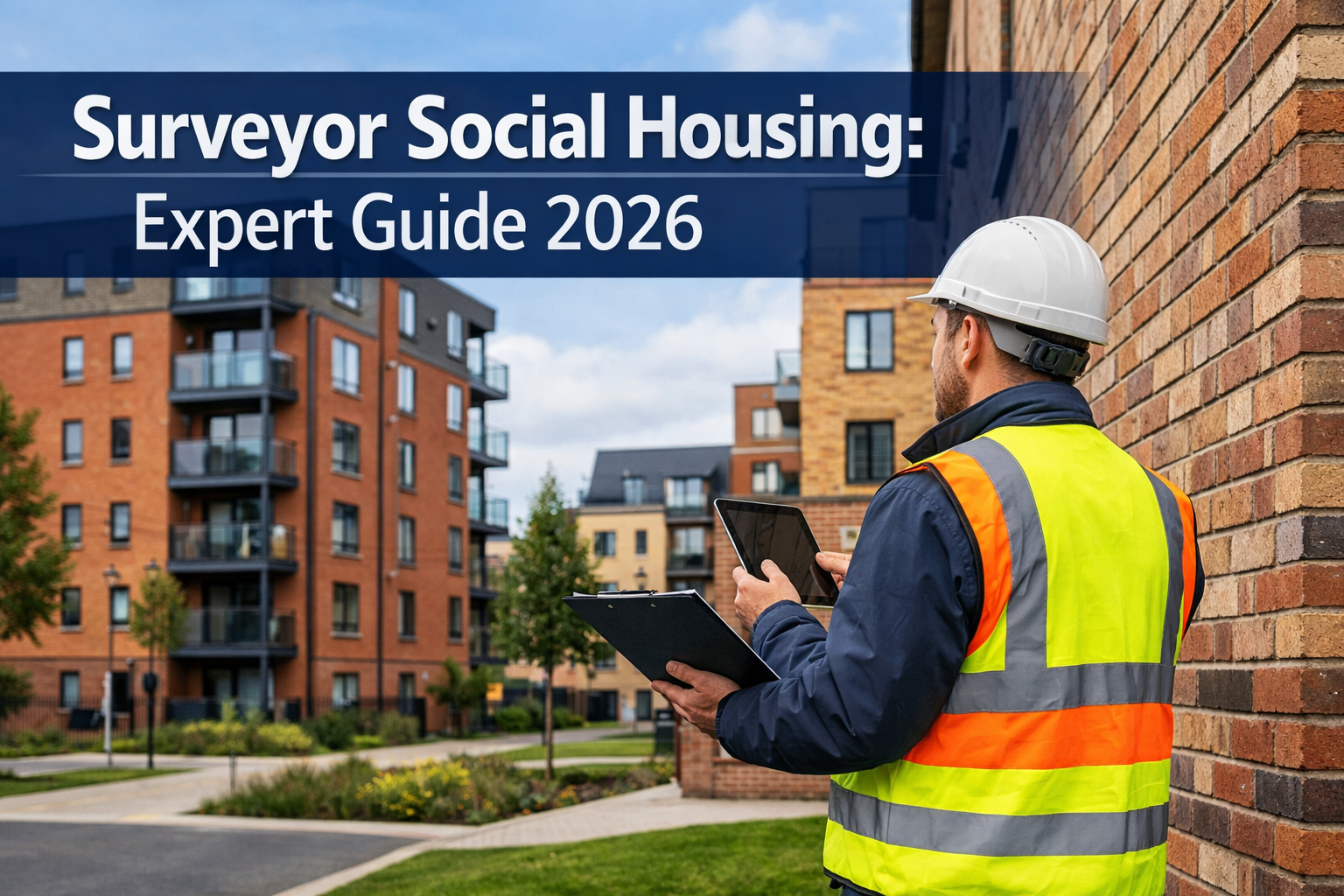
When thousands of families depend on safe, well-maintained homes, the role of a surveyor social housing professional becomes not just important—it’s absolutely critical. These specialized surveyors stand between vulnerable residents and potentially dangerous building defects, ensuring that social housing providers meet their legal obligations while maintaining properties that people can call home with dignity and safety.
The surveyor social housing sector has experienced unprecedented growth in 2026, driven by increased regulatory scrutiny following high-profile building safety incidents and the government’s commitment to upgrading existing social housing stock. With over 4 million social housing units across the UK requiring regular inspection, assessment, and maintenance planning, qualified surveyors in this field have never been in higher demand.
Key Takeaways
- Surveyor social housing professionals specialize in inspecting, assessing, and maintaining affordable housing properties owned by local authorities and housing associations
- The role requires specific knowledge of regulatory frameworks including the Decent Homes Standard, Building Safety Act, and social housing-specific legislation
- Career opportunities in social housing surveying offer competitive salaries ranging from £28,000 for junior positions to over £65,000 for senior chartered surveyors
- Stock condition surveys, planned maintenance programs, and compliance inspections form the core responsibilities of social housing surveyors
- Professional qualifications through RICS (Royal Institution of Chartered Surveyors) significantly enhance career prospects and earning potential in this specialized field
What Is a Surveyor Social Housing Professional?
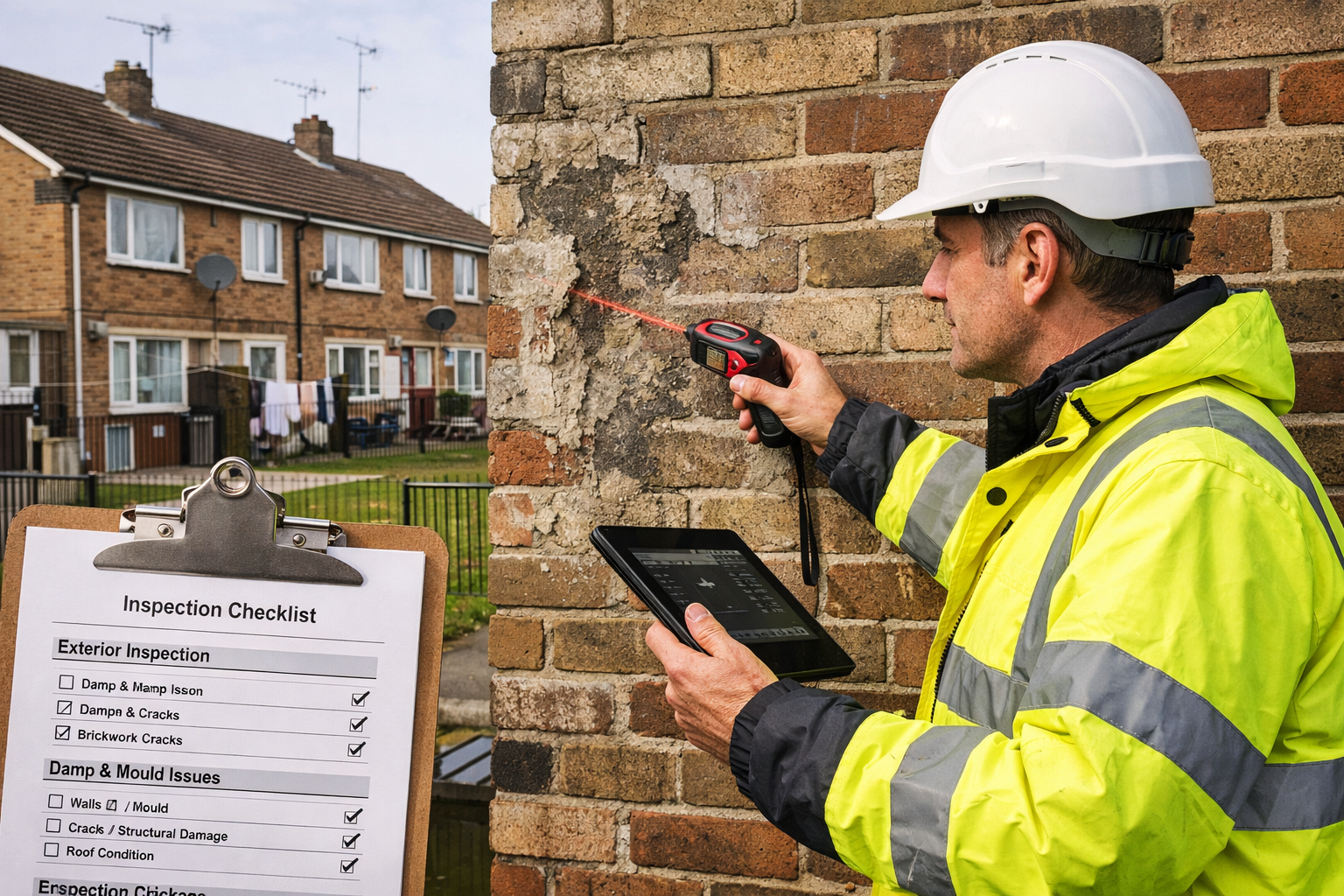
A surveyor social housing specialist is a qualified building professional who focuses exclusively on the assessment, maintenance, and improvement of affordable housing properties. Unlike general building surveyors who work across various property sectors, these experts develop deep knowledge of the unique challenges facing social housing providers.
Core Responsibilities
Social housing surveyors manage a diverse portfolio of responsibilities that directly impact residents’ quality of life:
Property Inspections and Assessments 🏘️
- Conducting comprehensive stock condition surveys across entire housing estates
- Identifying structural defects, damp issues, and building pathology concerns
- Assessing properties against Decent Homes Standard criteria
- Evaluating fire safety measures and compliance with Building Safety Act requirements
Planned Maintenance Programming
- Developing long-term maintenance strategies for housing stock
- Creating component replacement schedules (roofs, windows, heating systems)
- Budgeting for cyclical maintenance programs
- Prioritizing urgent repairs versus planned improvements
Regulatory Compliance
- Ensuring properties meet minimum energy efficiency standards
- Monitoring compliance with health and safety legislation
- Implementing recommendations from building safety inspections
- Coordinating with local authority building control departments
Tenant Liaison and Support
- Communicating inspection findings to residents
- Coordinating access for surveys and repairs
- Addressing tenant concerns about property conditions
- Managing expectations during improvement programs
Why Surveyor Social Housing Expertise Matters in 2026
The social housing sector faces unprecedented challenges that make specialized surveying expertise absolutely essential. Understanding why property owners hire surveyors applies equally—if not more critically—to social housing providers who carry legal and moral obligations to their tenants.
Regulatory Landscape Transformation
Following the Grenfell Tower tragedy and subsequent investigations, the regulatory framework governing social housing has undergone radical transformation. The Building Safety Act 2022 introduced stringent requirements for higher-risk buildings, while the Social Housing Regulation Act 2023 granted the Regulator of Social Housing enhanced powers to enforce decent homes standards.
Surveyor social housing professionals must navigate this complex regulatory environment, ensuring their organizations avoid enforcement action while protecting residents. The financial penalties for non-compliance can reach millions of pounds, making expert surveying an investment rather than an expense.
Stock Condition Challenges
Much of the UK’s social housing stock was built during the post-war period, with many properties now exceeding 50-70 years of age. These aging buildings present specific challenges:
| Building Era | Common Issues | Survey Focus Areas |
|---|---|---|
| 1945-1960s | Concrete carbonation, asbestos, poor insulation | Structural integrity, hazardous materials |
| 1960-1970s | System-built defects, cladding issues, thermal bridging | Non-traditional construction, energy efficiency |
| 1980-1990s | Cavity wall tie failure, flat roof deterioration | Building envelope, water ingress |
| 2000-2020s | New-build defects, fire safety concerns | Compliance with current standards, remediation |
Experienced social housing surveyors recognize these era-specific patterns, enabling proactive intervention before minor issues escalate into major failures requiring emergency repairs and temporary rehousing.
Financial Pressures and Value for Money
Social housing providers operate within tight financial constraints, balancing competing demands for new development, existing stock maintenance, and service improvements. Surveyor social housing professionals contribute directly to value for money by:
✅ Accurate budget forecasting through detailed condition assessments
✅ Lifecycle costing that optimizes component replacement timing
✅ Defect prioritization ensuring limited funds address the most critical issues
✅ Energy efficiency improvements that reduce long-term running costs for tenants
The ability to develop evidence-based maintenance strategies that maximize every pound spent distinguishes exceptional social housing surveyors from general practitioners.
Essential Skills and Qualifications for Surveyor Social Housing Careers
Breaking into the surveyor social housing field requires a combination of formal qualifications, technical knowledge, and interpersonal skills. The pathway differs slightly from general surveying routes, with specific competencies valued by social housing employers.
Educational Requirements
Undergraduate Level
Most social housing surveyors hold degrees in:
- Building Surveying (BSc or BEng)
- Construction Management
- Architectural Technology
- Civil Engineering with building specialism
RICS-accredited degree programs provide the most direct route to professional qualification, covering building pathology, construction technology, and surveying principles essential for social housing work.
Postgraduate Options
For graduates from non-accredited programs, RICS-approved postgraduate conversion courses offer an accelerated pathway. These intensive programs typically run 12-24 months and cover the competencies required for AssocRICS or MRICS qualification.
Apprenticeship Routes
The Level 6 Chartered Surveyor Degree Apprenticeship has gained popularity in social housing, allowing candidates to earn while learning. Housing associations and local authorities increasingly offer these positions, providing practical experience alongside academic study.
Professional Qualifications
RICS Membership Levels
The Royal Institution of Chartered Surveyors remains the gold standard for professional recognition:
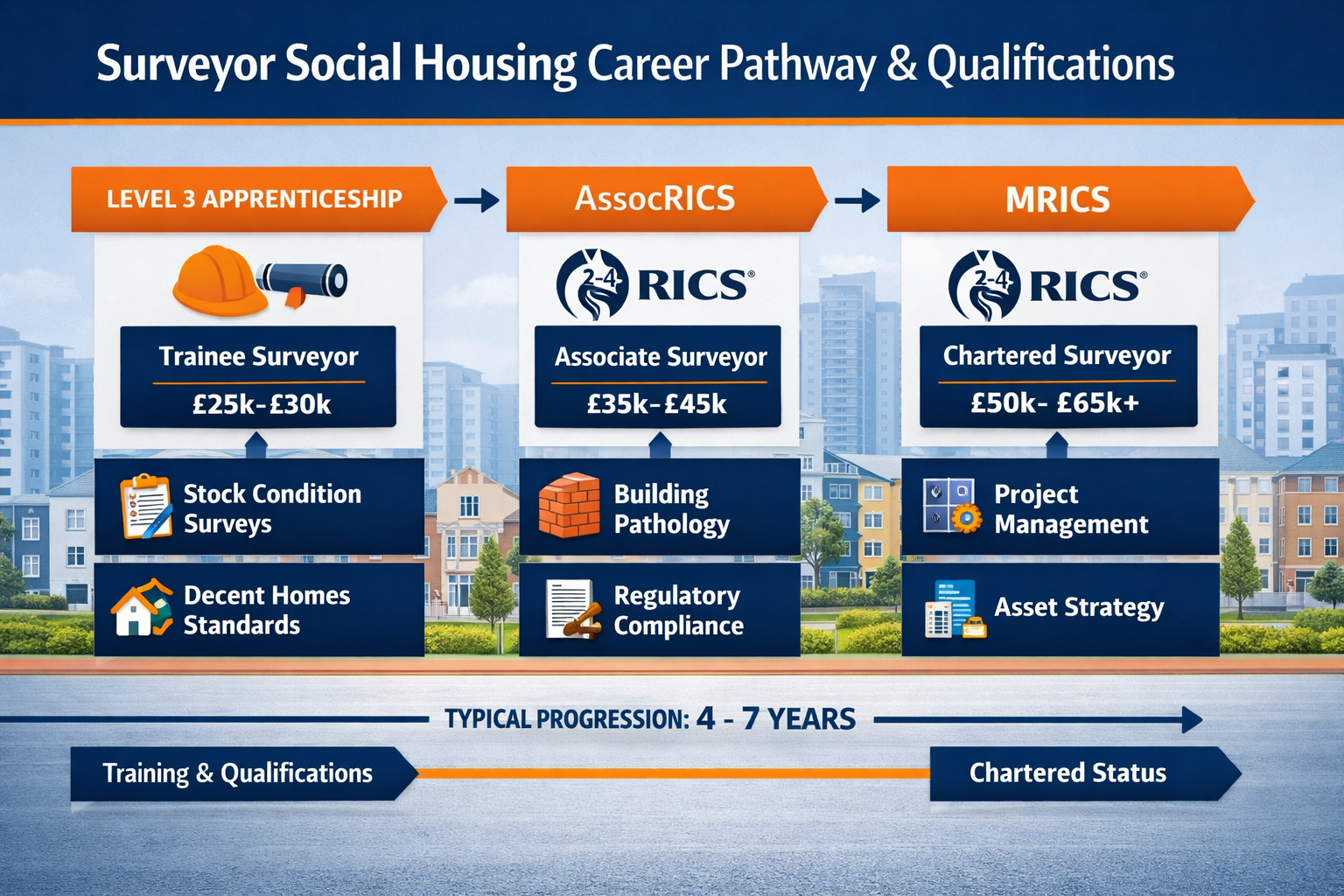
- AssocRICS (Associate) – Entry-level professional qualification demonstrating competence in core surveying skills
- MRICS (Member) – Full chartered status requiring demonstration of advanced competencies and professional experience
- FRICS (Fellow) – Senior recognition for surveyors making significant contributions to the profession
Many social housing employers require or strongly prefer RICS-qualified surveyors, particularly for senior positions managing large portfolios or leading technical teams.
Technical Competencies Specific to Social Housing
Beyond general surveying skills, surveyor social housing professionals must develop specialized knowledge:
Regulatory Frameworks 📋
- Decent Homes Standard and its application
- Housing Health and Safety Rating System (HHSRS)
- Building Safety Act requirements for higher-risk buildings
- Energy Performance Certificate (EPC) regulations and MEES compliance
Social Housing-Specific Building Types
- Non-traditional construction methods (Airey, Cornish Unit, Woolaway)
- System-built high-rise structures
- Sheltered housing and supported living facilities
- Mixed-use developments with commercial ground floors
Specialist Assessment Techniques
- Stock condition survey methodologies
- Asbestos management and surveys
- Fire risk assessment coordination
- Damp and condensation investigation in occupied properties
Understanding common defects in older homes provides foundational knowledge that social housing surveyors build upon with sector-specific expertise.
Soft Skills That Distinguish Excellent Surveyors
Technical competence alone doesn’t guarantee success in social housing surveying. The human element of working with vulnerable residents requires:
Empathy and Communication 💬
Social housing surveyors regularly interact with tenants facing challenging circumstances. The ability to explain technical issues in accessible language, listen to resident concerns, and maintain professional boundaries proves essential.
Diplomacy and Conflict Resolution
Balancing organizational constraints with tenant expectations requires diplomatic skills. Surveyors often deliver unwelcome news about repair timescales or explain why certain improvements can’t be prioritized immediately.
Cultural Competency
Social housing serves diverse communities. Surveyors must work respectfully across cultural, linguistic, and socioeconomic differences, adapting communication styles appropriately.
Career Pathways and Salary Expectations in Surveyor Social Housing
The surveyor social housing field offers clear career progression with competitive compensation reflecting the specialized nature of the work. Understanding the typical career trajectory helps aspiring professionals set realistic goals and timelines.
Entry-Level Positions (£25,000 – £32,000)
Assistant Building Surveyor / Graduate Surveyor
Recent graduates typically begin as assistant surveyors, supporting senior colleagues while developing practical competencies toward professional qualification. Responsibilities include:
- Conducting basic property inspections under supervision
- Preparing condition reports and photographic schedules
- Assisting with stock condition survey programs
- Learning organizational systems and procedures
- Working toward AssocRICS or MRICS qualification
This phase typically lasts 2-3 years, with progression dependent on competency development and successful completion of RICS Assessment of Professional Competence (APC).
Mid-Level Positions (£32,000 – £45,000)
Building Surveyor / Stock Condition Surveyor
Upon achieving professional qualification, surveyors assume greater autonomy and responsibility:
- Managing defined property portfolios independently
- Leading stock condition survey projects
- Specifying repair works and improvement programs
- Liaising directly with contractors and consultants
- Mentoring junior surveyors and apprentices
At this level, surveyors develop specializations—perhaps focusing on planned maintenance, disrepair claims, or energy efficiency improvements—that enhance their value to employers.
Senior Positions (£45,000 – £60,000)
Senior Building Surveyor / Principal Surveyor
Experienced professionals progress to senior roles involving strategic responsibilities:
- Managing teams of surveyors across multiple sites
- Developing asset management strategies
- Leading major refurbishment and regeneration programs
- Representing the organization with regulators and stakeholders
- Contributing to policy development and best practice
Senior surveyors often specialize further, becoming recognized experts in areas like fire safety, building pathology, or non-traditional construction.
Leadership Positions (£60,000 – £85,000+)
Head of Property Services / Director of Asset Management
The pinnacle of social housing surveying careers involves executive leadership:
- Strategic oversight of entire property portfolios (often 10,000+ units)
- Budget management running into tens of millions of pounds
- Board-level reporting and governance
- Regulatory compliance accountability
- Organizational policy setting and risk management
These positions require extensive experience, proven track record, and often additional qualifications in management or finance alongside surveying credentials.
Freelance and Consultancy Opportunities
Many experienced surveyor social housing professionals establish consultancy practices, offering specialized services to multiple housing providers. This route can prove financially rewarding, with day rates for chartered surveyors ranging from £350-£650 depending on specialization and reputation.
Consultants might focus on:
- Stock condition survey programs for smaller housing associations
- Expert witness services for disrepair litigation
- Building safety compliance reviews
- Energy efficiency strategy development
Key Services Provided by Surveyor Social Housing Professionals
Understanding the breadth of services that surveyor social housing specialists deliver helps clarify their value to organizations and residents alike. These services form the operational backbone of effective social housing management.
Stock Condition Surveys
The foundation of strategic asset management, stock condition surveys provide comprehensive data about the physical state of housing portfolios. Surveyor social housing teams conduct these assessments on cyclical programs, typically revisiting properties every 5-7 years.
Survey Methodology
Modern stock condition surveys employ standardized approaches:
- External inspection – Roof coverings, chimneys, walls, windows, doors, drainage
- Internal inspection – Structure, services (heating, electrical, plumbing), fixtures, decorations
- Component assessment – Condition grading, remaining life expectancy, replacement costs
- Compliance checking – Decent Homes Standard, HHSRS, energy efficiency
- Data capture – Digital survey tools, photographic evidence, asset registers
The resulting data feeds into asset management systems, enabling organizations to forecast maintenance requirements and budget accurately for future years.
Planned Maintenance Programming
Effective surveyor social housing professionals translate stock condition data into actionable maintenance programs that prevent reactive repairs and extend component lifecycles.
Component Replacement Cycles
Typical replacement intervals guide programming decisions:
- Roofing – 40-60 years (pitched), 20-30 years (flat)
- Windows and doors – 25-35 years
- Heating systems – 12-15 years
- Kitchens – 20-25 years
- Bathrooms – 25-30 years
- Electrical rewiring – 30-40 years
By scheduling replacements strategically, surveyors minimize disruption to residents while optimizing value for money through economies of scale when multiple properties receive similar improvements simultaneously.
Disrepair and Compliance Inspections
Social housing providers face legal obligations to maintain properties in good repair. When tenants report defects, surveyor social housing professionals conduct inspections to:
- Verify reported defects and identify underlying causes
- Assess urgency and prioritize repairs appropriately
- Specify remedial works with detailed schedules
- Defend against spurious or exaggerated claims
- Provide expert evidence in litigation if required
The consequences of ignoring building defects can prove severe, making prompt, professional assessment essential.
Energy Efficiency and Retrofit Assessments
With government targets requiring social housing to achieve minimum Energy Performance Certificate (EPC) ratings, surveyor social housing specialists play crucial roles in retrofit programs:
Retrofit Coordination
- Assessing properties for retrofit suitability
- Designing whole-house improvement approaches
- Coordinating with specialist consultants (heating engineers, insulation contractors)
- Managing funding applications for grant programs
- Monitoring installation quality and performance outcomes
The transition to net-zero carbon housing represents one of the sector’s greatest challenges, requiring surveyors to develop new competencies in modern construction methods, renewable technologies, and building physics.
Fire Safety Assessments and Building Safety Compliance
Following legislative changes, surveyor social housing professionals increasingly coordinate building safety activities:
- Commissioning and reviewing fire risk assessments
- Implementing fire safety improvement programs
- Managing external wall system investigations
- Coordinating with fire engineers and safety consultants
- Maintaining building safety case documentation for higher-risk buildings
While fire risk assessment itself requires specialist certification, surveyors coordinate the broader building safety compliance framework, ensuring all elements work together coherently.
Challenges Facing Surveyor Social Housing Professionals in 2026
The social housing surveying field presents unique challenges that test even experienced professionals. Understanding these difficulties helps set realistic expectations and identifies areas where the sector must evolve.
Balancing Competing Priorities
Social housing organizations face constant tension between:
- Regulatory compliance versus financial constraints
- Resident satisfaction versus value for money
- Reactive repairs versus planned maintenance
- New development versus existing stock investment
Surveyor social housing professionals navigate these competing demands daily, making difficult recommendations about resource allocation when needs inevitably exceed available budgets. The emotional toll of knowing that prioritization decisions directly affect residents’ living conditions can prove significant.
Access and Engagement Challenges
Unlike commercial properties, social housing remains occupied during inspections. Gaining access presents ongoing difficulties:
- Residents with work commitments unable to accommodate survey appointments
- Vulnerable tenants anxious about strangers entering their homes
- Language barriers requiring interpreter services
- Hoarding or safeguarding concerns complicating inspections
- No-access situations requiring legal remedies
Successful surveyors develop strategies for maximizing access rates while maintaining positive resident relationships, but this aspect of the role demands patience and persistence.
Technical Complexity of Aging Stock
The diversity of construction types within social housing portfolios requires surveyors to maintain extraordinarily broad technical knowledge. A single day might involve:
- Investigating concrete carbonation in a 1960s system-built tower
- Assessing damp penetration in Victorian terraced housing
- Reviewing fire stopping in a modern timber-frame development
- Evaluating structural movement in a post-war prefabricated dwelling
This variety keeps the work intellectually engaging but demands continuous professional development to maintain current knowledge across multiple specialisms. Resources like building inspection guides for homeowners provide foundational knowledge that social housing surveyors expand with sector-specific expertise.
Litigation and Regulatory Scrutiny
The social housing sector operates under intense scrutiny following high-profile failures. Surveyor social housing professionals face:
- Increased disrepair litigation from specialist tenant solicitors
- Regulatory inspections examining property condition standards
- Media attention when defects cause resident harm
- Professional indemnity considerations when providing expert opinions
This environment demands meticulous record-keeping, defensible decision-making, and clear documentation of all recommendations and actions.
Workforce Recruitment and Retention
The sector struggles to attract sufficient qualified surveyors to meet demand. Contributing factors include:
- Competition from higher-paying private sector roles
- Perception of social housing as less prestigious than commercial work
- Emotional demands of working with vulnerable populations
- Geographic challenges with properties often in less desirable locations
Organizations that invest in professional development, offer competitive compensation, and create supportive working environments gain significant advantages in this competitive labor market.
How to Choose the Right Surveyor Social Housing Partner
For housing associations, local authorities, and arm’s-length management organizations seeking surveying services, selecting the right partner proves critical to successful asset management. Whether recruiting in-house staff or appointing consultants, several factors warrant careful consideration.
Essential Qualifications and Experience
Professional Credentials ✓
Verify that surveyors hold appropriate RICS qualifications (AssocRICS or MRICS) and maintain professional indemnity insurance adequate for the scale of work involved. Check RICS membership status through the online directory to confirm current standing.
Sector-Specific Experience
General building surveying experience doesn’t automatically translate to social housing competence. Look for demonstrated experience with:
- Large-scale stock condition survey programs
- Social housing regulatory frameworks
- Tenant liaison in sensitive situations
- Non-traditional construction types common in social housing
Request case studies and references from similar organizations to verify relevant experience.
Technical Capabilities and Resources
Survey Methodology
Understand the surveyor’s approach to stock condition surveys:
- What survey standards do they follow (RICS guidance, BPE standards)?
- What digital tools and software do they employ?
- How do they ensure consistency across multiple surveyors?
- What quality assurance processes govern their work?
Modern surveyor social housing practices employ mobile survey applications, photographic documentation, and integrated asset management systems that streamline data collection and analysis.
Team Capacity
For large portfolios, verify that the surveying organization has sufficient qualified staff to deliver programs within required timescales. A single surveyor might inspect 8-12 properties daily depending on complexity, so calculate realistic delivery schedules based on team size.
Communication and Cultural Fit
Resident-Centered Approach
The best surveyor social housing professionals demonstrate genuine commitment to improving residents’ lives, not merely completing technical assessments. During procurement, assess:
- How do they approach resident communication?
- What strategies do they employ for vulnerable tenants?
- How do they handle complaints or concerns?
- What feedback have they received from previous clients’ residents?
Organizational Alignment
Surveying partners should share your organization’s values and understand your strategic priorities. A surveyor focused purely on compliance might miss opportunities for value-adding improvements, while one who recommends gold-plated solutions may not appreciate financial constraints.
Value for Money Considerations
Fee Structures
Social housing surveying services typically employ several pricing models:
- Day rates – Flexible for variable workloads but potentially expensive for large programs
- Per-property rates – Predictable costs for stock condition surveys
- Retainer arrangements – Ongoing support with guaranteed availability
- Framework agreements – Pre-agreed rates for call-off services
Compare proposals carefully, ensuring like-for-like comparisons that account for all deliverables, not just headline rates.
Long-Term Value
The cheapest option rarely delivers best value. Consider:
- Quality of deliverables and actionable insights
- Accuracy of cost forecasting (poor estimates create budget problems)
- Contribution to strategic planning beyond basic compliance
- Knowledge transfer and capacity building for in-house teams
Organizations seeking professional surveying services should prioritize partnerships that deliver sustainable improvements rather than transactional relationships focused solely on immediate outputs.
Future Trends in Surveyor Social Housing
The surveyor social housing field continues evolving rapidly, driven by technological innovation, regulatory change, and shifting societal expectations. Professionals entering the field in 2026 should prepare for significant transformations ahead.
Digital Transformation and PropTech
Building Information Modeling (BIM)
Social housing providers increasingly adopt BIM for asset management, creating digital twins of properties that integrate condition data, component specifications, and maintenance histories. Surveyor social housing professionals must develop competencies in:
- BIM software platforms (Autodesk, Graphisoft)
- Digital data capture and integration
- 3D modeling and visualization
- Information management protocols
Artificial Intelligence and Predictive Analytics
Machine learning algorithms analyze stock condition data to predict component failures before they occur, enabling truly preventive maintenance. AI-assisted defect identification from photographic surveys already supplements surveyor assessments, improving consistency and efficiency.
Internet of Things (IoT) Monitoring
Sensors monitoring temperature, humidity, and building movement provide real-time condition data, alerting surveyors to developing issues. This technology proves particularly valuable for:
- Damp and condensation problems
- Heating system performance
- Structural movement monitoring
- Energy consumption optimization
Sustainability and Net-Zero Transition
The race to decarbonize housing stock will dominate social housing surveying for decades. Surveyor social housing professionals must become retrofit experts, understanding:
- Whole-house energy modeling
- Fabric-first improvement approaches
- Heat pump and renewable technology integration
- Ventilation strategies for improved airtightness
- Embodied carbon considerations in material selection
Government funding programs will continue driving retrofit activity, creating opportunities for surveyors with specialized low-carbon competencies.
Resident Empowerment and Co-Production
The social housing sector increasingly recognizes residents as partners rather than passive recipients of services. Surveyor social housing approaches must evolve to incorporate:
- Resident-led inspection programs
- Co-design of improvement schemes
- Transparent communication about property conditions
- Accessible reporting that residents can understand and challenge
This shift requires surveyors to develop new communication skills and embrace collaborative working methods that may feel uncomfortable to professionals trained in traditional top-down approaches.
Regulatory Evolution
Expect continued regulatory tightening following the Social Housing Regulation Act. Future developments likely include:
- Mandatory stock condition survey frequencies
- Standardized condition assessment methodologies
- Public reporting of property condition metrics
- Enhanced tenant rights to information about their homes
- Increased penalties for non-compliance
Surveyor social housing professionals must stay current with regulatory developments, adapting practices to meet evolving requirements. Professional development through organizations like RICS and sector bodies like the Chartered Institute of Housing becomes increasingly important.
Conclusion: The Vital Role of Surveyor Social Housing Professionals
The surveyor social housing profession stands at the intersection of technical expertise, regulatory compliance, and social responsibility. These specialists ensure that millions of families live in safe, decent, well-maintained homes while helping organizations navigate complex challenges with limited resources.
For those considering careers in this field, the opportunities have never been greater. The combination of aging housing stock, enhanced regulatory requirements, and ambitious net-zero targets creates sustained demand for qualified professionals. The work offers intellectual variety, clear career progression, and the satisfaction of making tangible differences in people’s lives.
Social housing providers seeking surveying expertise should prioritize partners who combine technical competence with genuine commitment to resident outcomes. The right surveyor social housing professional becomes a strategic asset, not merely a compliance necessity—delivering insights that inform long-term planning, optimize investment decisions, and ultimately improve the quality of social housing across the UK.
Actionable Next Steps
For Aspiring Surveyors:
- Research RICS-accredited degree programs or apprenticeship opportunities in building surveying
- Seek work experience or volunteer opportunities with housing associations to understand the sector
- Join professional networks and attend industry events to build connections
- Consider specializing in areas of growing demand like retrofit or building safety
- Explore resources on professional surveying careers to deepen your understanding
For Social Housing Providers:
- Review your current surveying capacity against portfolio size and condition
- Assess whether in-house teams have adequate resources and up-to-date competencies
- Consider framework agreements with specialist consultants for surge capacity
- Invest in professional development for existing surveying staff
- Implement digital tools that improve survey efficiency and data quality
For Residents:
- Understand your rights regarding property inspections and condition standards
- Report defects promptly through proper channels to enable timely surveys
- Cooperate with access requests for stock condition surveys
- Ask questions about survey findings and planned improvements to your home
- Engage with resident involvement opportunities to influence asset management strategies
The surveyor social housing profession will continue evolving, but its fundamental purpose remains constant: ensuring that everyone deserves a safe, decent home. Whether you’re building a career in this field, managing a housing portfolio, or living in social housing, understanding the critical role these professionals play helps create better outcomes for all stakeholders in this essential sector.
How Prince Surveyors can help: explore our Level 3 building surveys or learn about our Level 2 vs Level 3 guide.