

Agreed Surveyor Party Wall: Your Complete Guide to Streamlined Dispute Resolution
When planning construction work that affects a shared boundary, property owners often face a critical decision that could save thousands of pounds and weeks of stress. The agreed surveyor party wall approach represents one of the most efficient and cost-effective methods for navigating Party Wall Act requirements, yet many homeowners remain unaware of this valuable option. Understanding how this streamlined process works can transform what might seem like a daunting legal requirement into a straightforward, collaborative solution.
Key Takeaways
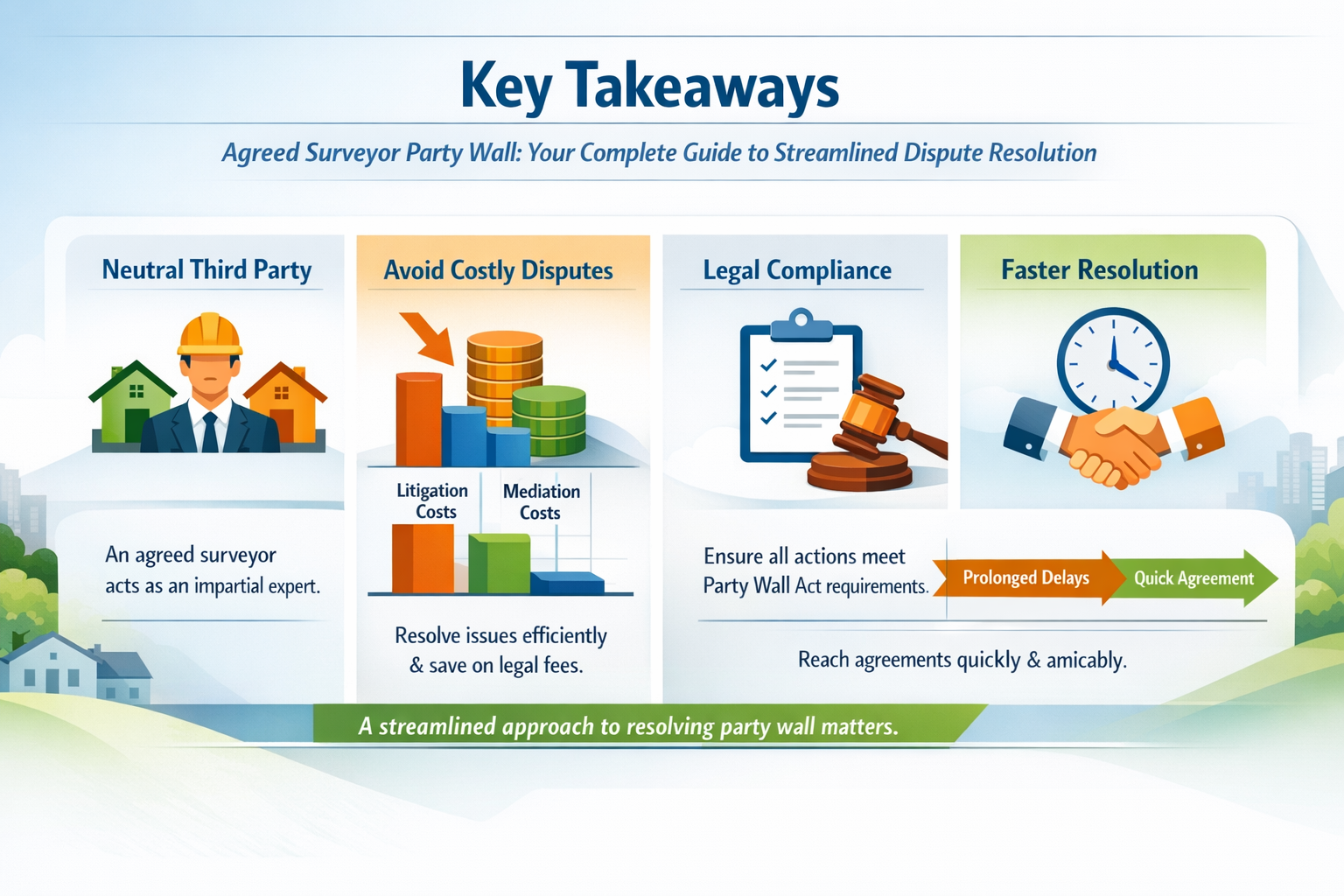
- 🏠 An agreed surveyor is a single party wall professional appointed by both the building owner and adjoining owner to handle all party wall matters impartially
- 💰 Using an agreed surveyor typically costs 50-60% less than appointing separate surveyors for each party
- ⚡ The agreed surveyor approach speeds up the process significantly, often completing awards within 2-3 weeks instead of 4-6 weeks
- 📋 The agreed surveyor must remain completely impartial and act in the interests of both parties equally under the Party Wall Act 1996
- ✅ This approach works best when neighbours have a good relationship and trust can be established from the outset
What Is an Agreed Surveyor Party Wall Arrangement?
An agreed surveyor party wall arrangement occurs when both the building owner (the person undertaking construction work) and the adjoining owner (the neighbour whose property shares the boundary) mutually consent to appoint a single surveyor to act on behalf of both parties. This professional becomes responsible for preparing the party wall award, conducting inspections, and ensuring compliance with the Party Wall etc. Act 1996.
Unlike the traditional approach where each party appoints their own surveyor, the agreed surveyor model creates a unified decision-making process. This single professional must maintain strict impartiality while serving both parties’ interests equally.
The Legal Framework
The Party Wall etc. Act 1996 explicitly provides for the agreed surveyor option under Section 10. The legislation recognizes that not all party wall matters require adversarial proceedings, and neighbours who can collaborate should have access to a more streamlined process.
Key legislative provisions include:
- Both parties must provide written consent to the appointment
- The agreed surveyor has the same legal powers and duties as separate surveyors
- Either party can request the appointment of a third surveyor if disputes arise
- The agreed surveyor must act impartially and cannot favour either party
For property owners navigating these requirements, understanding common misconceptions about party wall agreements helps avoid costly mistakes during the appointment process.
How Does the Agreed Surveyor Party Wall Process Work?
The agreed surveyor process follows a structured pathway designed to protect both parties while maintaining efficiency. Understanding each stage helps property owners make informed decisions about whether this approach suits their circumstances.
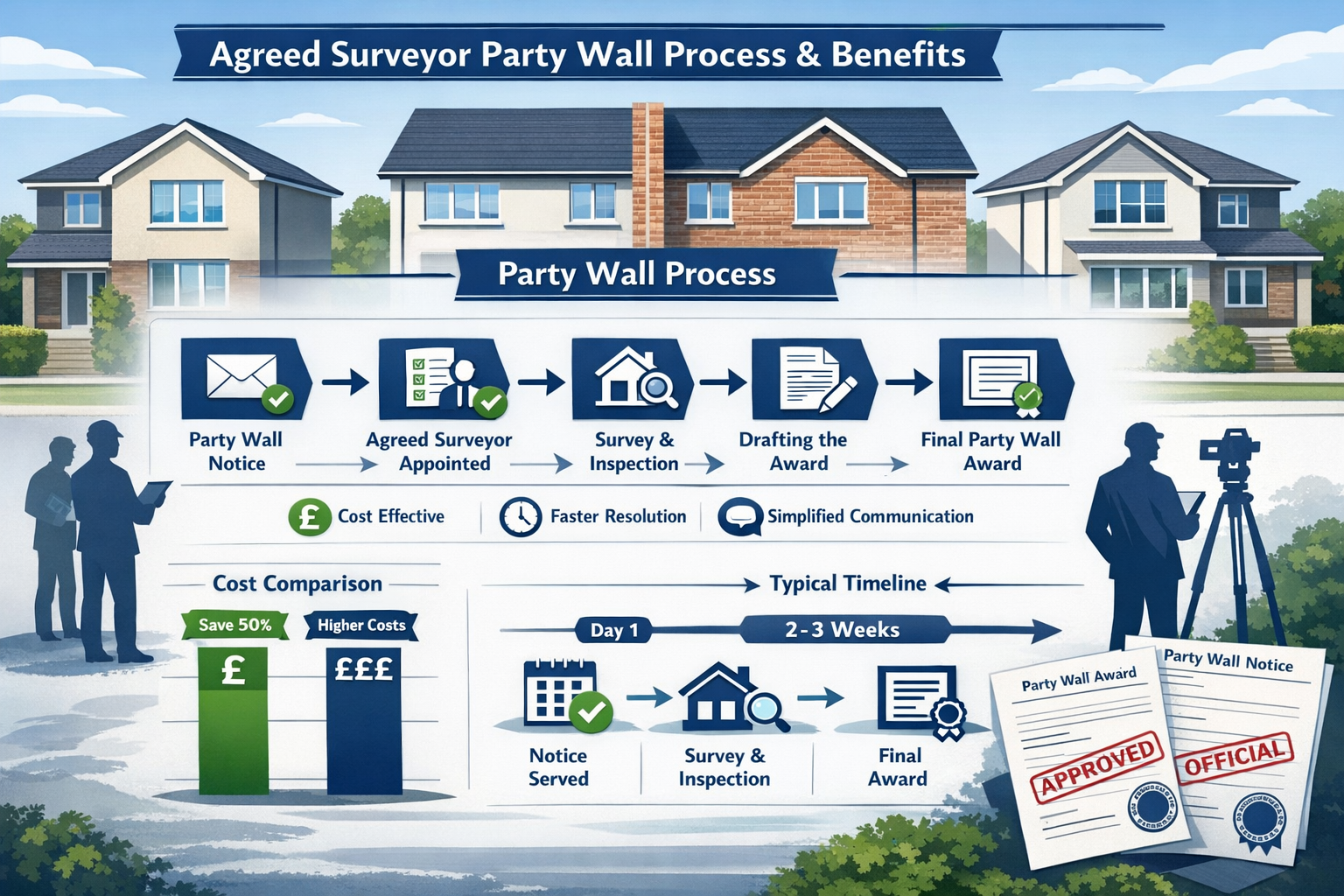
Step 1: Initial Party Wall Notice
The building owner must first serve a party wall notice to the adjoining owner, detailing the proposed works. This notice must comply with statutory requirements and provide sufficient information about:
- The nature and extent of the proposed work
- The date work will commence
- Technical drawings or specifications where applicable
The adjoining owner then has 14 days to respond. If they consent to the works in writing, no party wall award is necessary. However, if they dissent or fail to respond, the Party Wall Act procedures are triggered.
Step 2: Proposing an Agreed Surveyor
Either party can suggest using an agreed surveyor. This proposal typically happens through direct communication between neighbours or via their legal representatives. The building owner might include this suggestion in the initial party wall notice or raise it during subsequent discussions.
Important considerations when proposing an agreed surveyor:
- ✅ Both parties must genuinely agree without coercion or pressure
- ✅ The proposed surveyor should have relevant qualifications and experience
- ✅ Independence from both parties must be clearly established
- ✅ Fee structures should be transparent and agreed upfront
Step 3: Formal Appointment
Once both parties agree on a specific surveyor, they must formalize the appointment in writing. This documentation should clearly state:
| Appointment Element | Details Required |
|---|---|
| Surveyor’s full name and qualifications | MRICS, FRICS, or equivalent professional designation |
| Scope of appointment | All works covered under the party wall notice |
| Fee agreement | Total costs and payment responsibility allocation |
| Timeline expectations | Expected completion date for the party wall award |
| Contact protocols | How the surveyor will communicate with both parties |
Step 4: Site Inspection and Schedule of Condition
The agreed surveyor will conduct a thorough inspection of both properties, paying particular attention to:
- The existing condition of the party wall or structure
- Adjacent rooms and areas that might be affected by the works
- Any pre-existing defects or damage
- Structural elements that require monitoring
This inspection produces a schedule of condition—a detailed photographic and written record documenting the property’s state before work commences. This document becomes crucial if disputes arise later about damage caused by the construction work.
Many property owners find it helpful to understand why property owners hire surveyors beyond just party wall matters, as these professionals offer valuable expertise across multiple property scenarios.
Step 5: Preparing the Party Wall Award
The agreed surveyor prepares a comprehensive party wall award that legally binds both parties. This document typically includes:
- Detailed description of the proposed works with reference to plans and specifications
- Rights and responsibilities of both the building owner and adjoining owner
- Working hours and access arrangements for the construction period
- Protection measures to minimize disruption and prevent damage
- Dispute resolution procedures if disagreements arise during construction
- Cost allocation determining who pays for the surveyor’s fees
The award must be served on both parties, who then have 14 days to appeal to the Third Surveyor if they disagree with any provisions.
Step 6: Monitoring and Completion
Throughout the construction period, the agreed surveyor may conduct periodic inspections to ensure compliance with the award’s terms. After work completion, a final inspection compares the property’s condition against the original schedule of condition, identifying any damage that requires remediation.
Benefits of Using an Agreed Surveyor Party Wall Approach
The agreed surveyor model offers substantial advantages over appointing separate surveyors, particularly when neighbours maintain a cooperative relationship.
💰 Significant Cost Savings
Financial efficiency represents the most compelling benefit for many property owners. When separate surveyors are appointed:
- The building owner typically pays for both surveyors’ fees
- Each surveyor charges separately for inspections, award preparation, and administration
- Total costs can range from £1,200 to £3,000 or more for straightforward cases
With an agreed surveyor:
- Only one set of professional fees applies
- Typical costs range from £600 to £1,500 for standard residential work
- Savings of 50-60% are common compared to the two-surveyor approach
⚡ Faster Resolution Timeline
Time efficiency matters significantly when construction schedules are tight. The agreed surveyor approach typically completes the process in 2-3 weeks compared to 4-6 weeks or longer with separate surveyors.
Why the process moves faster:
- No need for coordination between multiple surveyors
- Single inspection schedule rather than duplicate visits
- Streamlined communication channels
- Reduced potential for procedural delays
🤝 Simplified Communication
Managing one professional relationship proves far simpler than coordinating between multiple parties. With an agreed surveyor:
- Both neighbours receive consistent information
- Misunderstandings decrease when everyone works from the same documentation
- Questions and concerns flow through a single point of contact
- Updates reach both parties simultaneously
📊 Reduced Administrative Burden
The administrative overhead of party wall procedures decreases substantially with an agreed surveyor. Property owners avoid:
- Duplicate documentation requests
- Multiple site access arrangements
- Conflicting advice from different professionals
- Complex three-way correspondence
For those interested in broader property management considerations, exploring the benefits of block management provides additional context for professional property oversight.
🎯 Impartial Decision-Making
While some property owners worry that a single surveyor might favour one party, professional ethics and legal obligations ensure impartiality. Agreed surveyors face:
- Strict professional conduct requirements from bodies like RICS
- Legal duties under the Party Wall Act to serve both parties equally
- Potential professional sanctions for bias or favouritism
- Reputation risks that deter unethical behaviour
When Should You Consider an Agreed Surveyor Party Wall Option?
The agreed surveyor approach works exceptionally well in specific circumstances but may not suit every situation. Understanding when this option makes sense helps property owners make strategic decisions.
✅ Ideal Scenarios for Agreed Surveyors
Good neighbour relations exist: When property owners maintain friendly, communicative relationships, the agreed surveyor approach capitalizes on this goodwill. Trust between neighbours forms the foundation for successful collaboration.
Straightforward construction work: Simple projects like single-storey extensions, loft conversions without structural complications, or standard party wall repairs benefit most from streamlined processes.
Budget consciousness matters: Property owners seeking to minimize costs while maintaining legal compliance find the agreed surveyor approach financially attractive.
Time sensitivity exists: When construction schedules are tight and delays would cause significant problems, the faster agreed surveyor process provides valuable time savings.
Both parties want involvement: Neighbours who prefer staying informed and engaged throughout the process appreciate the transparent communication an agreed surveyor provides.
❌ When Separate Surveyors Make More Sense
Existing disputes or tensions: If neighbours already have conflicts or communication has broken down, separate surveyors provide necessary independence and advocacy.
Complex or extensive works: Major structural alterations, basement excavations, or works affecting multiple properties often benefit from the additional scrutiny that separate surveyors provide.
Significant property value differences: When one property is substantially more valuable than the other, the adjoining owner may prefer independent representation to ensure their interests receive full protection.
Previous damage concerns: If the building owner has a history of causing property damage or failing to remediate issues, the adjoining owner may want their own surveyor for protection.
Professional advice recommends it: Sometimes solicitors or other advisors recommend separate surveyors based on specific circumstances or risk factors.
Understanding what homeowners should know about their property helps contextualize party wall decisions within broader property ownership responsibilities.
Qualifications and Selection Criteria for an Agreed Surveyor Party Wall Professional
Choosing the right agreed surveyor significantly impacts the process’s success. Both parties should carefully evaluate potential candidates against specific criteria.
Essential Professional Qualifications
RICS Membership: Look for surveyors who are Members (MRICS) or Fellows (FRICS) of the Royal Institution of Chartered Surveyors. This membership indicates:
- Formal education and training in surveying disciplines
- Ongoing professional development requirements
- Adherence to strict ethical standards
- Access to dispute resolution procedures if issues arise
Party Wall Specialization: While many surveyors can handle party wall matters, specialists bring valuable expertise. Look for professionals who:
- Regularly handle party wall cases (not just occasional work)
- Understand the nuances of the Party Wall etc. Act 1996
- Stay current with case law and regulatory developments
- Maintain professional indemnity insurance covering party wall work
Local Knowledge: Surveyors familiar with local building practices, common property types, and regional construction methods provide more relevant advice. They understand:
- Typical construction details in the area
- Local authority requirements and building control practices
- Common issues affecting specific property types
- Regional cost benchmarks for remediation work
Experience and Track Record
Beyond formal qualifications, practical experience matters enormously. When evaluating potential agreed surveyors, consider:
Years of Practice: Surveyors with 5+ years of party wall experience have typically encountered diverse scenarios and developed problem-solving skills.
Case Volume: Professionals handling 50+ party wall cases annually maintain sharp skills and current knowledge.
Dispute Resolution Success: Ask about the surveyor’s track record in preventing disputes and resolving issues when they arise.
Professional References: Request references from recent clients, particularly cases similar to your circumstances.
Independence and Impartiality
The agreed surveyor must demonstrate complete independence from both parties. Red flags include:
- ❌ Previous work for either party within the past 2-3 years
- ❌ Personal relationships with either property owner
- ❌ Financial interests in the outcome of the works
- ❌ Recommendations from only one party without the other’s input
Positive indicators of independence:
- ✅ No prior relationship with either party
- ✅ Transparent fee structures agreed upfront
- ✅ Clear communication protocols for both parties
- ✅ Professional liability insurance in place
Communication Skills and Accessibility
An effective agreed surveyor must communicate clearly with both technical professionals and lay property owners. Evaluate:
- Responsiveness: Do they reply to inquiries promptly?
- Clarity: Can they explain technical matters in understandable terms?
- Availability: Will they be accessible throughout the project timeline?
- Documentation: Do they provide clear, comprehensive written records?
For those considering broader surveying needs, learning about building surveyors in London offers insights into the wider professional landscape.
Common Challenges with Agreed Surveyor Party Wall Arrangements
Despite the many advantages, the agreed surveyor approach can encounter specific challenges. Awareness of these potential issues helps property owners navigate them effectively.
Challenge 1: Perceived Bias
Even when an agreed surveyor acts with complete impartiality, one party may perceive bias if decisions don’t align with their preferences. This perception can undermine trust and cooperation.
Mitigation strategies:
- Ensure both parties understand the surveyor’s legal duty of impartiality from the outset
- Request detailed explanations for significant decisions
- Maintain transparent communication throughout the process
- Document all interactions and decisions in writing
Challenge 2: Scope Creep and Additional Works
Construction projects sometimes evolve, with building owners proposing additional works beyond the original party wall notice. This creates complications:
- The agreed surveyor must determine whether new works require supplementary notices
- Additional fees may apply for evaluating and documenting scope changes
- The adjoining owner may feel the process has become unfair
Best practices:
- Address potential scope changes in the initial appointment agreement
- Establish clear protocols for handling additional works
- Ensure both parties receive prompt notification of any changes
- Document all variations to the original agreement
Challenge 3: Disagreements During Construction
Despite careful planning, disputes can arise during construction:
- Damage beyond what was anticipated in the award
- Working hours violations or excessive noise
- Access issues or disruption to the adjoining owner
- Quality concerns about protective measures
Resolution approaches:
- The agreed surveyor should conduct prompt site visits to assess issues
- Temporary stop-work orders may be necessary in serious cases
- Mediation between parties can resolve many disputes
- Either party retains the right to appeal to the Third Surveyor
Challenge 4: Fee Disputes
While the building owner typically pays the agreed surveyor’s fees, disputes can arise about:
- Whether fees are reasonable for the work performed
- Who pays for additional inspections or variations
- Costs associated with damage remediation
- Expenses for extended monitoring periods
Preventive measures:
- Obtain detailed fee quotations before appointment
- Clarify payment responsibilities in the appointment agreement
- Request itemized invoices showing work performed
- Agree on payment schedules and terms upfront
Understanding the cost of party wall surveyors helps property owners budget appropriately and identify unreasonable fee structures.
The Agreed Surveyor Party Wall Award: What It Contains
The party wall award represents the legal document that governs the construction work and protects both parties’ interests. Understanding its components helps property owners know what to expect.
Standard Award Components
1. Preamble and Parties
- Full names and addresses of the building owner and adjoining owner
- Property descriptions and legal boundaries
- Reference to the party wall notice that triggered the process
- Date of the agreed surveyor’s appointment
2. Description of Proposed Works
- Detailed explanation of all construction activities affecting the party wall
- Reference to architectural drawings, specifications, or engineering calculations
- Timeline for commencement and expected completion
- Phasing of works if the project proceeds in stages
3. Rights Granted
- Specific permissions for the building owner to carry out the works
- Access rights to the adjoining owner’s property if necessary
- Temporary use of adjoining land for scaffolding or equipment
- Rights to cut into or underpin the party wall as required
4. Protective Conditions
- Measures to prevent damage to the adjoining owner’s property
- Requirements for temporary weather protection or support
- Specifications for materials and workmanship standards
- Monitoring requirements during construction
5. Working Arrangements
- Permitted working hours (typically 8:00 AM to 6:00 PM weekdays)
- Restrictions on weekend or holiday work
- Notice periods for specific activities
- Access protocols and security arrangements
6. Schedule of Condition
- Detailed photographic record of the adjoining property
- Written descriptions of existing conditions
- Documentation of pre-existing defects or damage
- Baseline for assessing construction-related damage
7. Dispute Resolution Procedures
- Process for raising concerns during construction
- Agreed surveyor’s role in addressing disputes
- Right to appeal to the Third Surveyor
- Timelines for dispute resolution
8. Fee Provisions
- Total agreed surveyor fees and payment responsibility
- Provisions for additional fees if circumstances change
- Payment schedule and terms
- Costs associated with remediation or additional inspections
Award Variations for Specific Work Types
Different types of construction work require tailored award provisions:
Excavation and Basement Work:
- Detailed underpinning specifications
- Monitoring protocols for ground movement
- Requirements for structural calculations
- Party wall strengthening measures
Loft Conversions:
- Load distribution across party walls
- Sound insulation requirements
- Fire resistance specifications
- Roof structure modifications
Extensions and Additions:
- Foundation depth and proximity to boundaries
- Weatherproofing at party wall junctions
- Drainage and damp-proofing measures
- Structural connections to existing walls
For property owners undertaking renovations, understanding what permits you need before starting provides essential context beyond party wall requirements.
Costs Associated with an Agreed Surveyor Party Wall Process
Understanding the financial implications helps property owners budget appropriately and avoid surprises during the party wall process.
Typical Fee Structures
Agreed Surveyor Fees:
| Project Complexity | Typical Fee Range | What’s Included |
|---|---|---|
| Simple single-storey extension | £600 – £900 | Initial inspection, schedule of condition, award preparation, one follow-up visit |
| Loft conversion | £800 – £1,200 | As above plus additional structural assessment |
| Two-storey extension | £1,000 – £1,500 | Comprehensive inspections, detailed award, multiple site visits |
| Basement excavation | £1,500 – £2,500+ | Extensive monitoring, structural engineering input, frequent inspections |
Factors Affecting Costs:
- 📍 Location: London and South East England typically command higher fees
- 🏗️ Complexity: Structural works require more time and expertise
- 📏 Property size: Larger properties take longer to inspect and document
- 🔄 Number of adjoining owners: Multiple neighbours increase administrative work
- ⏱️ Project duration: Extended projects requiring ongoing monitoring cost more
Who Pays the Agreed Surveyor?
Under the Party Wall Act, the building owner typically pays all surveyor fees, including the agreed surveyor’s costs. This applies even though the surveyor serves both parties equally.
Exceptions and special circumstances:
- If the adjoining owner requests unnecessary additional inspections, they may bear those costs
- Frivolous objections or unreasonable demands may shift some costs to the adjoining owner
- Party wall awards can specify cost-sharing arrangements in exceptional cases
Additional Costs to Consider
Beyond the agreed surveyor’s fees, property owners should budget for:
Building Owner’s Additional Costs:
- Remediation of any damage caused during construction (£500 – £5,000+)
- Additional inspections if work deviates from the award (£150 – £300 per visit)
- Third Surveyor fees if disputes arise (£1,000 – £3,000+)
- Legal fees if formal disputes require solicitor involvement
Adjoining Owner’s Potential Costs:
- Independent technical advice if concerns arise (£200 – £500)
- Legal consultation for complex situations (£500 – £2,000)
- Costs are recoverable from the building owner if reasonable and justified
Cost Comparison: Agreed vs. Separate Surveyors
Example scenario: Two-storey rear extension on a semi-detached property
With separate surveyors:
- Building owner’s surveyor: £1,200
- Adjoining owner’s surveyor: £1,000
- Total cost to building owner: £2,200
With agreed surveyor:
- Single surveyor fee: £1,100
- Total cost to building owner: £1,100
- Savings: £1,100 (50%)
These savings multiply when multiple adjoining owners are involved or when projects require extended monitoring periods.
Legal Rights and Obligations Under an Agreed Surveyor Party Wall Arrangement
Both parties retain specific rights and assume particular obligations when appointing an agreed surveyor. Understanding these legal parameters prevents misunderstandings and protects everyone’s interests.
Building Owner’s Rights
Right to proceed with lawful works: Once the party wall award is in place, the building owner can proceed with the construction work as specified, regardless of the adjoining owner’s personal preferences.
Right to reasonable access: The building owner may access the adjoining property if necessary for the works, provided:
- Reasonable notice is given (typically 14 days)
- Access occurs during agreed hours
- Minimal disruption is caused
- The property is left secure
Right to challenge unreasonable objections: If the adjoining owner raises frivolous concerns or makes unreasonable demands, the building owner can appeal to the Third Surveyor for resolution.
Building Owner’s Obligations
Duty to serve proper notice: The building owner must provide compliant party wall notices with sufficient detail and appropriate timing (typically 2 months for most works, 1 month for certain repairs).
Responsibility for all costs: This includes surveyor fees, remediation of damage, and reasonable expenses incurred by the adjoining owner.
Compliance with the award: The building owner must follow all conditions specified in the party wall award, including:
- Working hours restrictions
- Protective measures
- Access protocols
- Quality standards
Duty to make good damage: Any damage caused by the works must be repaired promptly and to a standard that restores the property to its previous condition.
Adjoining Owner’s Rights
Right to independent advice: Even with an agreed surveyor, the adjoining owner can seek independent technical or legal advice at any time.
Right to reasonable protection: The party wall award must include adequate measures to protect the adjoining property from damage, disruption, and loss of amenity.
Right to appeal: If the adjoining owner disagrees with any aspect of the party wall award, they can appeal to the Third Surveyor within 14 days of receiving the award.
Right to compensation: The adjoining owner is entitled to compensation for:
- Damage caused by the works
- Loss of use or enjoyment of their property
- Reasonable expenses incurred due to the works
Adjoining Owner’s Obligations
Duty to respond to notices: While the adjoining owner can dissent from proposed works, they must respond to party wall notices within the statutory timeframe.
Reasonable cooperation: The adjoining owner should provide reasonable access for inspections and necessary works, though they can specify conditions and timing.
Good faith participation: When agreeing to an agreed surveyor, the adjoining owner should participate in good faith and not use the process to obstruct legitimate works.
The Third Surveyor: Your Safety Net in Agreed Surveyor Party Wall Cases
Even when both parties appoint an agreed surveyor, the Party Wall Act provides a crucial safeguard through the Third Surveyor mechanism. This professional serves as an independent arbiter if disputes arise.
When Is a Third Surveyor Appointed?
Disagreement with the award: Either party can appeal to the Third Surveyor within 14 days of receiving the party wall award if they disagree with any of its provisions.
Disputes during construction: If conflicts arise during the works that the agreed surveyor cannot resolve, either party can invoke the Third Surveyor process.
Concerns about bias: If one party believes the agreed surveyor has acted partially or unfairly, they can request Third Surveyor intervention.
How the Third Surveyor Process Works
1. Selection: The Third Surveyor should be selected when the agreed surveyor is initially appointed. If not pre-selected, the parties must agree on someone when needed, or request appointment by the appointing officer (typically the local authority).
2. Jurisdiction: The Third Surveyor has the power to:
- Review and modify the party wall award
- Make binding determinations on disputed matters
- Award costs against either party
- Set timelines for compliance
3. Costs: Third Surveyor fees typically range from £1,000 to £3,000 or more, depending on the complexity of the dispute. The Third Surveyor determines which party pays these costs based on the merits of the case.
4. Finality: Third Surveyor decisions are binding on both parties, though they can be challenged through the courts on limited grounds (typically only procedural errors or jurisdictional issues).
Preventing Third Surveyor Involvement
While the Third Surveyor provides essential protection, avoiding this stage saves time, money, and stress:
- ✅ Choose an experienced, well-qualified agreed surveyor from the outset
- ✅ Ensure both parties understand the award provisions before signing
- ✅ Maintain open communication throughout the construction period
- ✅ Address concerns promptly rather than letting them escalate
- ✅ Document all agreements and decisions in writing
Best Practices for a Successful Agreed Surveyor Party Wall Experience
Property owners can significantly improve their agreed surveyor experience by following proven best practices throughout the process.
Before Appointing an Agreed Surveyor
1. Discuss with your neighbour early: Don’t wait until the last minute to raise party wall matters. Early conversations build trust and allow time for thoughtful decision-making.
2. Research potential surveyors together: Both parties should participate in selecting candidates, reviewing qualifications, and interviewing prospects.
3. Obtain multiple quotations: Compare fees and services from at least three qualified surveyors to ensure value for money.
4. Clarify expectations upfront: Discuss what each party expects from the process, including communication frequency, inspection schedules, and decision-making timelines.
5. Review the appointment agreement carefully: Ensure all terms are clearly documented before signing, including:
- Scope of work
- Fee structure
- Payment terms
- Timeline expectations
- Dispute resolution procedures
During the Party Wall Process
1. Respond promptly to surveyor requests: Whether providing access, documentation, or information, timely responses keep the process moving smoothly.
2. Attend inspections when possible: While not required, being present during inspections allows you to ask questions and understand findings firsthand.
3. Review documents thoroughly: Read the schedule of condition and draft award carefully, raising any questions or concerns before finalization.
4. Maintain your own records: Keep copies of all correspondence, notices, awards, and photographic evidence for your records.
5. Communicate concerns immediately: Don’t wait for small issues to become major problems. Contact the agreed surveyor promptly if concerns arise.
During Construction
1. Comply with award conditions: Building owners should strictly follow all requirements regarding working hours, access, protective measures, and notification.
2. Monitor the works: Adjoining owners should periodically check that works proceed according to the award, documenting any concerns with photographs and written notes.
3. Report damage immediately: Any damage should be reported to the agreed surveyor as soon as discovered, allowing prompt assessment and remediation.
4. Maintain neighbourly relations: Construction is temporary; your neighbour relationship is permanent. Courtesy and consideration go a long way.
5. Document everything: Keep detailed records of all interactions, site conditions, and any issues that arise.
After Work Completion
1. Request final inspection: Ensure the agreed surveyor conducts a thorough final inspection comparing the property’s condition to the original schedule.
2. Address damage promptly: Any identified damage should be remediated quickly to prevent deterioration and maintain good neighbour relations.
3. Obtain completion documentation: Request written confirmation that all award requirements have been satisfied and any damage has been properly addressed.
4. Settle outstanding fees: Ensure all surveyor fees are paid promptly according to the agreed terms.
5. Archive all documentation: Store all party wall records with your property deeds, as they may be relevant for future works or property sales.
For comprehensive guidance on property matters, exploring resources at Prince Surveyors provides valuable professional insights across various surveying disciplines.
Frequently Asked Questions About Agreed Surveyor Party Wall Arrangements
Can I choose my own surveyor as the agreed surveyor?
While you can propose a surveyor you’ve worked with previously, true independence requires that the professional has no recent relationship with either party. Most experts recommend selecting someone neither party has used within the past 2-3 years to ensure genuine impartiality.
What happens if my neighbour won’t agree to an agreed surveyor?
If your neighbour prefers to appoint their own surveyor, you cannot force them to use an agreed surveyor. The Party Wall Act gives each party the right to independent representation. In this case, you’ll proceed with separate surveyors—you appoint one, they appoint one, and together those surveyors select a Third Surveyor.
Can I change my mind after appointing an agreed surveyor?
Yes, either party can withdraw consent for the agreed surveyor arrangement, though this should be done as early as possible to minimize wasted costs. If you withdraw consent, the process reverts to separate surveyors, and you’ll need to appoint your own professional.
How long does the agreed surveyor party wall process take?
For straightforward residential works, the process typically takes 2-3 weeks from appointment to award completion. Complex projects involving extensive structural work, multiple properties, or detailed technical assessments may take 4-6 weeks or longer.
What if I disagree with the agreed surveyor’s award?
You have 14 days from receiving the award to appeal to the Third Surveyor. You must clearly state which provisions you dispute and why. The Third Surveyor will review the matter and make a binding determination.
Does using an agreed surveyor mean I can’t get independent advice?
No. Both parties retain the right to seek independent technical or legal advice at any time, even when using an agreed surveyor. However, you’ll typically pay for this advice yourself unless it’s proven necessary due to the agreed surveyor’s error or inadequate service.
Can the agreed surveyor favour the building owner since they pay the fees?
No. Professional ethics, legal obligations under the Party Wall Act, and regulatory oversight from bodies like RICS require strict impartiality. Agreed surveyors who show bias risk professional sanctions, legal liability, and reputational damage.
What qualifications should an agreed surveyor have?
Look for professionals with RICS membership (MRICS or FRICS), specific party wall experience, professional indemnity insurance, and a track record of handling similar cases. Ideally, they should specialize in party wall matters rather than treating them as occasional work.
Real-World Examples: Agreed Surveyor Party Wall Success Stories
Case Study 1: Victorian Terrace Loft Conversion
Situation: A homeowner in South London planned a loft conversion affecting the party wall with their neighbour. Both properties were Victorian terraced houses with shared roof structures.
Approach: The neighbours had a good relationship and agreed to appoint a single surveyor specializing in Victorian properties and loft conversions.
Outcome:
- The agreed surveyor completed the award within 3 weeks
- Total surveyor fees: £950 (compared to an estimated £1,800 with separate surveyors)
- The award included detailed specifications for sound insulation and structural support
- Work completed without disputes
- Final inspection confirmed no damage to the adjoining property
Key success factors: Good neighbour relations, straightforward project scope, experienced surveyor selection.
Case Study 2: Semi-Detached Extension
Situation: A building owner wanted to construct a two-storey side and rear extension on a semi-detached property, requiring work to the party wall and excavation near the boundary.
Approach: Initially, the adjoining owner was hesitant about using an agreed surveyor due to the project’s complexity. The building owner suggested they jointly interview three potential surveyors before deciding.
Outcome:
- After meeting with candidates, both parties felt comfortable with an experienced professional
- The agreed surveyor identified potential foundation issues early, preventing future disputes
- Total fees: £1,350 (saving approximately £1,000 compared to separate surveyors)
- The surveyor’s proactive communication kept both parties informed throughout
- Minor damage during construction was quickly identified and remediated
Key success factors: Joint surveyor selection process, experienced professional, proactive communication.
Case Study 3: When an Agreed Surveyor Wasn’t Appropriate
Situation: A building owner planned significant basement excavation beneath a Victorian terraced house, requiring underpinning of the party walls on both sides.
Approach: One adjoining owner agreed to an agreed surveyor, but the other—concerned about the project’s scale and potential risks—preferred independent representation.
Outcome:
- The process proceeded with three surveyors (one for the building owner, one for the concerned neighbour, and one agreed surveyor for the other neighbour)
- The independent surveyor identified additional protective measures that the agreed surveyor had overlooked
- While more expensive, the extra scrutiny prevented potential damage
- All works completed successfully with enhanced monitoring protocols
Key lesson: Complex, high-risk projects sometimes benefit from the additional oversight that separate surveyors provide, even at higher cost.
Conclusion: Making the Right Choice for Your Party Wall Needs
The agreed surveyor party wall approach represents a practical, cost-effective solution for many property owners navigating Party Wall Act requirements. When neighbours maintain good relations and construction work follows standard patterns, this streamlined process delivers significant benefits: reduced costs, faster timelines, simplified communication, and efficient dispute resolution.
However, success depends on making informed decisions throughout the process. Property owners should carefully evaluate whether the agreed surveyor approach suits their specific circumstances, considering factors like neighbour relationships, project complexity, and risk tolerance. Selecting a qualified, experienced professional with demonstrated impartiality forms the foundation of a positive outcome.
Your Next Steps
If you’re considering party wall works:
- Start conversations early with your neighbours about the proposed works and the party wall process
- Research qualified surveyors in your area, focusing on those with specific party wall expertise and strong professional credentials
- Obtain multiple quotations to understand typical costs and service offerings
- Review the Party Wall Act requirements to ensure you understand your rights and obligations
- Consider your relationship with your neighbour honestly—good relations support the agreed surveyor approach, while tensions may warrant separate representation
- Seek professional advice if you’re uncertain about the best approach for your circumstances
For adjoining owners who’ve received party wall notices:
- Respond within the statutory timeframe (typically 14 days) to protect your rights
- Consider whether you’re comfortable with the agreed surveyor approach or prefer independent representation
- Research the proposed surveyor if one has been suggested, verifying their qualifications and independence
- Understand that you’re not obligated to agree to the building owner’s preferred approach
- Seek independent advice if you have concerns about the proposed works or the process
The party wall process exists to protect both building owners’ rights to improve their properties and adjoining owners’ rights to prevent damage and disruption. The agreed surveyor model, when appropriately applied, serves these dual purposes efficiently and economically.
By understanding how the agreed surveyor party wall arrangement works, recognizing when it’s appropriate, and following best practices throughout the process, property owners can navigate party wall requirements with confidence, maintaining good neighbour relations while protecting their legal rights and property interests.
Whether you’re planning construction work or responding to a neighbour’s party wall notice, taking time to understand your options and make informed decisions will pay dividends throughout the process and beyond. The investment in proper party wall procedures protects property values, prevents costly disputes, and preserves the community relationships that make neighbourhoods pleasant places to live.
How Prince Surveyors can help: explore our party wall surveyors or learn about our party wall surveyor costs.