

When buying a new-build home, you might expect it to be flawless. However, most new-build properties have defects, with over 93% of buyers reporting issues to their builder after moving in. A snagging report is a detailed inspection that identifies these problems – ranging from minor cosmetic flaws like scratched windows to serious structural issues such as plumbing leaks or faulty wiring.
Here are the key points you need to know:
- What is it? A snagging report lists defects in your new-build property, helping ensure the builder fixes them during the first two years.
- Why is it important? Builders are only obligated to address issues within the first two years, and ignoring snags can lead to costly repairs later.
- When to do it? Ideally, before legal completion or immediately after moving in.
- Cost: Professional inspections typically cost £300–£600 but can prevent larger expenses down the line.
- Common issues: Cosmetic defects (paint splatters, scratches) and structural problems (leaks, insulation gaps) are frequently found.
Professional snagging inspections uncover far more defects than a DIY approach, often identifying over 150 issues in a single home. Acting quickly and documenting defects thoroughly ensures your builder addresses them while still under warranty.
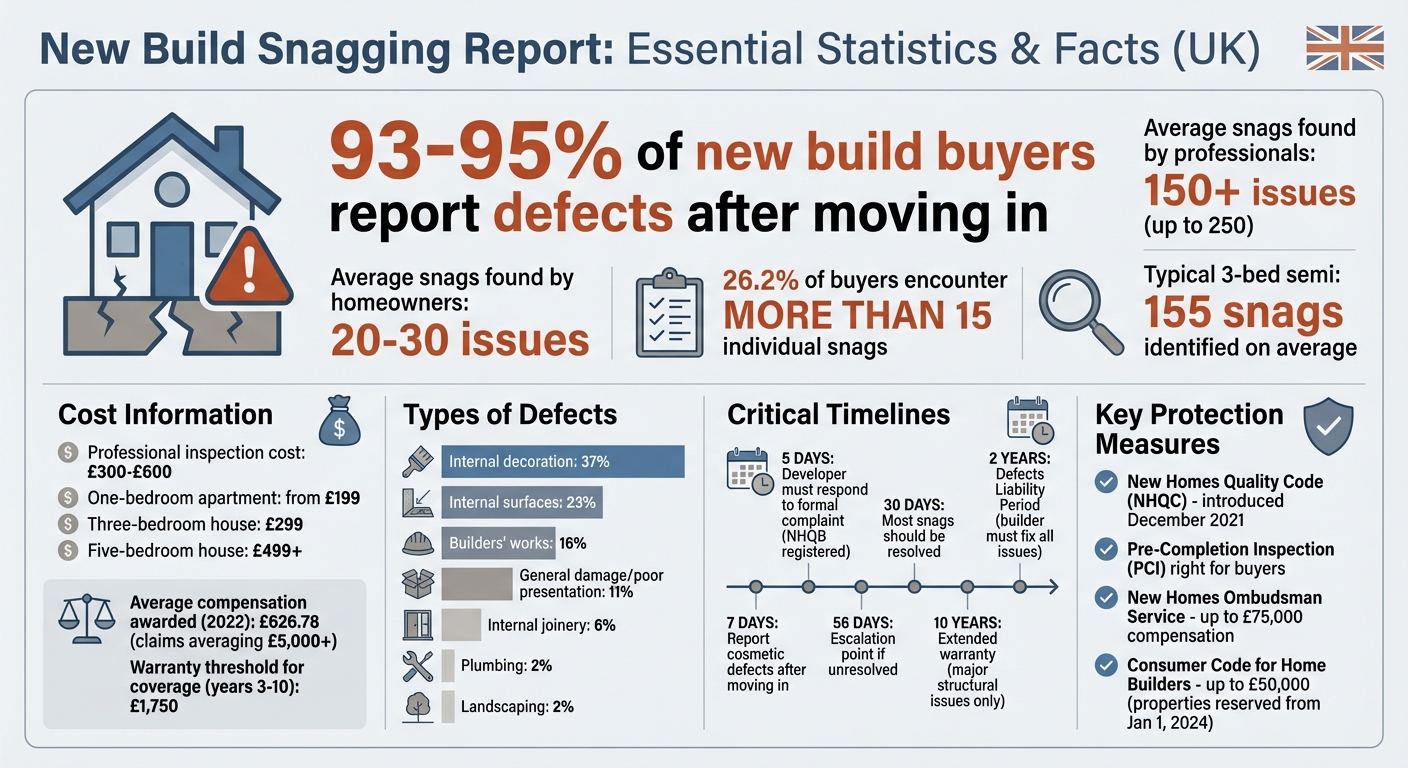
New Build Snagging Statistics and Key Facts UK 2024
New Build Snagging Tips | People in Property
sbb-itb-b9291f4
What Is a Snagging Report?
A snagging report is a detailed document that lists all defects, unfinished work, and poor-quality finishes in a newly built property. It acts as a formal record of anything that doesn’t meet Building Regulations or the standards set by your warranty provider. This includes visible problems, like scratched windows or paint splashes, as well as hidden issues that require expert knowledge to uncover, such as missing loft insulation or faulty wiring. Essentially, it’s a tool to identify and document flaws, paving the way for necessary repairs.
The goal of a snagging report is to ensure your developer takes responsibility for the identified issues. Once submitted, the builder is required to address and fix these problems within the first two years of ownership, a period known as the Defects Liability Period. After this time, your 10-year warranty – offered by providers like NHBC, LABC, or Premier Guarantee – usually only covers major structural problems.
These inspections are carried out by professionals, often chartered surveyors, who meticulously check every room, test fixtures and fittings, and use tools like thermal cameras to uncover hidden faults. Research shows that a professional inspection can reveal anywhere from 100 to 250 issues, with an average of 155 snags identified in a typical three-bedroom semi-detached house. This level of thoroughness is hard to achieve without expert help, making professional snagging inspections incredibly valuable.
Snagging Reports in the UK
In the UK, snagging reports are closely tied to consumer protection measures. The New Homes Quality Code (NHQC), introduced in December 2021, gives buyers the right to a professional Pre-Completion Inspection (PCI) before finalising the purchase. This allows you to identify issues before officially taking ownership, giving you stronger grounds to request repairs.
The NHQC requires developers to address reported snags within 30 days unless there’s a valid reason for delay. If a builder signed up to the code fails to resolve issues within a reasonable timeframe, you can escalate your complaint to the New Homes Ombudsman Service. This system ensures you’re not left handling unresolved defects on your own.
Your new build warranty also plays a key role. During the first two years, the builder is obligated to fix all snags at no cost to you. Understanding these protections highlights why timely reporting is so important, particularly when distinguishing between minor cosmetic issues and more serious structural problems.
Cosmetic vs Structural Defects
Not all snags are the same. Cosmetic defects are surface-level flaws that affect how your home looks but don’t impact its safety or functionality. These might include paint splatters, scratched glass, uneven tiles, or gaps in skirting boards. While these may seem minor, they can influence your overall satisfaction with the property and even its resale value.
Structural defects, however, are much more serious. They pose risks to safety or the building’s integrity. Examples include foundation problems, settlement cracks, faulty wiring, plumbing leaks, missing roof tiles, or inadequate insulation. If left unresolved, these issues can lead to long-term damage, safety hazards, or costly repairs. Recognising the difference between these types of defects is crucial, as cosmetic issues may become your responsibility once the builder’s liability period ends.
Timing is also critical when reporting snags. Many builders only allow seven days after handover to report cosmetic or decorative issues, arguing that any damage reported later may have been caused by the homeowner. However, structural defects can be reported throughout the full two-year Defects Liability Period.
Why New Builds Need Snagging Inspections
New build homes may seem pristine, but they’re rarely without flaws. Surveys reveal that the majority of buyers report snags or defects to their builder after moving in. In fact, over a quarter (26.2%) of buyers encounter more than 15 individual snags. A 2024 study found that a staggering 95% of new build buyers experienced issues post-move.
The rush to meet deadlines often means builders overlook details. With multiple trades – like electricians, plumbers, plasterers, and decorators – working on each property, the chances of miscommunication and errors increase. This is especially true in large developments, where recurring faults are more common.
Professional snagging inspections uncover far more issues than a casual review by homeowners. While buyers may spot 20–30 snags on their own, a professional inspection typically identifies over 150 defects. Many of these require specialist equipment – such as thermal imaging cameras, damp meters, or socket testers – to detect hidden problems like missing insulation or faulty wiring. This level of scrutiny is essential for pinpointing both visible and concealed defects.
Common Defects in New Build Properties
Snags in new homes often fall into several categories. According to data, internal decoration issues account for 37% of reported defects, internal surfaces make up 23%, builders’ works 16%, general damage or poor presentation 11%, internal joinery 6%, while plumbing and landscaping sit at 2% each.
Cosmetic defects are the most obvious and frequently reported. These include scratched windows, paint splatters on woodwork or glass, uneven plastering, poor painting finishes, and carpets catching under doors. While these may seem minor, they can impact satisfaction and even reduce the property’s resale value.
More serious are structural and technical problems. Faulty brickwork pointing can let in water, poorly installed loft insulation may drive up energy bills, leaking pipes can lead to mould or rot, and electrical wiring faults pose fire risks. These issues often go unnoticed during a quick walkthrough but are typically caught during professional inspections.
Functional defects can also disrupt everyday life. Misaligned kitchen cabinets, poorly fitted doors and windows causing draughts, faulty locks, or uneven floors can all be frustrating. While some minor imperfections – like small plaster cracks from natural settling – are normal, distinguishing these from genuine defects requires expertise. If ignored, these problems can escalate into larger, costlier issues.
What Happens If You Ignore Snags
Overlooking snags can lead to bigger problems down the line. For example, small gaps in sealant or tiny leaks can eventually cause mould, damp, and even structural damage. Missing or poorly installed insulation can result in cold spots and consistently high energy bills. Faulty brickwork or loose roof tiles may allow water ingress, leading to significant deterioration and expensive repairs.
During the two-year Defects Liability Period, builders are responsible for fixing most issues at no cost. However, once this period ends, homeowners bear the repair costs. From years 3 to 10, warranties generally only cover major structural or weatherproofing issues and often require repair costs to exceed a threshold – around £1,750 – before support kicks in. In 2022, the average compensation awarded to buyers was just £626.78, despite claims averaging over £5,000.
Rachel Lacey, a Money Expert from the Telegraph, warns: “Skipping this step could prove to be a false economy if it means you miss the opportunity to identify problems and get them fixed whilst snags are still covered by your warranty.”
Ignoring snags can also hurt your property’s resale value. Future surveyors may flag unresolved issues, giving buyers a reason to negotiate a lower price – or walk away entirely. Adding to this, developers often allow just a seven-day window to report cosmetic snags. Delaying your inspection could result in the builder refusing to fix problems, claiming they occurred after you moved in.
When to Get a Snagging Report
The best time to spot defects is after the building work is complete but before legal completion. At this point, the property is still legally owned by the builder, making them more inclined to fix issues before handing over the keys. Let’s take a closer look at the ideal timing both before and after completion.
Before Completion
Scheduling your inspection between the end of construction and legal completion comes with a key benefit: any repairs can be done without disrupting your daily life. This means fixes are carried out while the property is still unoccupied. If your developer follows the New Homes Quality Code, you’re entitled to arrange a professional Pre-Completion Inspection (PCI) before the handover.
The best time to book your inspector is when the builder issues the “notice to complete”, which is usually two weeks before your move-in date. However, some developers may limit access before completion, arguing that the property remains their responsibility until the handover. If access is denied, plan to conduct the inspection as soon as possible after moving in.
After Moving In
If a pre-completion inspection wasn’t possible, it’s crucial to act quickly once you’ve moved in. You should report any cosmetic defects – such as scratched windows, paint marks, or scuffed walls – within the first seven days. Missing this window could make it harder to file claims.
“In the case of cosmetic snags, such as chipped paintwork or scratched surfaces, it can be difficult to prove that you didn’t cause the damage yourself once you’ve moved in”, explains Rachel Lacey, Specialist, Telegraph Money.
For more serious issues, like leaks or faulty wiring, it’s important to address them promptly, as they can escalate if left unchecked. Keep in mind that you have a two-year Defects Liability Period to report workmanship problems. Always document any defects with photographs and maintain written records of all correspondence to protect your rights.
How to Conduct a Snagging Inspection
If you’re tackling a snagging inspection, it’s essential to approach it systematically. Start with the exterior of the property – inspect the roof, brickwork, and gutters – before heading indoors. Once inside, work through each room in a clockwise direction starting from the front door. This method helps ensure no area is overlooked.
Functionality checks are equally important. Turn on all taps and showers to test for leaks and water flow. Check every light switch and socket. Open and close all doors and windows to confirm they latch securely and seal against draughts. Test radiators for even heating, confirm extractor fans are working, and ensure toilets flush properly. Don’t neglect the loft – check that insulation is flat and gap-free, and examine the roof felt for any signs of damage.
Room-by-Room Checklist
To avoid missing anything, use a detailed checklist. For the exterior, inspect roof tiles for cracks or loose sections, look for damage or acid wash marks on brickwork, and verify that the damp proof course is at least 150mm above ground level. Ensure gutters are securely attached and the driveway is level.
Inside, check walls and ceilings for smooth plasterwork, visible nail fixings, and paint quality. In kitchens and bathrooms, test all appliances, check for leaks under sinks, and ensure cupboard doors align properly. Pay attention to grout and mastic, making sure they’re intact. For windows and doors, inspect glass for scratches, test locks and handles, and confirm that weather seals are effective. Finally, ensure all electrics and plumbing are in working order – check socket stability, radiator heat distribution, and water pressure.
DIY vs Hiring a Professional
While a DIY inspection can help you spot surface-level issues like paint drips or scratches, it often misses more complex defects that require professional expertise. Once you’ve completed your own inspection, it’s wise to bring in a professional snagging inspector. These experts are familiar with building regulations and use specialised tools to uncover hidden problems such as insulation gaps, uneven floors, and damp. Their detailed knowledge ensures a more thorough inspection and improves the chances of resolving all defects.
“After a DIY assessment, we always advise using a professional snagging company to check your new build home for any defects. This is because if you do not have the experience or are not fully qualified then it is likely defects will go undetected, costing you money in the long run”, explains Ian Lively, Housing & Snagging Survey Expert.
A professional inspection typically takes two to six hours, depending on the size of the property. Costs generally start at around £199 for a one-bedroom apartment, rising to £299 for a three-bedroom house and £499 or more for larger five-bedroom homes.
How to Document Defects
Properly documenting defects is key to getting developers to act, especially during the warranty period when repairs should be free of charge. Take multiple photos of each defect, capturing different angles, and note its location and severity. Where possible, include a suggestion for how the issue should be resolved – this helps contractors understand the problem and speeds up repairs.
Using a standardised digital report format can make a big difference. Organise defects by room and category to help site managers assign tasks efficiently. Digital property inspection software allows you to upload photos, add detailed notes, and prioritise issues, creating a professional report that developers are more likely to respond to quickly. Keep copies of all correspondence and photographs to maintain a clear record of what was reported and when.
Getting Developers to Fix Snags
When it comes to addressing snagging issues, timing and methodical follow-up are crucial. Most developers have dedicated after-sales or customer care teams to manage these concerns. If they are registered under industry codes, they must adhere to specific timelines for resolving complaints.
Submitting Your Snagging Report
Send your snagging report to the developer’s after-sales team as soon as possible. Always submit it in writing – via email or letter – to ensure there’s a clear audit trail. It’s also a good idea to copy in your conveyancing solicitor, as they can help secure a formal repair schedule.
For developers registered with the New Homes Quality Board (NHQB), they are required to respond to your formal complaint within 5 calendar days. Within 10 calendar days, they must provide a “path to resolution” letter. Typically, most snagging issues should be resolved within 30 calendar days unless there’s a valid reason for delay. Keep a detailed log of all interactions, including dates of site visits and the names of any contractors involved. These records can be invaluable in supporting your case.
What to Do If Snags Aren’t Fixed
If your snags remain unaddressed despite your prompt report, take the following steps. First, hold off on completing the House Builder Federation satisfaction survey until all issues are fixed. Developers often rely on these surveys to maintain their “five-star” ratings, which can also be tied to staff bonuses.
If after 56 days your snags are still unresolved, escalate the matter. For developers registered with the NHQB, you can approach the New Homes Ombudsman Service, which has the authority to award compensation of up to £75,000. For properties reserved from 1 January 2024 onwards, the Consumer Code for Home Builders allows claims of up to £50,000. You can also contact your warranty provider, such as NHBC, who can send a Claims Investigator to your property. If the developer fails to act within the specified timeframes, the warranty provider may even hire independent contractors to complete the work.
“If the work is not completed within the specified timeframes, the NHBC can hire contractors to finish the job.”
– The Professional Snagging Company
Avoid attempting any self-repairs. If something goes wrong, the developer could argue that you caused the damage, potentially invalidating your warranty. Stay professional, keep an archive of all correspondence, and ensure you exhaust the developer’s internal complaints process before escalating the issue externally.
Conclusion
A snagging inspection is a vital step in safeguarding what is likely your biggest financial commitment. With over 94% of new-build homes reporting defects within the first two years, and nearly a third of buyers uncovering more than 15 separate issues, it’s clear that “new” doesn’t always mean flawless.
Spotting defects early can save you significant money. During the two-year Defects Liability Period, builders are responsible for fixing these problems. Miss this window, and you could face hefty repair bills, as warranties usually only cover major defects costing over £1,750.
The difference professional expertise brings is striking. While the average homeowner might spot 20–30 snags, a professional inspector typically identifies over 150 issues. Prince Surveyors’ RICS-accredited specialists use advanced tools – like thermal imaging, moisture meters, and drones – to uncover hidden defects such as missing insulation or breaches of building regulations. The cost of a survey is small compared to the potential expense of undetected problems. Plus, a detailed report with photographic evidence ensures developers take your concerns seriously and resolve them properly.
Snagging inspections are essential to protecting your investment and ensuring your new home lives up to the quality you’ve paid for. Prince Surveyors provides independent snagging inspections designed to give you peace of mind and prevent unexpected repair costs. Don’t leave your investment to chance – schedule a professional snagging inspection today.
FAQs
What can I do if my builder won’t fix issues identified in my snagging report?
If your builder refuses to address the issues highlighted in your snagging report, the first step is to document everything meticulously. Send a formal letter or email outlining the problems, attaching your snagging report, relevant photos, and any applicable Building Regulations references. Keep a copy for your records and note the date you sent it – this establishes a clear paper trail.
Should the builder remain unresponsive, escalate the issue through their formal complaints process. Request a written response within a reasonable timeframe, such as 14 days. If this still doesn’t lead to progress, reach out to your warranty provider. Most new builds in the UK come with a 10-year warranty, and the provider may step in to pressure the builder or arrange an independent inspection. You can also contact the New Homes Ombudsman, who has the authority to mandate repairs or award compensation.
If these steps don’t resolve the situation, consider alternative dispute resolution (ADR) options like mediation or arbitration. Legal action through the County Court is another route, but it should only be pursued as a last resort due to the potential costs and time involved. Staying persistent and well-organised will help safeguard your investment and ensure your home meets the standards you were promised.
How can I make sure my snagging report covers everything?
To make sure your snagging report covers everything, work through a room-by-room checklist that looks at all parts of the property. Start with the exterior – inspect the brickwork, roof, and drainage. Then move inside to check the walls, flooring, tiling, and paintwork. Don’t forget to examine essential systems like electrics, heating, and plumbing, as well as fixtures such as doors, windows, and kitchen and bathroom fittings.
Record every issue, even minor ones, before the final handover. This gives you the opportunity to raise concerns with the developer straight away and ensures your new home meets the standards you expect.
What can I do if defects in my new build aren’t fixed during the warranty period?
New-build homes in the UK usually come with statutory warranties, which include a 10-year structural warranty and a shorter warranty – often around two years – for fixtures and fittings. These warranties oblige developers to fix defects reported within the specified timeframes.
On top of that, the Consumer Code for Home Builders gives buyers the right to request that developers address any problems. If a developer fails to resolve issues during the warranty period, you can escalate the matter through the warranty provider’s dispute resolution process. In more serious cases, legal action may be an option to secure compensation or repairs.
To ensure your rights are protected, make sure to document any issues in detail and report them to your developer as quickly as possible.
Related Blog Posts
How Prince Surveyors can help: explore our independent damp surveys or learn about our Level 3 building survey.