

An RICS Building Survey (Level 3) is the most detailed property inspection available in the UK. It’s designed to assess a building’s condition, identify defects, and provide repair advice. This survey is ideal for older, unique, or altered properties and helps buyers make informed decisions before exchanging contracts. The inspection is conducted by RICS-accredited surveyors, ensuring high standards and reliable advice.
Key Highlights:
- Who needs it? Buyers of older or unique homes, or properties in poor condition.
- What does it include? A detailed inspection of accessible areas, defect identification, and maintenance recommendations.
- Why is it important? It helps you avoid unexpected repair costs and renegotiate purchase terms if needed.
- Cost range: £500–£1,500, depending on property size and value.
- Timing: Arrange after your offer is accepted but before exchanging contracts.
This guide answers the 10 most common questions about RICS Building Surveys, helping you understand its purpose, benefits, and when to use it.
Level 2 Vs Level 3 Surveys
What an RICS Building Survey Covers
An RICS Building Survey involves a thorough inspection of all accessible areas of a property. The surveyor will physically enter the roof space, lift insulation to examine ceiling construction, assess areas prone to deterioration, and test floors for excessive movement using standard deflection tests. They’ll also check the functionality of all windows and doors by opening them and conduct a detailed inspection of the grounds, including any permanent outbuildings, fences, and gates. Below, we break down the survey into its key components: structural assessment, defect identification, and maintenance advice.
Structural Condition Assessment
The surveyor carries out a detailed evaluation of the building’s construction materials and design, determining how the structure was built and how its materials are likely to perform over time. This goes beyond surface-level checks to uncover signs of movement, settlement, or structural weakness.
"The survey of a building is part art and part science. The art is knowing where to look and the science is the interpretation of what one sees."
- Professor Malcolm Hollis
For instance, the surveyor may lift accessible drainage chamber covers and test a sample of lights and fans to ensure they are functioning as expected.
Defect Identification
Surveyors use their expertise to track down potential problems. If visible issues like damp patches, cracks, or decaying timber suggest deeper defects, they may recommend further investigation or the use of specialist tools, such as fibre optic probes. Findings are categorised using the familiar traffic light system to indicate severity and urgency.
Maintenance and Repair Advice
The survey report offers tailored recommendations for addressing identified defects, outlining repair methods and their potential costs. It also prioritises necessary work and provides suggested timelines, enabling you to plan and budget effectively.
"A Home Survey Level Three report does make general recommendations in respect of the priority and likely timescales for necessary work and could provide an indication of costs, if this is agreed as an additional service."
- RICS
In addition to immediate repairs, the report includes advice on future maintenance based on how the property’s materials are expected to age. If certain areas cannot be fully assessed due to access restrictions, the surveyor will detail the limitations, explain why further investigation is needed, and recommend consulting a specialist.
RICS Building Survey vs HomeBuyer Report
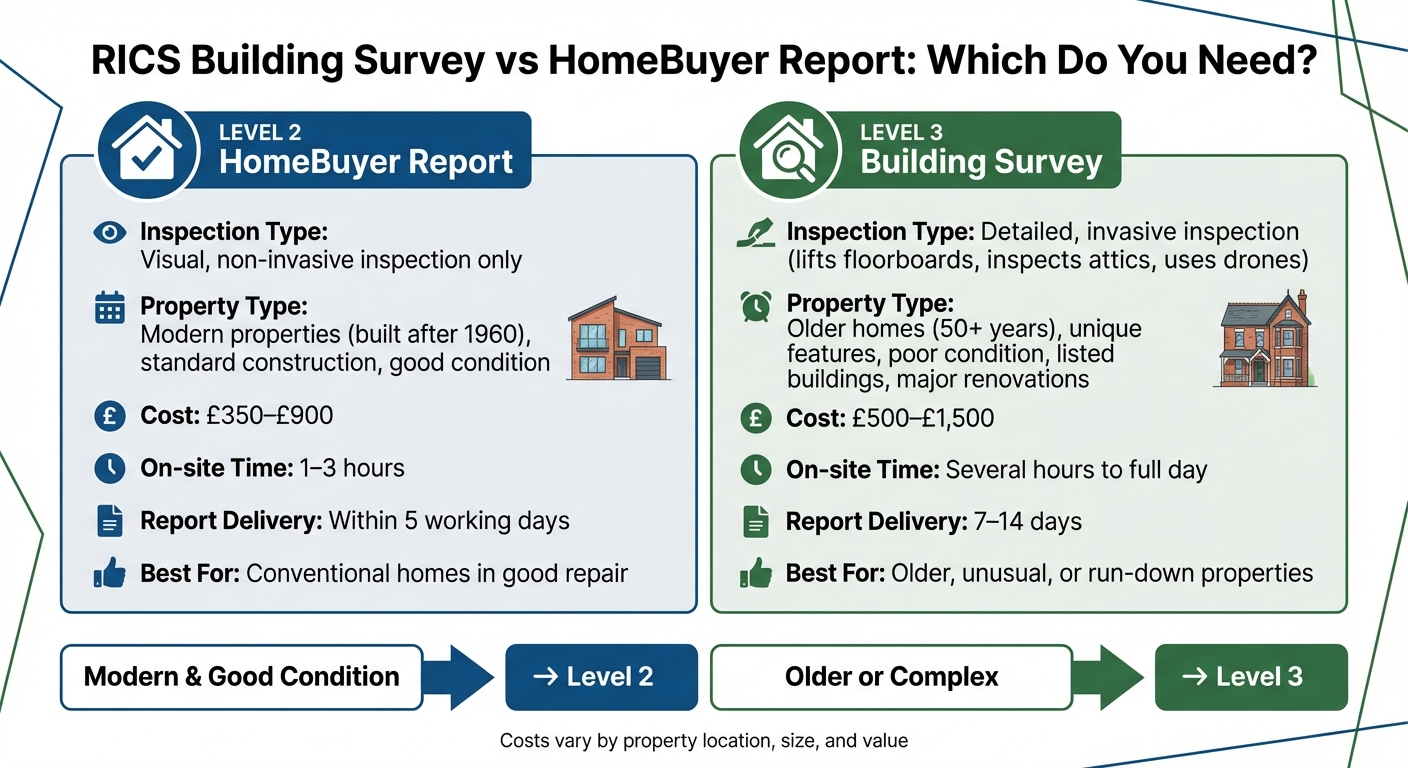
RICS Building Survey vs HomeBuyer Report Comparison Guide
Understanding the differences between these two survey types is key when deciding which house survey level is right for your property purchase. Each survey has a distinct purpose, so knowing what they offer can help you make an informed choice.
Depth of Inspection
The RICS Level 2 Home Survey (commonly called the HomeBuyer Report) is a visual, non-invasive inspection. Surveyors only examine accessible areas, meaning they won’t move furniture or lift floorboards during their assessment. On the other hand, the Level 3 Building Survey takes a more detailed approach. This involves inspecting attics, lifting loose floorboards, and even using tools like drones or pole cameras to assess hard-to-reach areas, such as roofs.
Which Properties Need Which Survey
A Level 2 HomeBuyer Report is ideal for standard, modern properties – typically built after 1960 – with no major issues and constructed using conventional materials. In contrast, a Level 3 Building Survey is better suited for older homes (over 50 years), properties with unique features like timber frames or thatched roofs, homes in poor condition, or properties requiring significant renovations. If you’re considering a listed building or one with extensive alterations, the Level 3 option is the better choice.
Cost and Timeframe Differences
| Feature | Level 2 (HomeBuyer Report) | Level 3 (Building Survey) |
|---|---|---|
| Typical Cost | £350–£900 | £500–£1,500 |
| On-site Time | 1–3 hours | Several hours to a full day |
| Report Delivery | Usually within 5 working days | Between 7–14 days |
| Best For | Modern properties in good repair | Older, unusual, or run-down properties |
The cost of each survey depends on factors like the property’s location, size, type, and value. Surveyors generally require a lead time of three to five days after receiving instructions before they can carry out the inspection. These distinctions make it easier to decide which survey aligns with your needs and the type of property you’re buying.
sbb-itb-b9291f4
How to arrange an RICS Building Survey
When to commission an RICS Building Survey
You should arrange your survey as soon as your offer is accepted. This demonstrates your commitment and helps ensure the transaction progresses smoothly.
Make sure the survey is completed before exchanging contracts, as this is when you become legally bound to the purchase. If you’re considering major renovations or have spotted issues like damp, structural movement, or timber decay in a property you already own, a Building Survey can offer detailed insights and guidance.
RICS Building Survey costs
The cost of an RICS Level 3 Building Survey generally falls between £500 and £1,500, depending on factors like the property’s size, age, complexity, and market value.
Here’s a breakdown of typical costs based on property value:
| Property Value | Average Level 3 Survey Cost |
|---|---|
| Up to £100,000 | £500 – £600 |
| £200,001 to £300,000 | £600 – £700 |
| £400,001 to £500,000 | £700 – £800 |
| £600,001 to £700,000 | £800 – £900 |
| £900,001 to £1,000,000 | £950 – £1,050 |
Keep in mind that you’re not required to use the surveyor recommended by your bank or estate agent. Shopping around can often lead to better pricing and access to niche expertise. Request quotes from several RICS-regulated firms and review sample reports to compare the level of detail and clarity provided.
How long an RICS Building Survey takes
Typically, the inspection itself lasts about eight hours, though it may take longer for larger or more complex properties. After the inspection, the written report is usually delivered within eight working days, with a scheduling lead time of three to five days.
Many surveyors offer an initial verbal summary on the day of the inspection, followed by the full written report. To make the most of the survey, inform your surveyor in advance of any specific concerns, such as potential damp or structural issues, so these can be prioritised during the inspection.
Prince Surveyors‘ RICS Building Survey Service
RICS-Accredited Professionals
At Prince Surveyors, all surveys are conducted by chartered professionals holding recognised RICS designations such as AssocRICS, MRICS, and FRICS. These qualifications ensure the highest level of professionalism, with advice that is clear, unbiased, and fully protected by professional indemnity insurance.
"A thorough, accurate and impartial survey undertaken by a regulated professional is a quality service that is worth paying for"
- RICS
This level of expertise allows Prince Surveyors to offer a tailored approach, ensuring every survey meets the specific needs of your property.
Tailored Property Advice
Every property is different, and Prince Surveyors customises each survey to address your specific concerns. Whether you’re worried about damp, structural cracks, or planning major renovations, the inspection will focus on what matters most to you. Using advanced tools like drones and pole cameras, they can access hard-to-reach areas – such as roofs and high-level masonry – that are often overlooked.
The result? A detailed report, typically 35–50 pages depending on your property’s size, covering everything from technical defect analysis to repair options, timelines, and potential risks if issues are left unaddressed. To make things even easier, the service includes a verbal summary of the findings and ongoing support to help you take the next steps.
Wherever your property is located in the UK, this personalised service is always available.
Nationwide Coverage
Prince Surveyors offers its Building Survey service across England, Wales, Scotland, and Northern Ireland. No matter where your property is, you can count on consistent, high-quality RICS surveying. The team’s understanding of regional construction methods and local building issues ensures that your survey reflects the specific characteristics of your area.
With Prince Surveyors, you get a comprehensive service designed to meet the unique needs of your property, no matter its location.
Conclusion
An RICS Building Survey acts as a thorough "health check" for your property, helping to safeguard your investment. It uncovers structural problems, damp, timber decay, and other defects that, if ignored, could lead to repair bills running into thousands of pounds. With this detailed knowledge, you can make informed choices – whether that’s renegotiating the purchase price, requesting repairs before completion, or stepping away from a potentially costly purchase.
Prince Surveyors brings a wealth of expertise to this process. Their RICS-accredited professionals deliver impartial and detailed assessments, all backed by professional indemnity insurance. This ensures you receive reliable advice and comprehensive reports that help you plan repairs and manage your budget effectively.
No matter where your property is located – England, Wales, Scotland, or Northern Ireland – Prince Surveyors provides a consistent, high-quality service tailored to your needs. By identifying potential issues early, their service equips you with the confidence to make decisions that protect your investment for the long term.
FAQs
What is the difference between a Level 2 HomeBuyer Report and a Level 3 Building Survey?
The Level 2 HomeBuyer Report is tailored for standard properties in good condition. It offers a straightforward assessment of visible issues, using a traffic-light system to rate the condition of features such as walls, roofs, and floors. While it flags significant concerns like damp or structural movement, it doesn’t include invasive inspections or detailed repair recommendations.
The Level 3 Building Survey, on the other hand, dives much deeper. It’s specifically designed for older, larger, or significantly altered properties, as well as those requiring extensive repairs. This survey evaluates structural components, including chimneys, windows, and outbuildings, offering detailed guidance on repairs, identifying risks, and outlining the potential consequences of neglecting them. It’s particularly useful if you’re considering renovations or purchasing a property in poor condition.
In essence, the Level 2 report is a concise option for standard homes, while the Level 3 survey delivers a comprehensive structural evaluation for more complex or problematic properties.
Can an RICS Building Survey help me negotiate a lower price for a property?
When you commission an RICS Building Survey, it can be a powerful tool during price negotiations. This survey pinpoints any defects or problems with the property and often includes an estimate of the repair costs. With this detailed insight, you can present a strong case to the seller for a price reduction, reflecting the expenses needed for repairs or maintenance.
This approach is especially effective before exchanging contracts, as it allows you to make an informed choice and potentially save money on your purchase. By addressing these issues upfront, you can ensure you’re not overpaying for the property.
What tools do surveyors use during a Level 3 Building Survey?
During a Level 3 Building Survey, surveyors rely on various specialised tools to carry out a detailed inspection of the property. Among these are a tape measure for precise measurements, a compass to determine orientation, and a spirit level to check for structural alignment. An inspection cover lifter is used to access hidden areas, while a meter box key allows them to examine utility meters. Additionally, digital devices are often employed to take notes and capture photographs.
These tools enable surveyors to pinpoint potential problems and compile a thorough report, giving you a comprehensive view of the property’s condition.
Related Blog Posts
How Prince Surveyors can help: explore our Level 3 building surveys or learn about our Level 2 vs Level 3 guide.