

The Complete Guide to Understanding the Difference Between Level 2 and Level 3 Survey
When purchasing a property in the UK, one of the most critical decisions buyers face is choosing the right type of survey. The difference between level 2 and level 3 survey options can significantly impact both your understanding of a property’s condition and your financial investment. With property transactions involving hundreds of thousands of pounds, making an informed choice about which survey level suits your needs isn’t just advisable—it’s essential for protecting your investment and avoiding costly surprises down the road.
Key Takeaways
• Level 2 surveys (HomeBuyer Reports) are suitable for conventional properties in reasonable condition, typically built after 1900, and cost between £400-£800
• Level 3 surveys (Building Surveys) provide comprehensive analysis for older, unusual, or deteriorated properties, with costs ranging from £600-£1,500
• Property age and condition are the primary factors determining which survey level you need—newer properties generally require Level 2, while pre-1900 or significantly altered properties benefit from Level 3
• Level 3 surveys offer deeper investigation including accessible roof spaces, cellars, and detailed structural analysis that Level 2 surveys don’t provide
• Both survey types can support price negotiations and help identify immediate safety concerns, but Level 3 surveys provide more actionable maintenance advice
Understanding Property Survey Levels in 2025
The Royal Institution of Chartered Surveyors (RICS) established standardized survey levels to help property buyers choose appropriate inspection services. These surveys represent different depths of investigation, each designed for specific property types and buyer requirements.
Level 1 surveys (Condition Reports) offer basic visual inspections for new or well-maintained properties. However, most property purchases involve choosing between Level 2 and Level 3 options, as these provide the comprehensive analysis needed for informed decision-making.
The survey landscape has evolved significantly in recent years, with professional surveyors adapting their methodologies to address modern property challenges including energy efficiency, building regulations compliance, and emerging construction technologies.
What Makes Survey Levels Different? 🔍
Survey levels differ primarily in their scope of investigation, reporting detail, and suitability for different property types. Understanding these distinctions helps buyers align their survey choice with their specific property and circumstances.
The key differentiating factors include:
- Inspection accessibility – how thoroughly surveyors examine different building areas
- Reporting depth – level of detail provided about identified issues
- Property suitability – which building types each survey level serves best
- Cost implications – investment required for each survey type
- Timeline considerations – how long each survey takes to complete
Level 2 Survey: The HomeBuyer Report Explained
Level 2 surveys, officially known as HomeBuyer Reports, represent the most popular choice for UK property purchases. These surveys strike a balance between cost-effectiveness and comprehensive property assessment, making them suitable for the majority of residential transactions.
What Does a Level 2 Survey Include?
A Level 2 survey provides a visual inspection of accessible areas without moving furniture or lifting floorboards. Surveyors examine:
External Elements:
- Roof condition (viewed from ground level)
- External walls and pointing
- Windows and doors
- Guttering and downpipes
- Boundaries and outbuildings
Internal Areas:
- Wall and ceiling surfaces
- Floors (where visible)
- Built-in fittings
- Plumbing and heating systems (visual check)
- Electrical installations (basic assessment)
Additional Services:
- Market valuation
- Insurance rebuild cost assessment
- Identification of urgent repairs
- Advice on ongoing maintenance
The report uses a traffic light system (🟢 Green, 🟡 Amber, 🔴 Red) to categorize issues by urgency, making it easy for buyers to understand priorities and potential costs.
When is Level 2 Survey Appropriate?
Level 2 surveys work best for:
- Properties built after 1900 with conventional construction
- Standard residential buildings including houses, flats, and bungalows
- Properties in reasonable condition without obvious structural problems
- Buyers seeking cost-effective assessment with essential information
- Straightforward transactions where comprehensive investigation isn’t required
Most homeowners should know these essential property facts before commissioning any survey, as this knowledge helps determine the appropriate survey level.
Level 2 Survey Limitations
While Level 2 surveys provide valuable insights, they have specific limitations:
Accessibility Restrictions:
- No inspection of roof spaces or cellars
- Areas behind furniture remain unexamined
- Floorboards and fitted carpets aren’t lifted
- Services testing is limited to visual assessment
Investigation Depth:
- Surface-level examination only
- No structural calculations or detailed analysis
- Limited investigation of potential problems
- Minimal advice on repair methodologies
Understanding these limitations helps buyers set appropriate expectations and determine whether Level 2 surveys meet their specific needs.
Level 3 Survey: The Comprehensive Building Survey
Level 3 surveys, known as Building Surveys or Structural Surveys, provide the most thorough property investigation available. These comprehensive assessments suit buyers who need detailed analysis of property condition, structural integrity, and long-term maintenance requirements.
Comprehensive Investigation Scope
Level 3 surveys involve extensive examination of accessible building elements, with surveyors investigating areas that Level 2 surveys cannot reach:
Detailed External Assessment:
- Close-up roof inspection (where safely accessible)
- Detailed structural element examination
- Comprehensive drainage assessment
- Boundary and garden structure evaluation
- Outbuilding and garage inspection
Thorough Internal Investigation:
- Roof space examination (where accessible)
- Cellar and basement inspection
- Floor structure assessment (lifting boards where agreed)
- Detailed services evaluation
- Built-in furniture and fitting analysis
Specialized Analysis:
- Structural integrity assessment
- Material condition evaluation
- Defect investigation and diagnosis
- Repair methodology recommendations
- Maintenance planning advice
The resulting report provides detailed technical analysis with photographs, diagrams, and comprehensive explanations of identified issues.
When Level 3 Surveys Are Essential
Consider Level 3 surveys for:
Property Characteristics:
- Buildings constructed before 1900 with traditional materials
- Unusual construction types including timber frame, thatched, or non-standard builds
- Significantly altered properties with extensions or conversions
- Properties in poor condition requiring extensive renovation
- Listed buildings or those in conservation areas
Buyer Circumstances:
- Investment properties requiring detailed condition assessment
- Renovation projects where comprehensive planning is essential
- High-value transactions justifying detailed investigation
- Buyers with specific concerns about structural integrity
For properties requiring structural engineering expertise, Level 3 surveys often identify when specialist consultation becomes necessary.
Advanced Reporting and Analysis
Level 3 survey reports provide:
Detailed Technical Information:
- Comprehensive defect descriptions
- Repair priority recommendations
- Cost guidance for identified issues
- Maintenance scheduling advice
- Long-term property care planning
Professional Insights:
- Construction methodology analysis
- Material performance assessment
- Regulatory compliance evaluation
- Energy efficiency considerations
- Future alteration possibilities
This detailed analysis helps buyers understand not just current property condition, but also long-term ownership implications and investment potential.
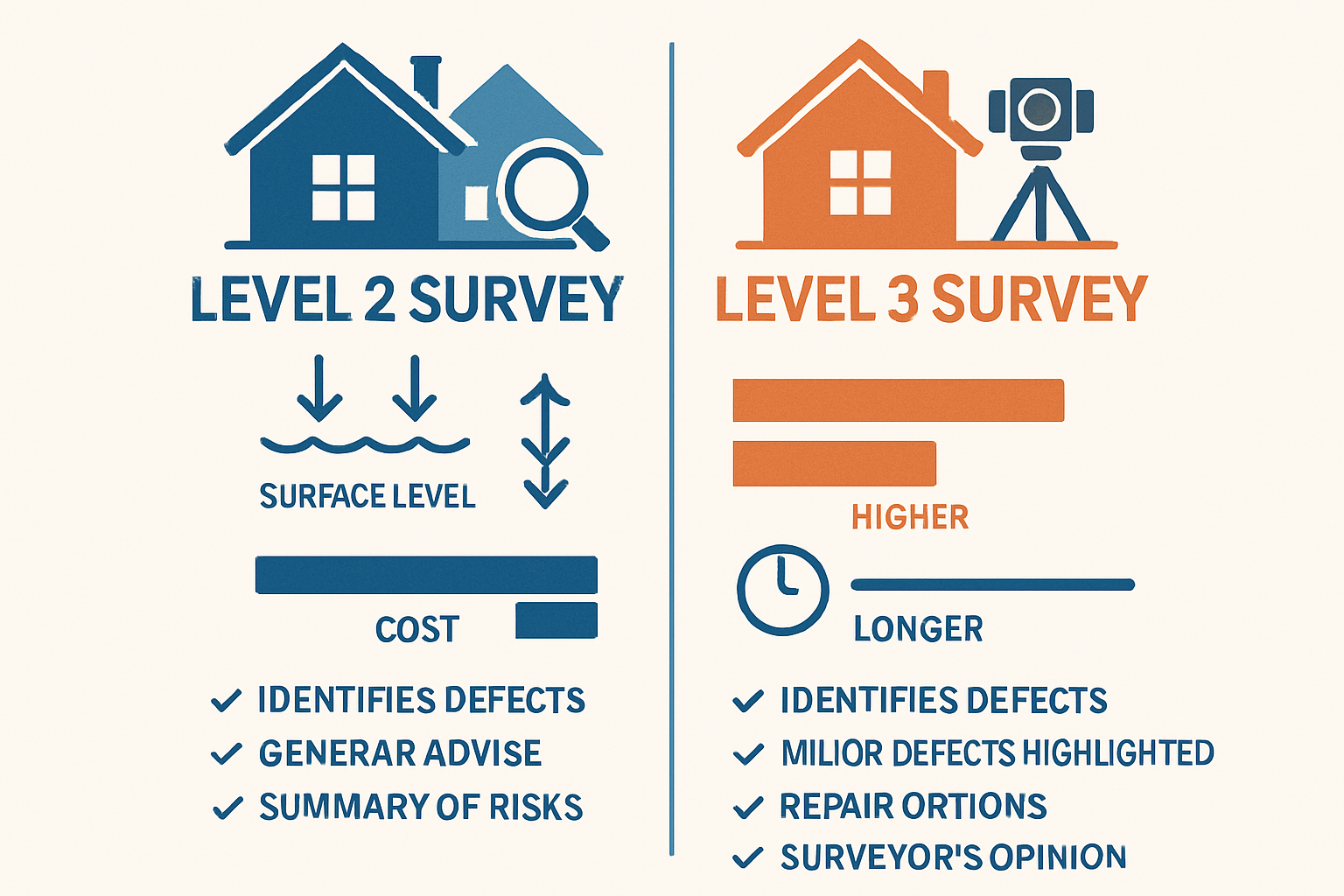
Key Differences Between Level 2 and Level 3 Survey Options
Understanding the difference between level 2 and level 3 survey approaches helps buyers make informed decisions based on their specific property and circumstances. The following comparison highlights the most significant distinctions:
Investigation Depth and Accessibility
| Aspect | Level 2 Survey | Level 3 Survey |
|---|---|---|
| Roof Inspection | Ground level viewing only | Close-up examination where accessible |
| Roof Space Access | Not included | Comprehensive inspection |
| Cellar/Basement | Basic visual check | Detailed examination |
| Floor Investigation | Surface inspection only | May include lifting boards |
| Services Assessment | Visual check only | Detailed evaluation |
| Structural Analysis | Basic condition report | Comprehensive structural assessment |
Reporting Detail and Analysis
Level 2 Reports Feature:
- Traffic light condition ratings
- Standard property valuation
- Basic repair recommendations
- Insurance rebuild costs
- Straightforward maintenance advice
Level 3 Reports Include:
- Detailed technical analysis
- Comprehensive defect investigation
- Specific repair methodologies
- Long-term maintenance planning
- Professional construction insights
Cost and Timeline Considerations
Level 2 Surveys:
- Cost range: £400-£800 (depending on property size and location)
- Timeline: Typically completed within 2-3 hours
- Report delivery: Usually within 2-3 working days
- Best value for: Standard properties in good condition
Level 3 Surveys:
- Cost range: £600-£1,500 (varies significantly with property complexity)
- Timeline: Half-day to full-day inspection
- Report delivery: 5-7 working days for comprehensive analysis
- Investment justified for: Complex or problematic properties
Many buyers find that understanding common defects in older homes helps them determine which survey level provides appropriate investigation depth.
Property Suitability Guidelines
The difference between level 2 and level 3 survey suitability often depends on specific property characteristics:
Level 2 Survey Properties:
- Post-1900 construction with standard materials
- Conventional house, flat, or bungalow layouts
- Properties in reasonable decorative condition
- Standard construction without unusual features
- Buildings without obvious structural concerns
Level 3 Survey Properties:
- Pre-1900 buildings with traditional construction
- Unusual building types or materials
- Properties requiring significant renovation
- Buildings with known or suspected problems
- Listed buildings or conservation area properties
Making the Right Choice: Which Survey Do You Need?
Selecting the appropriate survey level requires careful consideration of multiple factors. The difference between level 2 and level 3 survey options becomes clearer when evaluated against specific property characteristics and buyer requirements.
Property Assessment Framework
Age and Construction Type:
- Post-1900 conventional builds: Level 2 typically sufficient
- Victorian and earlier properties: Level 3 often recommended
- Non-standard construction: Level 3 provides necessary detail
- Recent renovations: Consider Level 3 for comprehensive assessment
Condition Indicators:
- Well-maintained properties: Level 2 usually appropriate
- Obvious defects present: Level 3 investigation recommended
- Structural concerns: Level 3 essential for proper assessment
- Extensive alterations: Level 3 provides detailed analysis
Budget and Risk Considerations
Financial Investment Analysis:
- Purchase price relative to survey cost: Higher-value properties often justify Level 3 investment
- Renovation budget availability: Level 3 helps accurate project planning
- Risk tolerance: Conservative buyers may prefer Level 3 comprehensive analysis
- Future plans: Long-term ownership may benefit from detailed Level 3 insights
Risk Management Factors:
- First-time buyers: Often benefit from Level 2 guidance and education
- Investment purchases: Level 3 provides detailed condition assessment
- Chain transactions: Survey choice may affect timeline considerations
- Insurance requirements: Some policies may require specific survey levels
Professional building surveyors can provide personalized advice based on specific property characteristics and buyer circumstances.
Decision-Making Checklist
Use this framework to determine the most appropriate survey level:
Choose Level 2 Survey When:
✅ Property built after 1900 with standard construction
✅ Building appears in reasonable condition
✅ Conventional house, flat, or bungalow layout
✅ Budget constraints favor cost-effective option
✅ Quick turnaround required for transaction
Choose Level 3 Survey When:
✅ Property built before 1900 or unusual construction
✅ Obvious defects or structural concerns present
✅ Planning significant renovations or alterations
✅ High-value investment requiring detailed analysis
✅ Listed building or conservation area property
Professional Consultation Benefits
Many buyers benefit from professional consultation before selecting survey levels. Qualified surveyors can provide preliminary property assessment and recommend appropriate investigation levels based on:
- Visual property characteristics
- Local area knowledge
- Construction type expertise
- Historical building experience
- Regulatory requirement awareness
This professional guidance helps ensure buyers invest in appropriate survey levels while avoiding unnecessary costs or inadequate investigation.
Additional Considerations for 2025
The property market in 2025 presents unique considerations affecting survey choice:
Regulatory Changes:
- Updated building regulations may affect older properties
- Energy efficiency requirements influence property assessments
- Safety standards continue evolving for residential buildings
Market Conditions:
- Competitive markets may favor quicker Level 2 surveys
- Buyer’s markets allow time for comprehensive Level 3 analysis
- Property prices affect survey cost-benefit calculations
Technology Integration:
- Modern survey techniques enhance both Level 2 and Level 3 investigations
- Digital reporting improves accessibility and understanding
- Advanced detection methods identify previously hidden issues
Understanding these contemporary factors helps buyers make informed decisions about survey levels that serve their specific 2025 property purchase requirements.
Cost-Benefit Analysis and Return on Investment
Understanding the financial implications of the difference between level 2 and level 3 survey options helps buyers make economically sound decisions. The survey investment should align with property value, potential risks, and long-term ownership plans.
Detailed Cost Breakdown
Level 2 Survey Investment:
- Basic fee: £400-£600 for typical properties
- Large properties: £600-£800 for extensive buildings
- Additional services: Valuation included in standard fee
- Timeline efficiency: Quick turnaround supports faster transactions
Level 3 Survey Investment:
- Standard properties: £600-£1,000 for comprehensive analysis
- Complex buildings: £1,000-£1,500 for detailed investigation
- Specialist properties: £1,500+ for unusual or problematic buildings
- Value-added services: Detailed maintenance planning and repair guidance
Return on Investment Scenarios
Level 2 Survey Benefits:
- Negotiation leverage: Identified issues support price reduction discussions
- Insurance clarity: Rebuild cost assessment ensures adequate coverage
- Maintenance planning: Basic guidance helps budget for ongoing care
- Peace of mind: Professional assessment reduces purchase anxiety
Level 3 Survey Advantages:
- Comprehensive understanding: Detailed analysis prevents costly surprises
- Renovation planning: Thorough investigation supports accurate project budgeting
- Long-term savings: Proactive maintenance advice prevents expensive emergency repairs
- Investment protection: Detailed condition knowledge supports informed decision-making
Real-World Financial Impact
Consider these scenarios illustrating survey value:
Scenario 1: Level 2 Success
- Property purchase price: £350,000
- Level 2 survey cost: £550
- Issues identified: Minor roof repairs (£2,000)
- Price negotiation: £3,000 reduction
- Net benefit: £2,450 plus repair cost avoidance
Scenario 2: Level 3 Value
- Property purchase price: £500,000
- Level 3 survey cost: £1,200
- Major issues discovered: Structural problems (£15,000 repairs)
- Transaction outcome: Purchase withdrawn
- Potential loss avoided: £15,000+ plus legal costs
These examples demonstrate how appropriate survey selection provides significant financial protection relative to the initial investment.
Common Misconceptions About Survey Levels
Several misconceptions about the difference between level 2 and level 3 survey options can lead to inappropriate choices. Understanding these common errors helps buyers make better-informed decisions.
Misconception 1: “Level 3 Surveys Always Find More Problems”
Reality: Level 3 surveys provide more detailed investigation, but this doesn’t necessarily mean they identify more issues. Instead, they offer:
- Deeper analysis of visible conditions
- Better understanding of identified problems
- More accurate assessment of repair requirements
- Comprehensive maintenance guidance
Misconception 2: “New Properties Don’t Need Surveys”
Truth: Even new builds benefit from professional assessment. New build surveys can identify:
- Construction quality issues
- Incomplete finishing work
- Warranty claim opportunities
- Early maintenance requirements
Misconception 3: “Level 2 Surveys Miss Important Problems”
Clarification: Level 2 surveys effectively identify significant issues within their scope. However, they have defined limitations:
- Accessibility restrictions rather than investigative failures
- Appropriate scope for their intended property types
- Professional standards ensuring quality assessment within defined parameters
Misconception 4: “Survey Choice Doesn’t Affect Insurance”
Fact: Survey selection can impact insurance in several ways:
- Rebuild cost assessments affect coverage adequacy
- Risk identification influences premium calculations
- Compliance verification supports policy validation
- Claims support through documented property condition
Understanding these realities helps buyers set appropriate expectations and choose suitable survey levels for their specific circumstances.
Maximizing Your Survey Investment
Regardless of whether you choose Level 2 or Level 3, maximizing the value of your survey investment requires active engagement with the process and results.
Pre-Survey Preparation
Property Research:
- Review available property history and documentation
- Identify specific areas of concern for surveyor attention
- Prepare questions about construction, alterations, or maintenance
- Gather information about local area characteristics
Surveyor Communication:
- Discuss property-specific concerns during booking
- Clarify survey scope and limitations
- Arrange property access and timing
- Confirm reporting timeline and delivery method
During the Survey Process
Buyer Involvement:
- Consider attending the survey (where permitted)
- Ask questions about observed conditions
- Understand surveyor’s preliminary observations
- Discuss any immediate concerns or safety issues
Documentation Support:
- Provide property documentation if available
- Share knowledge of recent maintenance or repairs
- Highlight areas of particular concern
- Ensure surveyor has complete property access
Post-Survey Action Planning
Report Analysis:
- Review findings thoroughly and systematically
- Prioritize identified issues by urgency and cost
- Research repair costs and methodologies
- Consider long-term maintenance implications
Professional Follow-up:
- Seek clarification on unclear report sections
- Obtain specialist quotes for identified repairs
- Consider additional specialist inspections if recommended
- Plan negotiation strategy based on findings
Effective survey utilization extends beyond the initial report, providing ongoing value through informed property ownership and maintenance planning.
Conclusion
The difference between level 2 and level 3 survey options represents more than just cost and investigation depth—it’s about selecting the right tool for your specific property purchase circumstances. Level 2 surveys provide excellent value for conventional properties in reasonable condition, offering essential information for informed decision-making at an accessible price point. Level 3 surveys deliver comprehensive analysis for complex, older, or problematic properties where detailed investigation justifies the additional investment.
Your survey choice should align with property characteristics, budget considerations, and risk tolerance. Properties built after 1900 with standard construction typically benefit from Level 2 assessment, while pre-1900 buildings, unusual construction types, or properties with obvious defects often require Level 3 investigation. The key lies in matching survey scope to property complexity and buyer requirements.
Take Action Today:
- Assess your property using the guidelines provided in this article
- Consult with qualified surveyors to confirm your survey level choice
- Budget appropriately for both survey costs and potential repairs
- Plan your timeline to accommodate survey requirements within your transaction schedule
- Prepare questions to maximize your survey investment value
Remember that professional survey investment represents a small percentage of your total property purchase cost while providing essential protection against costly surprises. Whether you choose Level 2 or Level 3, working with experienced surveyors ensures you receive quality assessment and valuable insights for your property investment decision.
The right survey choice provides confidence, negotiation leverage, and long-term property management guidance—making it one of the most valuable investments in your property purchase journey.
How Prince Surveyors can help: explore our chartered surveyor services or learn about our contact our team.