

The Complete Guide to Condition Survey Reports in 2025
When a property owner discovers unexpected structural damage costing tens of thousands of pounds to repair, the first question is always the same: “Why wasn’t this identified earlier?” The answer often lies in the absence of a thorough condition survey report. Whether you’re purchasing a commercial building, managing a property portfolio, or planning major renovations, understanding the critical role of a condition survey report can save you from costly surprises and protect your investment for years to come.
A condition survey report is a comprehensive professional assessment that documents the current state of a building or property, identifying defects, deterioration, and potential issues that require attention. This detailed evaluation provides property owners, buyers, and managers with the essential information needed to make informed decisions about maintenance, repairs, and investment strategies.
Key Takeaways
- 📋 A condition survey report provides a detailed assessment of a property’s current state, documenting defects, structural issues, and maintenance requirements
- 💰 Professional surveys can save thousands of pounds by identifying problems early, enabling accurate budgeting for repairs and preventing costly emergency interventions
- 🏗️ Different survey types serve different purposes, from basic visual inspections to comprehensive structural assessments with invasive testing
- ⚖️ Condition reports are legally valuable for lease agreements, property transactions, insurance claims, and dispute resolution
- 🔄 Regular condition surveys help property owners maintain asset value, plan preventative maintenance, and comply with regulatory requirements
What Is a Condition Survey Report?
A condition survey report is a professional document prepared by qualified surveyors that provides a systematic evaluation of a building’s physical condition at a specific point in time. Unlike valuation reports that focus on market worth, condition surveys concentrate exclusively on the structural integrity, building fabric, and maintenance requirements of the property.
These reports serve multiple purposes across residential, commercial, and industrial properties. They document existing defects, assess the severity of identified issues, estimate repair costs, and provide recommendations for remedial works. The comprehensive nature of a condition survey report makes it an invaluable tool for risk management and strategic planning.
Core Components of a Condition Survey Report
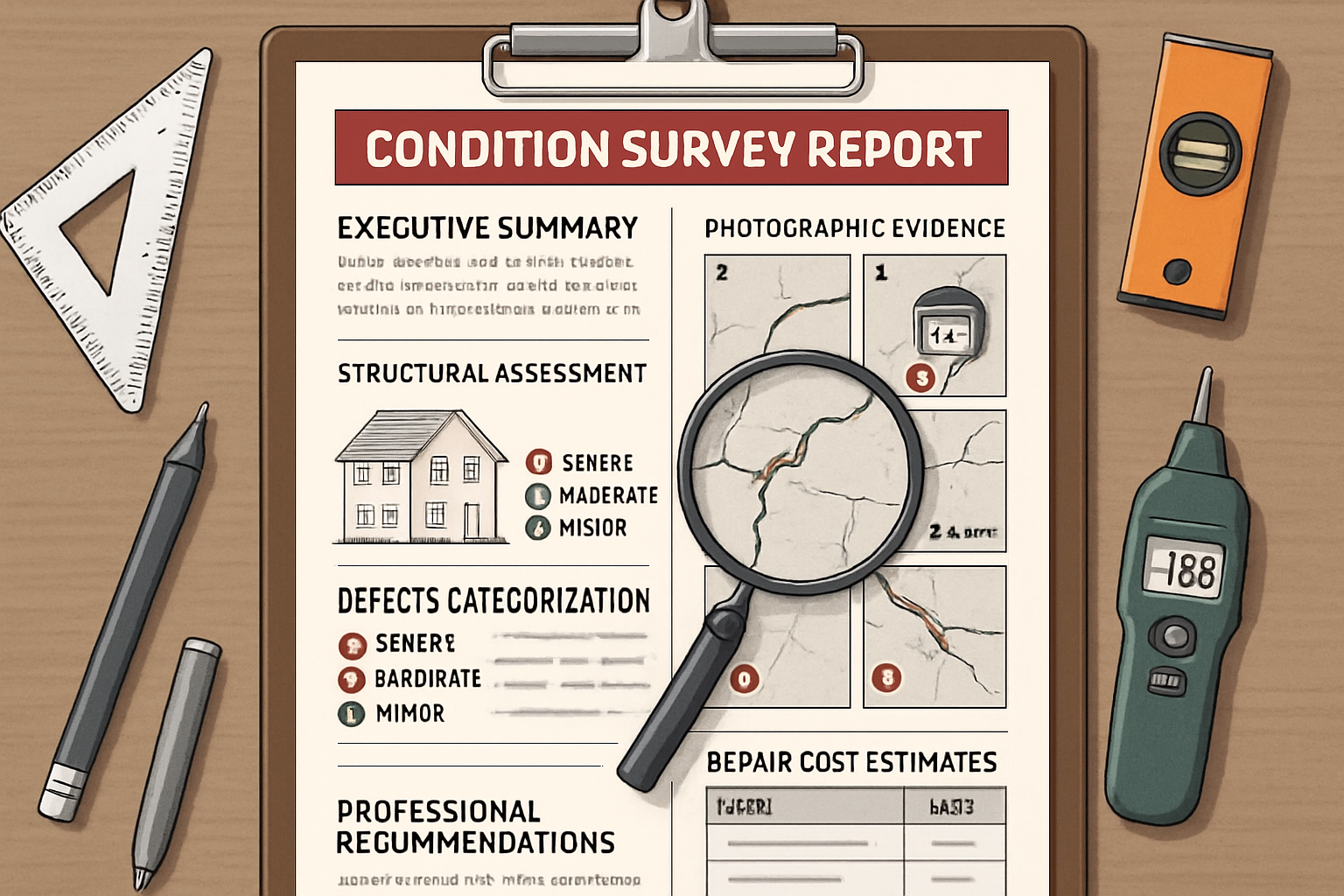
Every professional condition survey report should include several essential elements:
Executive Summary 📊
A concise overview highlighting critical findings, urgent defects, and priority recommendations that require immediate attention.
Property Description
Detailed information about the building including age, construction type, materials used, and architectural features.
Methodology Statement
Explanation of the inspection approach, areas examined, limitations encountered, and any sections that were inaccessible during the survey.
Detailed Findings
Systematic documentation of all defects, deterioration, and maintenance issues organized by building element (roof, walls, foundations, services, etc.).
Photographic Evidence
High-quality images illustrating identified defects with annotations and reference numbers corresponding to written descriptions.
Severity Ratings
Color-coded or numerical classification system indicating the urgency and seriousness of each defect (typically using red/amber/green categories).
Cost Estimates
Approximate budgets for recommended repairs and maintenance works, helping property owners plan financially.
Recommendations
Professional advice on remedial actions, timescales for intervention, and suggestions for further specialist investigations if required.
Understanding common defects in older homes can help property owners appreciate the depth of analysis required in a comprehensive condition survey.
Why Property Owners Need a Condition Survey Report
The value of a condition survey report extends far beyond simple documentation. These professional assessments provide tangible benefits that protect investments and inform strategic decisions.
Financial Protection and Budget Planning
One of the primary reasons to commission a condition survey report is financial risk mitigation. By identifying defects early, property owners can:
- Avoid unexpected repair costs that disrupt budgets
- Plan maintenance expenditure over multiple years
- Negotiate purchase prices based on documented defects
- Prioritize spending on the most critical issues
- Prevent minor problems from escalating into major failures
A well-prepared condition survey report provides the financial intelligence needed to make sound investment decisions. For instance, discovering that a commercial property requires £50,000 in roof repairs before purchase allows buyers to negotiate accordingly or reconsider the acquisition entirely.
Legal and Compliance Requirements
Condition survey reports fulfill important legal functions in various contexts:
| Scenario | Purpose of Condition Survey |
|---|---|
| Lease Agreements | Documents property condition at lease commencement and termination for dilapidations assessments |
| Property Transactions | Provides buyers with comprehensive condition information for informed decision-making |
| Insurance Claims | Establishes pre-existing conditions and validates damage claims |
| Dispute Resolution | Offers independent professional evidence in boundary or maintenance disputes |
| Regulatory Compliance | Demonstrates due diligence for health and safety requirements |
Many landlords and property managers find that regular condition surveys help them understand why property owners hire surveyors and the value these professionals bring to property management.
Asset Management and Value Preservation
For property portfolios and commercial assets, condition survey reports are essential tools for strategic asset management. They enable:
✅ Planned Preventative Maintenance – Scheduling repairs before failures occur reduces overall lifecycle costs
✅ Value Protection – Maintaining buildings in good condition preserves and potentially enhances market value
✅ Performance Benchmarking – Regular surveys track deterioration rates and maintenance effectiveness
✅ Investment Planning – Multi-year maintenance forecasts support capital expenditure planning
✅ Tenant Relations – Transparent condition documentation reduces disputes and demonstrates professional management
Property managers who implement systematic condition surveying programs typically achieve better returns on investment and lower emergency repair costs compared to reactive maintenance approaches.
Types of Condition Survey Reports
Not all condition surveys are created equal. Different property types, purposes, and budgets require varying levels of detail and investigation. Understanding the distinctions helps property owners select the appropriate survey type for their specific needs.
Level 1: Basic Condition Survey
The most straightforward assessment, a Level 1 condition survey (formerly called a Condition Report under RICS guidelines) provides a basic overview of a property’s condition. This survey type:
- Involves visual inspection only, without invasive testing
- Identifies obvious defects and areas of concern
- Suits relatively modern properties in reasonable condition
- Provides limited detail and minimal cost estimates
- Delivers results quickly at the lowest price point
Level 1 surveys are typically appropriate for newer properties (less than 10 years old) constructed with conventional methods and materials, where buyers simply want confirmation that no major issues exist.
Level 2: Homebuyer Survey
The Level 2 condition survey (RICS HomeBuyer Report) represents the middle ground, offering more detailed analysis than a basic survey while remaining more affordable than a comprehensive structural assessment. Key features include:
- Thorough visual inspection of accessible areas
- Market valuation and insurance reinstatement figure
- Identification of urgent defects and potential problems
- Advice on necessary repairs and ongoing maintenance
- Suitable for conventional properties in reasonable condition
This survey type is the most popular choice for residential property purchases, providing sufficient detail for informed decision-making without the expense of a full structural survey. Many homeowners also benefit from understanding essential items every homeowner should have to maintain their property after purchase.
Level 3: Building Survey (Full Structural Survey)
The most comprehensive option, a Level 3 building survey provides exhaustive analysis of a property’s condition. This detailed condition survey report includes:
- Extensive inspection of all accessible areas
- Detailed analysis of construction methods and materials
- Investigation of defects with recommendations for further specialist testing
- Comprehensive repair cost estimates
- Advice on maintenance and alterations
- Suitable for older properties, unusual constructions, or buildings in poor condition
Level 3 surveys are essential for properties built before 1900, buildings with known defects, properties constructed with non-standard materials, or any building where the buyer plans significant alterations. The investment in a thorough building survey often pays for itself many times over by revealing hidden problems before purchase completion.
Specialist Condition Surveys
Beyond standard residential surveys, various specialist condition survey reports address specific property types or concerns:
Commercial Building Surveys 🏢
Tailored for offices, retail units, industrial buildings, and mixed-use developments, focusing on business-critical systems and compliance issues.
Dilapidations Surveys
Assess lease-end condition against original lease terms to determine tenant repair obligations and landlord claims.
Pre-Acquisition Surveys
Support commercial property investment decisions with detailed condition analysis and capital expenditure forecasting.
Planned Maintenance Surveys
Create multi-year maintenance schedules with cost projections for large estates and property portfolios.
Defect Analysis Surveys
Investigate specific problems in detail, often involving invasive testing and specialist equipment.
For properties requiring structural modifications, understanding when to hire a structural engineer becomes crucial alongside condition survey findings.
The Condition Survey Process: What to Expect
Understanding how surveyors conduct condition assessments helps property owners prepare effectively and maximize the value of their investment in professional surveys.
Pre-Survey Preparation
Before the surveyor arrives, property owners can facilitate a more thorough inspection by:
- Providing Access – Ensuring all areas are accessible, including lofts, basements, and external spaces
- Sharing Documentation – Supplying previous survey reports, building plans, and maintenance records
- Highlighting Concerns – Informing the surveyor of any specific issues or areas of concern
- Arranging Utilities – Ensuring electricity and water are connected for testing services
- Clearing Obstructions – Moving furniture or stored items that might prevent inspection of walls, floors, or ceilings
The Inspection Day
A comprehensive condition survey typically takes 3-6 hours for residential properties, though larger or more complex buildings may require multiple visits. During the inspection, surveyors will:
- External Assessment – Examine roofs, chimneys, walls, windows, doors, drainage, and grounds
- Internal Evaluation – Inspect all rooms, floors, ceilings, walls, staircases, and built-in fittings
- Services Review – Assess heating systems, electrical installations, plumbing, and ventilation
- Moisture Testing – Use electronic meters to detect dampness in walls and floors
- Photographic Documentation – Capture images of all significant defects and areas of concern
- Note Taking – Record detailed observations using standardized templates and classification systems
Professional surveyors from reputable surveying firms use specialized equipment including moisture meters, thermal imaging cameras, crack width gauges, and endoscopes to detect hidden defects.
Report Delivery and Review
Following the inspection, surveyors typically deliver the condition survey report within 5-10 working days. The report should be:
- Clearly Written – Using accessible language with technical terms explained
- Well Organized – Following a logical structure with easy navigation
- Thoroughly Illustrated – Including photographs with annotations and reference numbers
- Actionable – Providing specific recommendations with priority rankings
- Professional – Prepared on branded letterhead with surveyor credentials and insurance details
Many surveyors offer a follow-up consultation where they discuss findings, answer questions, and clarify recommendations. This conversation provides valuable context and helps property owners understand the practical implications of the report’s findings.
Understanding Defect Classifications in Condition Survey Reports
Professional condition survey reports use standardized classification systems to communicate the severity and urgency of identified defects. Understanding these categories helps property owners prioritize remedial actions and allocate resources effectively.
The Traffic Light System
Most modern condition survey reports employ a color-coded rating system similar to traffic lights:
🔴 Red (Condition Rating 3) – Urgent Defects
Issues requiring immediate attention because they pose safety risks, cause ongoing damage, or will deteriorate rapidly if not addressed. Examples include:
- Structural instability or movement
- Active water penetration causing damage
- Dangerous electrical installations
- Missing roof coverings allowing weather ingress
- Severe timber decay or insect infestation
🟡 Amber (Condition Rating 2) – Significant Defects
Problems that require repair or replacement but don’t pose immediate dangers. These should be addressed in the near to medium term. Examples include:
- Minor roof repairs needed
- Aging heating systems approaching end of life
- Deteriorating external decorations
- Inadequate ventilation causing condensation
- Worn floor coverings or damaged fixtures
🟢 Green (Condition Rating 1) – No Repair Currently Needed
Elements in satisfactory condition requiring only normal maintenance. Examples include:
- Recently installed or well-maintained systems
- Sound structural elements
- Good quality decorations
- Properly functioning services
This intuitive system allows property owners to quickly identify priority areas even before reading detailed descriptions. For those dealing with older properties, understanding common defects in period buildings helps contextualize survey findings.
Cost Implications by Category
The financial impact of defects varies significantly based on classification:
| Category | Typical Cost Range | Timeframe for Action |
|---|---|---|
| Red (3) | £5,000 – £50,000+ | Immediate (0-3 months) |
| Amber (2) | £1,000 – £15,000 | Near term (3-12 months) |
| Green (1) | Routine maintenance | Ongoing |
These figures are indicative only; actual costs depend on property size, defect extent, and regional labor rates. A comprehensive condition survey report should provide specific cost estimates for identified repairs.
Common Issues Identified in Condition Survey Reports
Certain defects appear frequently in condition surveys across different property types and ages. Awareness of these common problems helps property owners understand what surveyors look for and why certain issues matter.
Structural Concerns
Subsidence and Settlement 🏚️
Ground movement causing cracking in walls, typically appearing as diagonal cracks wider than 3mm. Subsidence can result from clay soil shrinkage, tree root activity, or inadequate foundations.
Wall Tie Failure
In cavity wall construction, corroded metal wall ties can cause bulging brickwork and structural instability, particularly in properties built between 1920-1980.
Lintel Deterioration
Failed lintels above windows and doors cause sagging and cracking. Steel lintels are particularly prone to corrosion when exposed to moisture.
Roof Spread
Outward movement of roof structures due to inadequate bracing or tie failure, visible as cracks where walls meet ceilings and bulging external walls.
Damp and Water Penetration
Rising Damp
Moisture traveling up through walls from the ground, usually caused by failed or absent damp-proof courses. Identified by tide marks, damaged plaster, and salt deposits.
Penetrating Damp
Water entering through defective roofs, walls, or windows. Common causes include damaged roof coverings, blocked gutters, cracked render, and failed pointing.
Condensation
Surface moisture caused by inadequate ventilation and heating, leading to mold growth and decoration damage. Particularly common in bathrooms, kitchens, and poorly ventilated rooms.
Understanding how to prevent and remove damp and mould growth becomes essential when condition surveys identify moisture problems.
Roof Defects
Slipped or Missing Tiles
Weather damage or deteriorating fixings allow roof coverings to slip, creating potential water ingress points.
Flat Roof Deterioration
Felt or membrane failures on flat roofs cause leaking and water pooling. Most flat roofs have a lifespan of 15-25 years depending on materials and maintenance.
Chimney Issues
Leaning chimneys, damaged pointing, cracked pots, and missing flaunching are common defects requiring attention to prevent water penetration and structural problems.
Gutter and Downpipe Problems
Blocked, damaged, or inadequate rainwater systems cause water overflow, leading to damp penetration and foundation damage.
Services and Systems
Outdated Electrical Installations
Old wiring systems lacking modern safety features like RCD protection pose fire and shock risks. Electrical installations should be tested every 10 years.
Aging Heating Systems
Boilers typically last 10-15 years. Inefficient or unreliable heating systems require replacement planning and budgeting.
Plumbing Defects
Lead pipes (health hazard), corroded copper, or outdated galvanized steel plumbing may require replacement. Leaking pipes cause hidden water damage.
Drainage Issues
Blocked or damaged drains, inadequate surface water disposal, and failed septic systems create health hazards and potential structural damage.
How to Use Your Condition Survey Report Effectively
Receiving a comprehensive condition survey report is just the first step. Maximizing its value requires strategic action and informed decision-making.
Immediate Actions After Receiving Your Report
1. Read the Executive Summary First 📖
Start with the overview to understand critical issues before diving into detailed sections. This provides context for the comprehensive findings.
2. Identify Priority Defects
Create a list of all red-rated items requiring immediate attention. These should form your urgent action plan.
3. Request Clarification
Contact your surveyor to discuss any unclear findings or technical terminology. Most surveyors welcome follow-up questions and can provide additional context.
4. Obtain Specialist Opinions
For significant structural issues or complex defects, commission specialist reports from structural engineers, damp specialists, or other experts as recommended.
5. Get Repair Quotations
Obtain multiple quotes from qualified contractors for priority repairs. This validates the surveyor’s cost estimates and helps budget accurately.
Negotiating Property Purchases
When a condition survey report reveals significant defects before completing a property purchase, several negotiation strategies become available:
Price Reduction 💷
Request a purchase price reduction equivalent to repair costs plus a contingency for unexpected complications. Buyers typically negotiate 75-100% of estimated repair costs.
Retention of Funds
Agree to complete the purchase with a portion of the price held in escrow until specified repairs are completed to an agreed standard.
Seller Remediation
Request that the seller completes essential repairs before completion, with independent verification of work quality.
Walking Away
If defects are too extensive or costly, the condition survey report provides justified grounds to withdraw from the purchase without proceeding.
Understanding how to negotiate house prices based on survey findings can save thousands of pounds in property transactions.
Long-Term Maintenance Planning
A condition survey report serves as the foundation for strategic property maintenance:
Create a Maintenance Calendar
Schedule repairs according to priority ratings, spreading costs over manageable timeframes while addressing urgent issues immediately.
Establish a Maintenance Reserve
Set aside funds monthly based on the report’s cost estimates, ensuring resources are available when repairs become necessary.
Track Deterioration
Commission follow-up surveys every 3-5 years to monitor how identified issues progress and assess the effectiveness of completed repairs.
Plan Major Works
Use the report to plan significant projects like roof replacement, heating system upgrades, or external redecoration, coordinating works for efficiency.
Maintain Documentation
Keep the condition survey report with property deeds and maintenance records. This documentation adds value when selling and helps demonstrate property care to potential buyers.
Choosing the Right Surveyor for Your Condition Survey Report

The quality and value of a condition survey report depends entirely on the competence and experience of the surveyor who prepares it. Selecting the right professional requires careful consideration.
Essential Qualifications and Credentials
Look for surveyors with recognized professional qualifications:
RICS Membership ✅
Royal Institution of Chartered Surveyors (RICS) membership indicates the surveyor has met rigorous education and experience requirements. RICS members use designations like MRICS (Member) or FRICS (Fellow).
Relevant Specialization
Building surveyors specialize in property condition assessment, unlike valuation surveyors who focus on market worth. Ensure your surveyor has specific experience with your property type.
Professional Indemnity Insurance
Adequate insurance (typically £1-10 million depending on property value) protects clients if the surveyor’s negligence causes financial loss.
Local Knowledge
Surveyors familiar with local construction methods, common regional defects, and area-specific issues provide more insightful assessments.
Questions to Ask Potential Surveyors
Before commissioning a condition survey report, interview potential surveyors:
- What qualifications and professional memberships do you hold?
- How many years of experience do you have with properties similar to mine?
- What does your survey include, and are there any exclusions?
- How long will the inspection take, and when will I receive the report?
- Do you offer a follow-up consultation to discuss findings?
- What is your fee structure, and what exactly does it cover?
- Can you provide references from recent clients?
- What level of professional indemnity insurance do you carry?
Professional surveyors should answer these questions confidently and provide clear, transparent information about their services.
Red Flags to Avoid
Be cautious of surveyors who:
- Offer significantly cheaper fees than competitors (quality surveys require time and expertise)
- Cannot provide proof of qualifications or insurance
- Refuse to discuss their methodology or report format
- Promise to complete surveys unrealistically quickly
- Show reluctance to answer questions or provide references
- Are not members of recognized professional bodies
Investing in a quality condition survey report from a reputable firm like Prince Surveyors ensures you receive accurate, comprehensive information that protects your property investment.
The Cost of Condition Survey Reports in 2025
Understanding the financial investment required for professional condition surveys helps property owners budget appropriately and recognize the value these assessments provide.
Typical Fee Ranges
Condition survey costs vary based on property size, type, location, and survey level:
| Survey Type | Property Value | Typical Cost Range |
|---|---|---|
| Level 1 (Basic) | Up to £500,000 | £300 – £600 |
| Level 2 (HomeBuyer) | Up to £500,000 | £450 – £900 |
| Level 3 (Building Survey) | Up to £500,000 | £600 – £1,500 |
| Level 3 (Building Survey) | £500,000 – £1,000,000 | £1,000 – £2,000 |
| Commercial Building Survey | Variable | £1,500 – £5,000+ |
These figures represent typical costs in 2025 for standard properties. Larger, more complex, or listed buildings command higher fees reflecting the additional time and expertise required.
Factors Affecting Survey Costs
Several variables influence the final cost of a condition survey report:
Property Size 📏
Larger properties require more inspection time and generate longer, more detailed reports, increasing costs proportionally.
Property Age and Complexity
Older buildings with unusual construction methods, multiple extensions, or listed status require more extensive investigation and specialist knowledge.
Location
Survey fees in London and the Southeast typically exceed those in other UK regions, reflecting higher business costs and market rates.
Access Challenges
Properties with limited access, multiple levels, or areas requiring specialist equipment (scaffolding, cherry pickers) incur additional costs.
Additional Services
Valuation services, energy performance certificates, or specialist testing (asbestos, electrical, drainage) add to the base survey fee.
Return on Investment
While condition survey fees may seem substantial, the return on investment is typically significant:
- Negotiation Leverage – Surveys often identify defects worth 10-20 times the survey cost, enabling price reductions
- Avoided Disasters – Discovering major defects before purchase can prevent catastrophic financial losses
- Maintenance Planning – Strategic repair scheduling reduces overall lifecycle costs by 15-30%
- Insurance Protection – Documentation of property condition supports insurance claims and may reduce premiums
- Peace of Mind – Professional assessment eliminates uncertainty and supports confident decision-making
A £1,000 investment in a comprehensive condition survey report that reveals £25,000 of necessary repairs provides exceptional value, whether through price negotiation or informed withdrawal from an unsuitable purchase.
Condition Survey Reports vs. Other Property Assessments
Property owners often encounter various types of surveys and reports, leading to confusion about which assessment best suits their needs. Understanding the distinctions helps ensure you commission the right service.
Condition Survey vs. Valuation Survey
Condition Survey Report
Focuses exclusively on the physical state of the property, identifying defects, deterioration, and maintenance requirements. Does not assess market value.
Valuation Survey
Determines the property’s market worth for mortgage lending purposes. Provides minimal condition information, focusing instead on whether the property provides adequate security for the loan.
Key Difference: Valuation surveys serve lenders’ interests, while condition surveys protect buyers and owners by revealing property defects.
Condition Survey vs. Energy Performance Certificate
Condition Survey Report
Comprehensive assessment of building fabric, structure, and systems with detailed defect analysis and repair recommendations.
Energy Performance Certificate (EPC)
Evaluates energy efficiency and environmental impact, providing ratings from A (most efficient) to G (least efficient) with improvement suggestions.
Key Difference: EPCs focus solely on energy performance and are legally required for property sales, while condition surveys address all aspects of building condition.
Condition Survey vs. Specific Defect Report
Condition Survey Report
Holistic assessment of the entire property, documenting all visible defects and providing comprehensive overview.
Specific Defect Report
Detailed investigation of a particular problem (subsidence, damp, timber defects) often involving invasive testing and specialist equipment.
Key Difference: Specific defect reports provide deeper analysis of known issues, while condition surveys identify all visible problems across the property.
For properties undergoing renovations, understanding what requires permits before starting complements the findings of condition survey reports.
Legal and Insurance Implications of Condition Survey Reports
Condition survey reports carry significant legal weight and serve important functions in various formal contexts. Understanding these implications helps property owners maximize the utility of these professional assessments.
Lease Agreements and Dilapidations
In commercial property leasing, condition survey reports play crucial roles:
Schedule of Condition 📋
A detailed condition survey conducted at lease commencement creates a baseline record of the property’s state. This protects tenants from liability for pre-existing defects when the lease ends.
Dilapidations Assessment
At lease termination, a condition survey compares the property’s current state against the original schedule of condition and lease repair obligations. This determines the tenant’s liability for repairs and compensation to the landlord.
Interim Condition Reviews
Mid-lease condition surveys help landlords ensure tenants maintain properties according to lease terms and identify breaches requiring remediation.
Understanding dilapidations protocols helps commercial property owners navigate these complex processes effectively.
Insurance Claims Support
Condition survey reports provide valuable evidence in insurance contexts:
Pre-Existing Condition Documentation
Surveys conducted before damage occurs establish what defects existed previously, preventing insurers from denying claims by attributing damage to pre-existing issues.
Damage Assessment
Post-incident condition surveys document the extent of insured damage, supporting accurate claim valuations and preventing under-settlement.
Dispute Resolution
Independent professional assessments help resolve disagreements between policyholders and insurers about damage causes, extent, and repair costs.
Property Transaction Protection
In property sales and purchases, condition survey reports offer legal protections:
Informed Consent
Buyers who commission condition surveys demonstrate due diligence, making it harder to claim misrepresentation if undisclosed defects later emerge.
Disclosure Requirements
Sellers who commission pre-sale condition surveys can disclose known defects transparently, reducing liability for non-disclosure claims.
Contract Negotiation
Survey findings provide objective evidence supporting price adjustments, repair clauses, or warranty exclusions in sale contracts.
Withdrawal Justification
Serious defects revealed by condition surveys provide legitimate grounds for buyers to withdraw from purchases without penalty in most cases.
Future Trends in Condition Survey Reporting
The surveying profession continues evolving, with technological advances and changing client expectations shaping how condition survey reports are prepared and delivered.
Digital Innovation and Technology
Drone Surveys 🚁
Unmanned aerial vehicles enable safe, detailed inspection of roofs, chimneys, and tall structures without scaffolding, reducing costs and improving safety.
Thermal Imaging
Infrared cameras detect heat loss, moisture penetration, and insulation defects invisible to the naked eye, enhancing diagnostic accuracy.
3D Laser Scanning
Advanced scanning technology creates precise digital models of buildings, enabling accurate measurements and detailed defect documentation.
Digital Report Delivery
Interactive digital reports with embedded photographs, videos, and hyperlinked sections improve accessibility and user experience compared to traditional paper documents.
Building Information Modeling (BIM)
Integration of condition data into BIM systems enables sophisticated asset management and maintenance planning for commercial properties.
Sustainability and Environmental Considerations
Modern condition survey reports increasingly address environmental performance:
- Energy Efficiency Assessment – Identifying insulation deficiencies and thermal bridging
- Sustainability Recommendations – Suggesting eco-friendly repair materials and methods
- Climate Resilience – Evaluating vulnerability to flooding, overheating, and extreme weather
- Retrofit Potential – Assessing suitability for renewable energy installations and carbon reduction measures
Regulatory Changes
Evolving building regulations and safety standards influence condition survey scope:
- Fire Safety – Enhanced focus on fire protection measures following regulatory changes
- Electrical Safety – Increased emphasis on electrical installation condition and testing requirements
- Energy Performance – Greater integration with EPC requirements and minimum energy efficiency standards
- Accessibility – Assessment of compliance with disability access regulations
Staying informed through resources like the Prince Surveyors blog helps property owners understand how these trends affect their properties and condition survey requirements.
Conclusion: Protecting Your Property Investment with Condition Survey Reports
A comprehensive condition survey report represents one of the most valuable investments property owners can make. Whether you’re purchasing a new property, managing an existing asset, or planning major renovations, professional condition assessment provides the critical information needed to make informed decisions, avoid costly surprises, and protect your financial interests.
The relatively modest cost of a quality condition survey—typically less than 0.2% of a property’s value—delivers returns many times greater through negotiation leverage, avoided disasters, strategic maintenance planning, and peace of mind. In an era where property represents most people’s largest financial commitment, professional condition assessment isn’t a luxury; it’s an essential component of responsible property ownership.
Take Action Today
Ready to protect your property investment with a professional condition survey report? Consider these next steps:
✅ Identify Your Needs – Determine which survey level suits your property type and circumstances
✅ Research Qualified Surveyors – Seek RICS-qualified professionals with relevant experience and strong references
✅ Request Detailed Quotations – Obtain written quotes specifying exactly what the survey includes and excludes
✅ Schedule Your Survey – Book your inspection with sufficient time before purchase completion or project commencement
✅ Prepare Your Property – Ensure full access to all areas and gather relevant documentation
✅ Review Reports Thoroughly – Read your condition survey report carefully and request clarification on any unclear points
✅ Act on Recommendations – Implement priority repairs and develop a long-term maintenance strategy
For professional, comprehensive condition survey services from experienced chartered surveyors, explore the range of surveying solutions available at Prince Surveyors. Their qualified team provides detailed assessments that give property owners the confidence and knowledge to make sound investment decisions.
Remember: discovering property defects through a professional condition survey report before they become expensive emergencies is always more cost-effective than dealing with unexpected failures after purchase or during ownership. Invest in professional assessment today to protect your property investment for years to come.
How Prince Surveyors can help: explore our Level 3 building surveys or learn about our Level 2 vs Level 3 guide.